组成图示
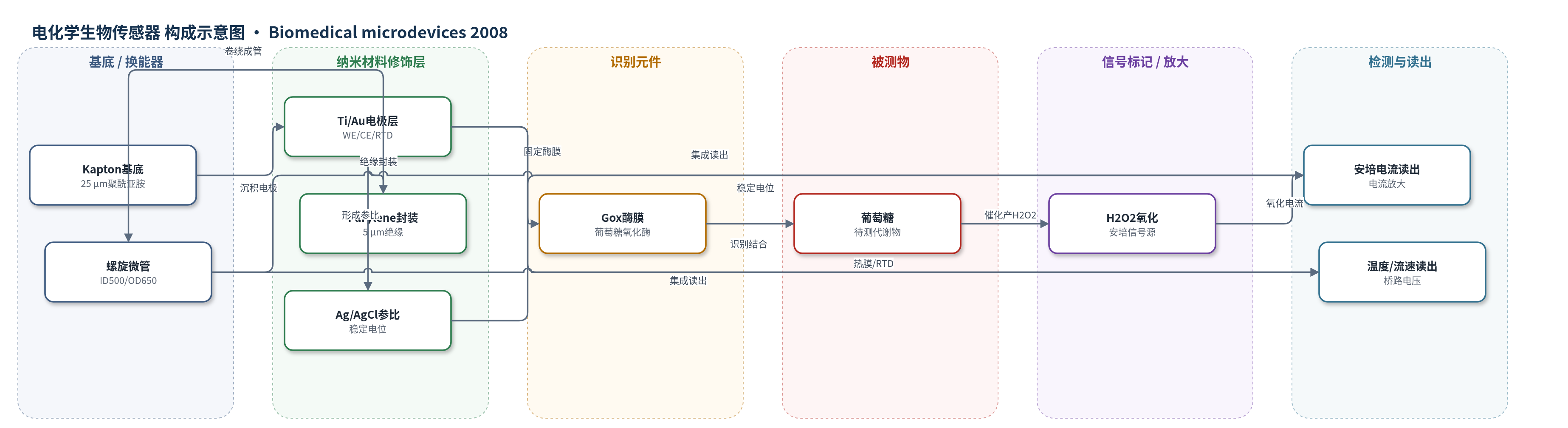
点击图片查看大图 · 依据论文自动绘制
传感器类型
电化学生物传感器
检测对象
葡萄糖(glucose)、温度(temperature)、流速(flow rate);样品基质:血液/导管内生理样品,实验校准用 PBS 及不同粘度糖水
检测原理
该装置采用多参数换能机制。葡萄糖检测中,葡萄糖氧化酶(Gox)识别并催化葡萄糖与氧气反应生成葡萄糖酸内酯和过氧化氢(H2O2);H2O2 在 Au 工作电极上发生氧化反应释放电子,形成安培电流,电流大小随葡萄糖浓度升高而增大。温度检测采用 Ti/Au 电阻温度检测器(RTD),其电阻随温度近似线性变化,TCR 为 0.003 K−1,在恒流激励下输出电压反映温度。流速检测采用热膜风速计,传感器膜被恒流加热并置于惠斯通电桥中,流体流过时对流散热改变桥路电流/电压,从而反映流速。整体无核酸或酶催化沉积放大,主要依靠酶催化产 H2O2 和电化学氧化实现信号转换。
检测灵敏度
葡萄糖线性范围: 20–150 mg/dl;相关系数: 0.992;流速灵敏度: 3.06 mV/(ml/min);温度 TCR: 0.003 K−1
效应效果
所制备传感器在平面与螺旋卷绕构型下均保持良好性能。葡萄糖传感器响应 50 s 内稳定,55 s 读取峰电流;不同工作电极面积下在 20–150 mg/dl 线性响应,相关系数 0.992,可覆盖人体血糖 60–120 mg/dl。温度传感器低滞后、高线性,TCR 0.003 K−1,可补偿葡萄糖温度漂移。流速传感器在 1、3、7、93 cP 糖水中输出差异小于 1.07%,灵敏度 3.06 mV/(ml/min),功耗低于 5 mW。柔性管最大弯曲角约 58°(直径 700 μm),编织结构抗弯折;气体泄漏测试至 110 kPa 无泄漏,液体 1 μl/min 至 10 ml/min 无渗漏。作者认为该平台适合低成本量产,可用于智能微导管多参数监测。
传感器的构成
- 基底/柔性载体:25 μm Kapton 聚酰亚胺薄膜,提供柔性、低热导、生物相容并承载电极与传感器。
- 电极层:Ti(100 Å)/Au(1000 Å) 薄膜光刻图形化,形成葡萄糖传感器工作电极(WE, Au)、对电极(CE, Au)及温度/流速 RTD 金属膜。
- 参比电极层:选择性电镀 Ag 并在 1 M KCl 中反向电镀氯化,形成 Ag/AgCl 参比电极(RE)。
- 识别/催化层:葡萄糖氧化酶(Gox)固定于聚丙烯酰胺(polyacrylamide)酶膜,催化葡萄糖氧化生成 H2O2。
- 选择性/保护半透膜:2% (w/v) 环氧-聚氨酯 THF 溶液(约30%环氧胶+固化剂、70%聚氨酯)丝网印刷,作为葡萄糖可透层并增强酶膜附着与抗弯剥离。
- 绝缘封装层:5 μm Parylene 涂层,提供电绝缘与生物相容。
- 螺旋卷绕管体:内层 Kapton 涂医用硅胶粘合剂 MED ADH 4100 RTV,外层带传感器 Kapton 反向卷绕,形成 ID=500 μm/OD=650 μm 编织柔性微管。
- 读出电路:恒流/恒温桥路与电流放大电路,用于 RTD 温度、热膜流速和安培葡萄糖电流读出。
中文摘要
本文设计、制备并表征了一种用于智能微导管的柔性聚合物管实验室芯片。该芯片将物理与生化传感器模块集成于柔性螺旋结构上,可在导管应用中同时测量生理参数(温度、流速)和代谢参数(葡萄糖浓度)。该方法利用标准微加工工艺在柔性聚合物管内外组装多个传感器,避免了传统导管传感器布线、封装和装配困难,同时保留导管腔道用于原位给药或器械插入。作为概念验证,温度传感器(RTD)、流速传感器(热膜风速计)和葡萄糖生物传感器(安培法)被成功制备并完全集成于螺旋卷绕聚合物管外,管内径 500 μm、外径 650 μm。所制备传感器在平面和螺旋卷绕构型下均表现出良好性能。该柔性微管实验室芯片为开发患者特异性智能微导管提供了通用平台,可进一步集成微传感器、微执行器、微流控器件和无线信号通信模块。
英文摘要
A flexible polymer tube lab-chip integrated with physical and biochemical sensor modules mounted on a flexible spiral structure for measuring physiological (temperature/flow rate) and metabolic data (glucose concentration) in a catheter application was designed, fabricated and characterized in this work. This new approach not only provides a unique way to assemble multiple sensors on both the inside and outside the flexible polymer tube using standard microfabrication methods while avoiding wiring and assembling problems associated with previous methods, but also maintains catheter inherent lumen potency for in situ drug delivery or insertion of medical tools. Three well-known sensors: temperature sensor (RTD), flow rate sensor (hot film anemometry) and glucose biosensor (amperometric sensor) have been successfully fabricated and fully integrated outside the spirally rolled polymer tube (ID = 500 microm, OD = 650 microm) of this demonstration device. The fabricated sensors showed good performances not only in a planar configuration but also in a spirally rolled configuration. This flexible micro tube lab-chip system provides a generic platform for developing patient-specific "smart" microcatheters that incorporate microsensors, microactuators, microfluidic devices and wireless signal communication modules that are tailored for the patients' unique condition.