组成图示
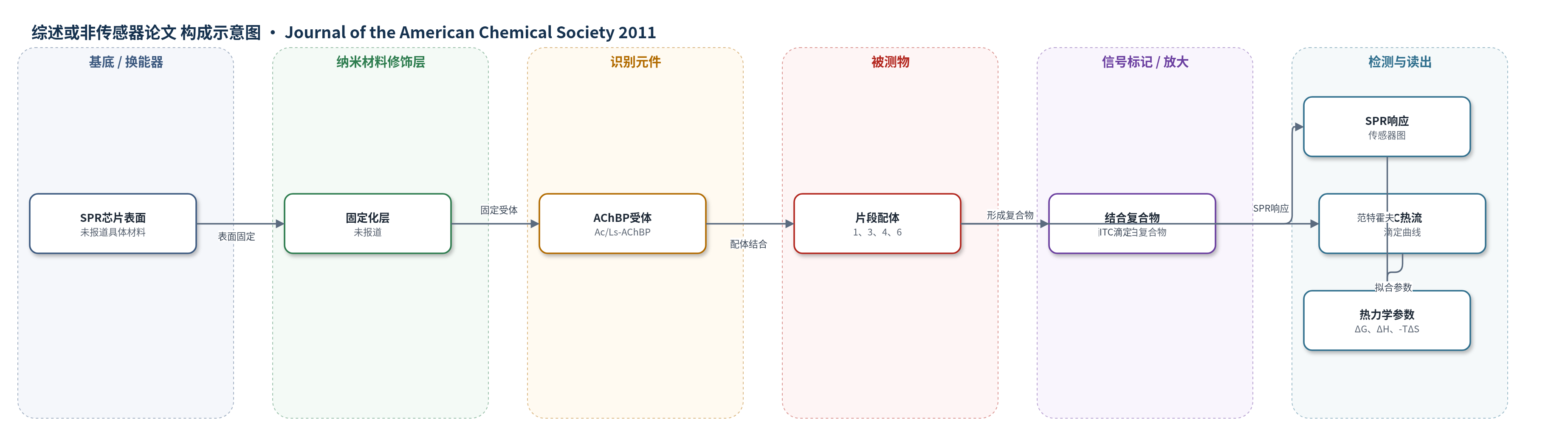
点击图片查看大图 · 依据论文自动绘制
传感器类型
综述或非传感器论文
检测对象
片段配体(fragment ligands:1、3、4、6、lobeline、nicotine、acetylcholine);样品基质:重组 AChBP 蛋白结合实验缓冲液(未明确具体成分)
检测原理
本研究并非传感检测,而是利用 SPR 与 ITC 研究配体结合。AChBP 固定于 SPR 芯片表面,片段配体流过时与受体结合,界面质量/折射率变化产生 SPR 响应,响应随配体浓度增加而增大;在 15–35 ℃多温度 SPR 结合 van't Hoff 分析可拆分 ΔH 与 ΔS。ITC 直接测量滴定热流,得到 ΔH、ΔG 和 ΔS。片段生长进入 lobeline 亚口袋会诱导 Tyr91 由 g 到 t 翻转,改变结合模式,使结合焓显著有利,从而在热力学特征上区别于不进入该亚口袋的配体。无信号放大策略。
检测灵敏度
未报道 LOD、线性范围、灵敏度斜率、相关系数(非传感方法)。
效应效果
片段 1 的 LE 为 0.43 kcal·mol⁻¹/重原子;片段生长得到 3 后 pKi 为 7.0±0.1,亲和力提高约 50 倍;去羟基衍生物 4 的 pKi 为 7.5±0,较片段 1 提高约 150 倍。季铵化 6 使 Ac-AChBP 亲和力降低 10 倍、Ls-AChBP 提高 6 倍,选择性由 8 倍 Aplysia 偏好反转为 8 倍 Lymnaea 偏好。S165Y 突变使 lobeline 和 3 的亲和力分别降低 >400 倍和 25 倍,Y53W 使 3 降低 5 倍。SPR 与 ITC 热力学结果一致,4 相对 1 在 Ac-AChBP 中 ΔΔH 为 -12.9 kcal·mol⁻¹(SPR)和 -11.5 kcal·mol⁻¹(ITC),在 Ls-AChBP 中为 -3.6 和 +1.4 kcal·mol⁻¹。
传感器的构成
- 基底/换能器:未报道(SPR 生物传感器分析仅作为结合检测工具)
- 修饰层:未报道(未说明芯片表面或固定化材料)
- 识别元件:AChBP(作为结合受体,非传感识别元件)
- 信号标记物:未报道(无标记物,直接监测结合)
- 封闭剂:未报道
- 电子供体:未报道
中文摘要
片段命中化合物向高亲和力先导化合物的优化是片段药物发现(FBDD)的关键环节。本研究通过片段生长策略,将苯甲酸酯取代去托品片段优化至乙酰胆碱结合蛋白(AChBP)结合位点中由配体诱导形成的亚口袋。AChBP 是半胱氨酸环受体配体结合域的可溶性同源蛋白。作者利用配体复合物 X 射线晶体结构、表面等离子共振(SPR)生物传感器分析和等温滴定量热(ITC)系统监测片段优化过程。结合定点突变和不同物种 AChBP 的比较,发现结合热力学特征的特异性变化可指示配体与 AChBP 中配体诱导亚口袋的相互作用。结果表明,热力学分析能够为配体结合模式提供重要信息,并与亲和力数据互补,有助于指导基于结构和片段的理性药物发现。
英文摘要
Optimization of fragment hits toward high-affinity lead compounds is a crucial aspect of fragment-based drug discovery (FBDD). In the current study, we have successfully optimized a fragment by growing into a ligand-inducible subpocket of the binding site of acetylcholine-binding protein (AChBP). This protein is a soluble homologue of the ligand binding domain (LBD) of Cys-loop receptors. The fragment optimization was monitored with X-ray structures of ligand complexes and systematic thermodynamic analyses using surface plasmon resonance (SPR) biosensor analysis and isothermal titration calorimetry (ITC). Using site-directed mutagenesis and AChBP from different species, we find that specific changes in thermodynamic binding profiles, are indicative of interactions with the ligand-inducible subpocket of AChBP. This study illustrates that thermodynamic analysis provides valuable information on ligand binding modes and is complementary to affinity data when guiding rational structure- and fragment-based discovery approaches.