组成图示
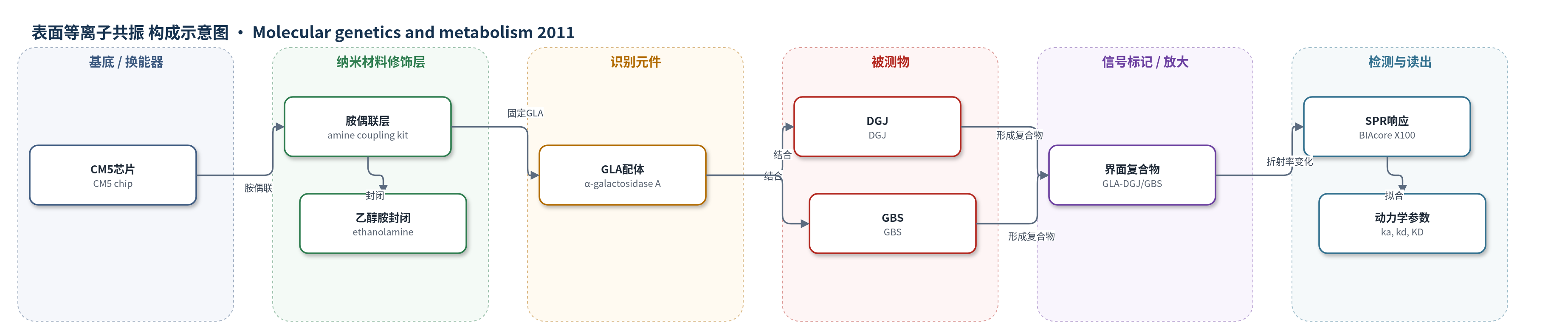
点击图片查看大图 · 依据论文自动绘制
传感器类型
表面等离子共振(SPR)生物传感器
检测对象
亚氨基糖 1-脱氧半乳糖诺吉里霉素(DGJ)、半乳糖平定素亚硫酸氢盐(GBS);样品基质为 50 mM 醋酸钠缓冲液(pH 5.0,含 150 mM NaCl)或 50 mM 磷酸钠缓冲液(pH 7.0,含 150 mM NaCl)
检测原理
GLA 通过胺偶联固定在 CM5 芯片表面,未反应基团用乙醇胺封闭。DGJ 或 GBS 在流动相中流过芯片,与 GLA 活性位点结合,形成 GLA-亚氨基糖复合物,使界面质量与折射率发生变化,SPR 响应随之改变。结合相响应随分析物浓度升高而增大,达到结合平衡;停止流动后复合物解离,响应下降。系统记录结合/解离曲线并拟合 ka、kd 和 KD。该过程无额外信号放大,直接依赖 SPR 对界面结合事件的实时检测;pH 5.0 与 7.0 的比较用于判断酸性条件下结合是否保留。
检测灵敏度
原文未报告 LOD、线性范围、灵敏度斜率、相关系数。
效应效果
SPR 显示 DGJ 对野生型和 M51I GLA 的结合强于 GBS:pH 7.0 时 DGJ KD 为 3.7×10^-9 M(野生型)和 3.1×10^-9 M(M51I),GBS 为 1.9×10^-7 M 和 1.2×10^-7 M;pH 5.0 时 DGJ KD 为 6.0×10^-9 M 和 6.9×10^-9 M,GBS 为 3.5×10^-8 M 和 3.8×10^-8 M。DGJ 与 GBS 的 kd 在 pH 5.0 和 7.0 接近,提示酸性下仍结合。M51I 突变酶在中和酸性 pH 下不稳定,DGJ(100 nM)和 GBS(1.0 μM)改善稳定性。COS-7 中 20 μM 增加酶活和蛋白量,100 μM 降低酶活但蛋白量不变。酵母产量约 1.5 mg/L(野生型)和 0.6 mg/L(M51I),纯化约 200 倍、回收率 40%。作者认为有助于改进法布里病药理学伴侣治疗,但需酸性 pH 下更快解离。
传感器的构成
- 基底/换能器:CM5芯片,提供SPR换能表面
- 固定层:amine coupling kit,将GLA共价固定
- 识别元件:α-galactosidase A(GLA),作为配体结合亚氨基糖
- 封闭剂:ethanolamine,封闭未反应表面
- 流动相:50 mM sodium acetate pH 5.0含150 mM NaCl或50 mM sodium phosphate pH 7.0含150 mM NaCl
- 分析物:DGJ、GBS,与GLA结合产生SPR响应
- 读出:BIAcore X100,检测SPR响应并拟合ka、kd、KD
中文摘要
包括亚氨基糖在内的小分子有望作为突变 α-半乳糖苷酶 A(GLA)的药理学伴侣,用于法布里病治疗,但其分子机制尚不清楚。本研究关注此前报道对亚氨基糖反应强烈的 M51I 突变 GLA。结构预测显示该氨基酸替换引起的结构变化很小且位于分子表面。作者在酵母中表达该突变酶并测定其酶学特性,发现其参数与野生型 GLA 基本相同,但突变酶在中性和酸性 pH 下均不稳定。随后直接考察 1-脱氧半乳糖诺吉里霉素(DGJ)和半乳糖平定素亚硫酸氢盐(GBS)对纯化突变酶的影响,结果显示两种亚氨基糖在中性和酸性 pH 下均能改善突变酶稳定性。表面等离子共振(SPR)生物传感器检测表明,亚氨基糖在中性和酸性 pH 下仍保持与突变酶的结合活性。这些信息将有助于改进法布里病的药理学伴侣治疗。
英文摘要
Small molecules including imino sugars are expected to act as chaperones for a mutant α-galactosidase A (GLA), which will be useful for pharmacological chaperone therapy for Fabry disease. However, there is little detailed information about the molecular mechanism. We paid attention to an M51I mutant GLA which had been reported to strongly react to an imino sugar. The predicted structural change caused by this amino acid substitution is very small and located on the surface of the molecule. We produced the mutant enzyme in yeast, and determined its enzymological characteristics. The enzymological parameter values are almost the same as those of the wild-type GLA, although the mutant enzyme is unstable not only under neutral pH conditions but also under acidic ones. Then, we directly examined the effect of imino sugars including 1-deoxygalactonojirimycin and galactostatin bisulfite on the purified mutant enzyme. The imino sugars apparently improved the stability of the mutant enzyme under both neutral and acidic pH conditions. The results of surface plasmon resonance biosensor assaying suggested that the imino sugars retained their binding activity as to the mutant enzyme under both neutral and acidic pH conditions. This information will facilitate improvement of pharmacological chaperone therapy for Fabry disease.