组成图示
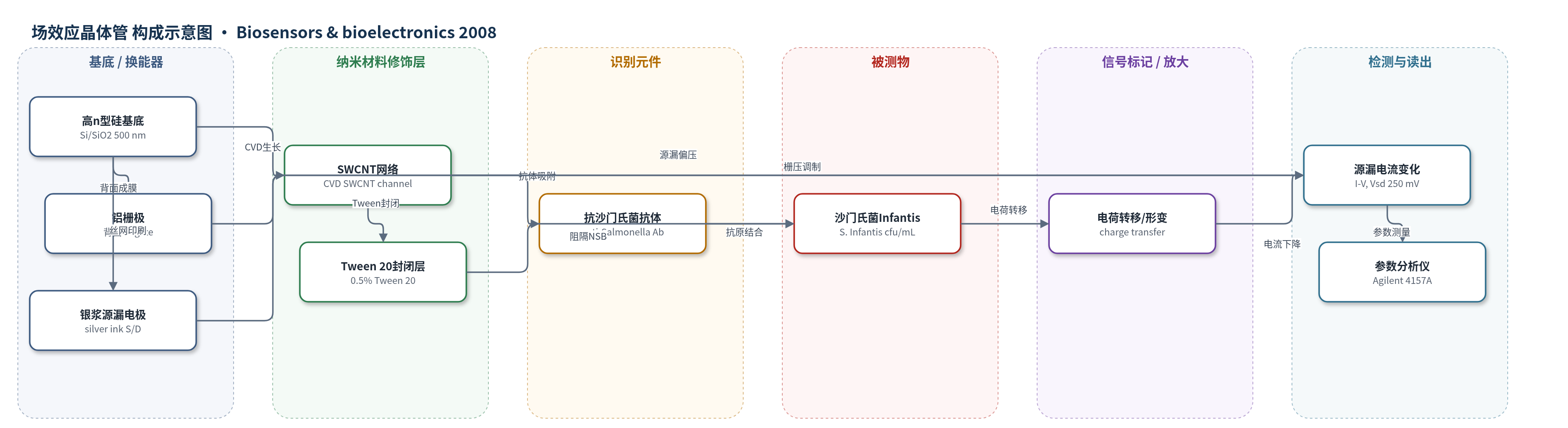
点击图片查看大图 · 依据论文自动绘制
传感器类型
场效应晶体管(FET)生物传感器
检测对象
沙门氏菌 Infantis(Salmonella Infantis, S. Infantis);样品基质:无菌 0.85% NaCl 溶液(生理盐水),潜在食品/水样
检测原理
该传感器以 CVD 生长的 SWCNT 网络作为 FET 沟道,抗沙门氏菌抗体吸附在 SWCNT 侧壁,Tween 20 封闭剩余表面。S. Infantis 的体细胞 O 抗原和鞭毛 H 抗原与抗体特异性结合后,细菌蛋白中的氨基等基团向 SWCNT 发生电荷转移,或细菌吸附引起 SWCNT 形变/界面电容变化,使 p 型 SWCNT 沟道载流子浓度和阈值电压改变。在固定源漏偏压 Vsd = 250 mV 下,背栅电压扫描得到的源漏电流随结合细菌数量增加而下降;在 Vg = −10 V 处,100、300、500 cfu/mL 分别引起约 45% 至 80% 的电流下降。该过程无需荧光、酶或放射性标记,也不依赖酶催化放大,信号直接来自生物识别事件引起的电学响应。
检测灵敏度
LOD: 100 cfu/mL(原文:able to detect at least 100 cfu/mL in 1 h)
效应效果
该传感器在 1 h 内可检测至少 100 cfu/mL 的 S. Infantis,明显快于传统培养(3–7 d)和 PCR/ELISA(8–48 h)。选择性方面,500 cfu/mL 的 S. pyogenes 和 S. sonnei 均不干扰,暴露后电流仅出现仪器变异范围内的轻微变化,而 S. Infantis 使电流下降 50–60%。无抗体对照中 Tween 20 修饰器件仅结合 1–2 个细菌,证明 Tween 20 有效抑制非特异结合。SEM 计数显示 100、300、500 cfu/mL 分别附着 25、36、63 个细菌,与浓度呈正相关。响应至少稳定 24 h,无漂移,重复测量变异低于 10%。作者认为该无标记 CNT-FET 平台可用于食品和水样中沙门氏菌及其他病原的快速检测。
传感器的构成
- 基底/换能器电极:高 n 型掺杂硅芯片(highly n-type doped silicon chips)与热生长 500 nm SiO2 层,背面铝层作栅极(Al gate),银浆(silver ink)丝网印刷源漏电极(S/D,间距 0.5 mm)
- 导电沟道:化学气相沉积(CVD)生长的单壁碳纳米管(SWCNTs)网络,平均高度约 1.5 nm,作为 FET 沟道
- 识别元件:抗沙门氏菌兔多克隆抗体(anti-Salmonella antibodies,针对 O 和 H 抗原,10 ppm PBS)吸附于 SWCNT 侧壁
- 封闭/抗非特异层:0.5% Tween 20(PBS 中)覆盖 SWCNT 未被抗体保护区域,防止其他细菌或蛋白非特异结合
- 被测物样品:Salmonella Infantis(S. Infantis)菌悬液,无菌 0.85% NaCl 中,100/300/500 cfu/mL
- 信号读出:Agilent 4157A 半导体参数分析仪测量源漏电流 I 随背栅电压 Vg 变化,Vsd = 250 mV
中文摘要
本文报道了一种基于单壁碳纳米管(SWCNT)场效应晶体管(FET)的快速、灵敏、无标记生物传感器,用于选择性检测沙门氏菌 Infantis(Salmonella Infantis, S. Infantis)。该器件以化学气相沉积(CVD)生长的 SWCNT 网络作为导电沟道,将抗沙门氏菌兔多克隆抗体吸附于 SWCNT 侧壁作为识别元件,并用 Tween 20 封闭未被抗体覆盖区域,以抑制其他细菌或蛋白的非特异性结合。当 S. Infantis 与抗体特异性结合后,细菌表面抗原引起的电荷转移或界面变化改变 SWCNT 沟道电学特性,使源漏电流下降。实验表明,该传感器在 1 h 内可检测至少 100 cfu/mL 的 S. Infantis;在 500 cfu/mL 条件下,链球菌和志贺氏菌均不干扰检测。该无标记平台有望用于食品和水样中病原菌的快速筛查。
英文摘要
In this paper we report a fast, sensitive and label-free biosensor for the selective determination of Salmonella Infantis. It is based on a field effect transistor (FET) in which a network of single-walled carbon nantotubes (SWCNTs) acts as the conductor channel. Anti-Salmonella antibodies were adsorbed onto the SWCNTs and subsequently the SWCNTs were protected with Tween 20 to prevent the non-specific binding of other bacteria or proteins. Our FET devices were exposed to increasing concentrations of S. Infantis and were able to detect at least 100 cfu/mL in 1h. To evaluate the selectivity of our FET devices, Streptococcus pyogenes and Shigella sonnei were tested as potential competing bacteria for Salmonella. At a concentration of 500 cfu/mL, neither Streptococcus nor Shigella interfered with the detection of Salmonella. Therefore, these devices could be used as useful label-free platforms to detect S. Infantis and, by using the suitable antibody, other bacteria or viruses.