组成图示
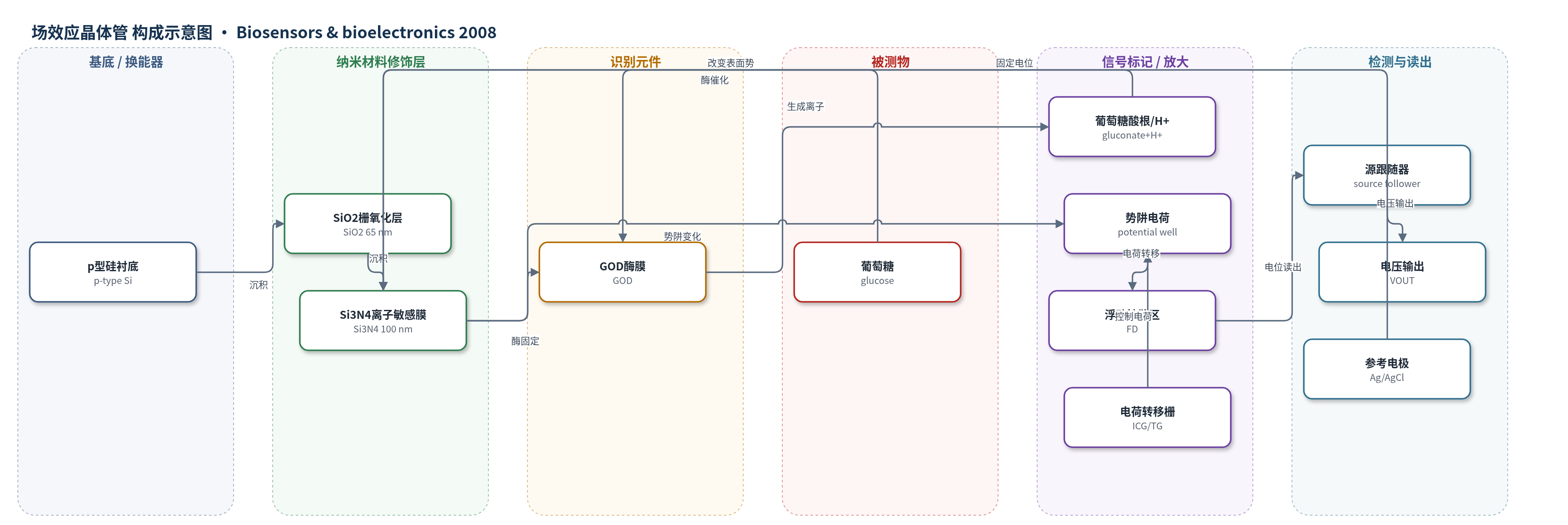
点击图片查看大图 · 依据论文自动绘制
传感器类型
场效应晶体管(FET)生物传感器
检测对象
葡萄糖(glucose);样品基质:磷酸盐缓冲液(PBS)葡萄糖标准溶液、血液/血样
检测原理
葡萄糖氧化酶 GOD 催化葡萄糖氧化生成葡萄糖酸内酯和 H2O2,葡萄糖酸内酯水解产生葡萄糖酸根和 H+。这些离子在 Si3N4 离子敏感膜表面改变表面电荷与界面势,使 p 型硅衬底下的势阱深度随葡萄糖浓度变化。输入二极管 ID 和输入控制栅 ICG 将对应电荷注入势阱,转移栅 TG 将电荷转移到浮动扩散区 FD;重复 5 次信号积分周期,使信号电荷在 FD 中积累,信噪比按 sqrt(n) 提高。FD 电位经源跟随器读出为 VOUT。葡萄糖浓度越高,产生的葡萄糖酸根/H+越多,势阱电荷变化越大,输出电压变化越大;电荷转移放大系数 A=C_SENS/C_FD×ASF,无需外部放大器。
检测灵敏度
CTTGS:检出限:约 0.01 mM/L;上限:约 200 mM/L;范围:缓冲液至 200 mM/L;线性范围:缓冲液至 25 mM/L;灵敏度:7.22 mV/mM;人体葡萄糖水平灵敏度:29.06 mV/mM;线性方程:y = 0.0294x + 1.8612(表1亦为 y = 0.029x + 1.8643);R^2 = 0.9999。ISFET:检出限:约 0.01 mM/L;上限:约 100 mM/L;范围:缓冲液至 100 mM/L;线性范围:缓冲液至 25 mM/L;灵敏度:1 mV/mM;临床范围灵敏度:2.28 mV/mM;线性方程:y = -0.0023x + 0.9898;R^2 = 0.9896。
效应效果
CTTGS 在缓冲液至 200 mM/L 范围内稳定测量,跨度 1445 mV,响应时间 20 s,灵敏度 7.22 mV/mM,约为 ISFET 1 mV/mM 的 7 倍;人体葡萄糖水平附近灵敏度达 29.06 mV/mM,非线性误差约 ±0.27%(表列总非线性误差 0.275699%)。重复性测试 60 次,缓冲液至 25 mM/L 线性方程 y=0.0294x+1.8612,R^2=0.9999,各浓度变异系数为 0.488456%、0.271979%、0.10466%、0.201402%、0.312%。作者称其高灵敏度、高信噪比、高准确度,满足 ISO15197 临床应用要求,并用于真实血液样品葡萄糖检测,性能优于安培法葡萄糖传感器。
传感器的构成
- 基底/换能器:p型硅衬底(p-type Si substrate),形成势阱并承载 CMOS 电荷转移结构
- 栅氧化层:SiO2(65 nm),隔离硅衬底与离子敏感膜,构成 MIS 结构
- 离子敏感膜:Si3N4(100 nm,LP-CVD),感知葡萄糖酸根/H+离子并改变表面势
- 识别元件:葡萄糖氧化酶 GOD(Aspergillus niger,吸附法固定),催化葡萄糖氧化生成葡萄糖酸内酯和 H2O2
- 电荷转移元件:输入二极管 ID、输入控制栅 ICG、转移栅 TG、浮动扩散区 FD 和复位开关,实现电荷积累与转移
- 读出电路:源跟随器电路(source follower)和 VOUT 节点,将浮动扩散区电位转换为电压输出
- 参考电极:Ag/AgCl,固定溶液电位,保证测量稳定
中文摘要
本文提出并实验演示了一种基于电荷转移技术葡萄糖传感器(CTTGS)的增强型葡萄糖生物传感器。CTTGS 采用积累法葡萄糖酸根/H+离子感知系统,其输出信号质量随信号积分周期提高,可通过积累周期在无外部放大器条件下放大传感信号。由于离子敏感场效应晶体管(ISFET)理论最大灵敏度仅为 59 mV/pH,且小输出信号易被金属-绝缘体-半导体场效应晶体管(MISFET)的 1/f 噪声淹没,微小离子波动难以测量。CTTGS 具有高灵敏度、高准确度和高信噪比,并成功通过电荷转移技术实现。实验表明,CTTGS 对葡萄糖具有大跨度 1445 mV 和良好重现性,灵敏度为 7.22 mV/mM,低检测限约 0.01 mM/L,高检测限约 200 mM/L,优于近期研究的安培法葡萄糖分析。在最优条件下,CTTGS 性能超过广泛使用的 ISFET 葡萄糖传感器,其灵敏度为 ISFET 1 mV/mM 的 7 倍。人体葡萄糖水平下灵敏度为 29.06 mV/mM,非线性误差 ±0.27%,线性方程 y=0.0294x+1.8612,R^2=0.9999,可满足临床应用要求。作者还利用所开发的 CTTGS-ISFET 系统进行了真实血液样品葡萄糖水平分析。
英文摘要
An enhanced glucose biosensor based on a charge transfer technique glucose sensor (CTTGS) is described and demonstrated experimentally. In the proposed CTTGS, which is accumulation method (d-gluconate+H(+)) ion perception system, the quality of output signal with "signal integration cycles" is high. With the proposed CTTGS it is possible to amplify the sensing signals without an external amplifier by using an accumulation cycle. It can be supposed that measurements of small (d-gluconate+H(+)) ion fluctuation are difficult by ion-sensitive field effect transistor (ISFET) because the theoretical maximum sensitivity is only 59 mV/pH and the small output signals are buried in the 1/f noise component of the metal-insulator-semi-conductor field-effect transistor (MISFET). Therefore, the CTTGS has many advantages, such as high sensitivity, high accuracy, high signal-to-noise ratio (SNR), and has been successfully demonstrated using a charge transfer technique. The CTTGS exhibited excellent performance for glucose with a large span (1445 mV) and good reproducibility. Moreover, the CTTGS has good sensitivity in this range of 7.22mV/mM, a lower detection limit of about 0.01 mM/L and an upper detection limit of about 200 mM/L compared with amperometric glucose analysis which has been studied recently. Under optimum conditions, the proposed CTTGS exceeds the performance of the widely used ISFET glucose sensor. The sensitivity of the CTTGS (7.22 mV/mM) was seven times higher than that of the ISFET (1 mV/mM). Furthermore, the sensitivity obtained for human glucose levels was 29.06 mV/mM with a non-linear error of +/-0.27%; the linearity is y=0.0294x+1.8612 and R(2)=0.9999, which is acceptable for clinical application. Real sample analysis is investigated in blood glucose level by our developed CTTGS ISFET system.