组成图示
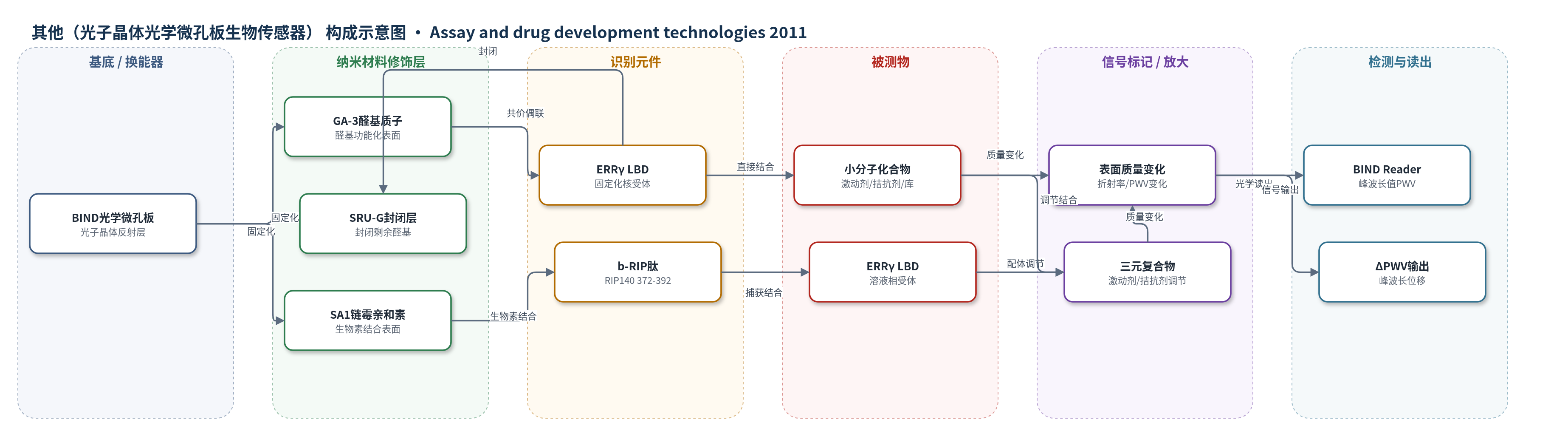
点击图片查看大图 · 依据论文自动绘制
传感器类型
其他(光子晶体光学微孔板生物传感器)
检测对象
小分子化合物(small-molecule compounds,含 GSK9089、4-羟他莫昔芬及 1408 化合物库)、RIP140 肽(RIP140 peptide);样品基质为 DMSO 化合物库溶液/缓冲液(Assay Buffer,1% DMSO)
检测原理
该传感器采用无标记光学换能:ERRγ LBD 或 b-RIP 固定于光子晶体微孔板表面,结合事件改变表面生物质与局部折射率,使反射峰波长值 PWV 发生位移 ΔPWV。直接结合格式中,小分子与固定化 ERRγ LBD 结合后,ΔPWV 随浓度呈 1:1 饱和结合并叠加线性非特异响应;反向格式中,b-RIP 捕获 ERRγ LBD 产生较大 ΔPWV,激动剂促进受体–肽–配体三元复合物使信号增加,拮抗剂竞争或阻止 RIP 结合使信号下降。通过时间曲线和剂量响应可计算 Kd、化学计量与动力学,无需标记或放大。
检测灵敏度
原文未报告 LOD、线性范围与灵敏度斜率;报告:DPWV of 10 pm represents a signal fivefold greater than noise.
效应效果
固定化均一性良好:板内 CV 2.3%–3.0%,板间 CV 0.7%;各板 Z′ 为 0.55–0.72,重复孔 R² 为 0.893、0.957、0.929、0.973。24 h 内低/高对照稳定,初始与 24 h 响应相关系数 0.87。1408 化合物主筛命中 9 个,命中率 0.6%;样品选择性比 0.7±0.06,命中阈值 >0.9。拮抗剂使 RIP 依赖信号降低 80%,RIP 依赖组分 100% 消除;激动剂 EC50 0.34 mM,拮抗剂 EC50 0.48 mM。相比流动 SPR,微孔板并行、无需反复再生,非特异结合物不影响其他孔,适用于孤儿受体直接结合筛选。
传感器的构成
- 基底/换能器:SRU BIND 光学微孔板(GA-3/SA1,96/384孔,光子晶体反射层),提供无标记光学检测与固定化表面
- 固定化化学层:GA-3 高密度三维醛基功能化基质,通过醛基与蛋白赖氨酸氨基共价偶联 ERRγ LBD
- 识别元件:人 ERRγ 配体结合域(ERRγ LBD,26.4 kDa),识别小分子配体并介导结合信号
- 封闭剂:SRU-G 亲水性小分子封闭剂,封闭剩余醛基并降低非特异结合
- 固定化化学层:SA1 链霉亲和素预修饰表面,通过生物素–链霉亲和素作用捕获 b-RIP
- 识别/捕获元件:生物素化 RIP140 肽(b-RIP,RIP140 372–392),捕获 ERRγ LBD 并作为共抑制因子相互作用探针
- 分析物/信号来源:小分子化合物(GSK9089 激动剂、4-羟他莫昔芬拮抗剂、化合物库)或 RIP140 肽,结合引起表面质量/折射率变化
- 读出:BIND Reader 光学微孔板读数仪,测量峰波长值 PWV 及其变化 ΔPWV
中文摘要
光学微孔板生物传感器将无标记检测与工业标准实验基础设施及可扩展性相结合。基于微孔板的无标记平台既可用于量化大分子相互作用,也可用于筛选和表征药物样小分子相互作用。本文以孤儿雌激素相关核受体γ(ERRγ)配体结合域(LBD)为模型,展示该类生物传感器上多种生化检测格式的快速开发与实用性。分别将 ERRγ LBD 或其对应共抑制因子 RIP140 衍生肽固定化于传感器表面。利用固定化 LBD 表征小分子药物的直接结合;随后加入肽可区分化合物是拮抗肽结合,还是促进三元复合物的激动剂。固定化肽格式对化合物影响 LBD–肽相互作用更敏感。采用直接结合格式,对 1408 个 DMSO 化合物库进行筛选,命中化合物再用其他格式表征。直接结合格式以可接受的命中率、质量参数和通量满足完整主筛要求,使孤儿受体等靶标无需已知配体即可直接筛选。
英文摘要
Optical microplate-based biosensors combine the advantages of label-free detection with industry-standard assay laboratory infrastructure and scalability. A plate-based label-free platform allows the same basic platform to be used to quantify molecular interactions of macromolecules and to screen and characterize drug-like small-molecule interactions. The ligand-binding domain of orphan estrogen-related nuclear receptor-γ (ERRγ) is utilized, as a model system of a challenging type of target, to illustrate the rapid development and utility of a range of biochemical assay formats on these biosensors. Formats in which either the domain, or a peptide derived from its cognate corepressor, RIP140, were immobilized were utilized. The direct binding of small drug molecules to the domain was characterized using immobilized domain. Subsequent addition of peptide distinguished whether compounds acted as either antagonists of peptide binding, or as agonists promoting a ternary complex. The format with peptide immobilized gave a more sensitive procedure for establishing the effect of compounds on the domain-peptide interaction. Using a direct-binding format, a diverse chemical library of 1,408 compounds in DMSO was screened for ability to bind to biosensors coated with ERRγ ligand-binding domain. Hits were then characterized using the other biosensor assay formats. The standard requirements for a full primary screening campaign were fulfilled by the acceptable hit-rate, quality-performance parameters, and throughput of the direct-binding assay format. Such a format allows direct screening of targets, such as orphan receptors, without the requirement for prior knowledge of a validated ligand.