组成图示
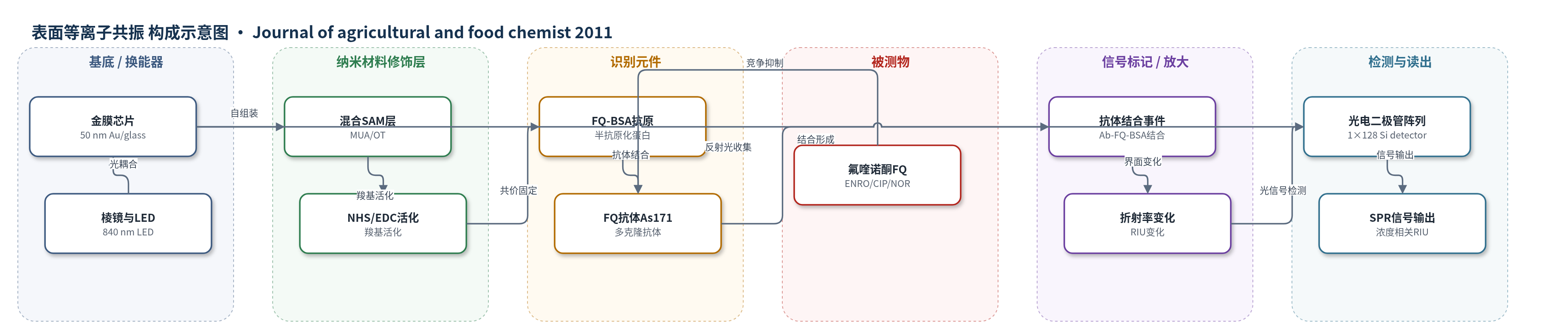
点击图片查看大图 · 依据论文自动绘制
传感器类型
表面等离子共振(SPR)生物传感器
检测对象
氟喹诺酮类抗生素(fluoroquinolones, FQs;恩诺沙星 enrofloxacin, ENRO、环丙沙星 ciprofloxacin, CIP、诺氟沙星 norfloxacin, NOR);样品基质:牛奶(bovine whole milk)
检测原理
该传感器采用无标记间接竞争式 SPR 免疫检测。金芯片表面经 MUA/OT 混合自组装单分子层(m-SAM)和 NHS/EDC 活化后,共价固定 FQ 半抗原化蛋白 FQ-BSA。FQ 特异性多克隆抗体 As171 与表面 FQ-BSA 结合,使界面质量与折射率增加,导致表面等离子体共振条件改变,反射光信号变化,表现为 SPR 信号(RIU)升高。样品中 FQ 与 FQ-BSA 竞争结合 As171,FQ 浓度越高,抗体被占据越多,能结合到芯片表面的抗体越少,SPR 响应呈剂量依赖性下降。信号由 840 nm LED 激发金膜表面等离子体,硅光电二极管阵列采集反射光并转换为折射率单位(RIU),无需酶或荧光标记放大。
检测灵敏度
LOD: 1.0 ± 0.4 μg L−1(缓冲液,恩诺沙星);LOD: 2.0 ± 0.2 μg L−1(牛奶,恩诺沙星);考虑稀释与回收率后 LOD: 10.7 μg L−1(10.7 μg kg−1);线性范围: 30–250 μg kg−1(牛奶);斜率: −1.0 ± 0.2(缓冲液与牛奶);R^2 = 0.981(缓冲液);R^2 = 0.986(牛奶)
效应效果
该传感器在牛奶中抗基质干扰良好,离心除脂并 1:5 稀释后非特异信号显著降低,FQ 回收率 93±10%。三通道、循环、日间和芯片间 CV 分别为 8%、6%、12%、14%;芯片约 80 个循环、10 个工作日后信号仍保持首次 80%。As171 响应显著高于非特异抗体和 BSA,在 β-内酰胺、头孢菌素、磺胺类存在下仍选择性检测 FQ。雀巢盲样无假阳性/假阴性,GF21、GF22、GF24 判为潜在不合格,GF20、GF23、GF25 合格。LOD 与 ELISA(0.5–12.5 μg/kg)和 HPLC(0.5–18 μg/L)相当,样品处理更简单,三样品 <30 min,适合现场筛查。
传感器的构成
- 基底/换能器:硼硅酸盐玻璃表面镀 50 nm 金层(Au),置于塑料棱镜上,用于耦合光并激发表面等离子体
- 微流控流池:聚丙烯三通道流池(1 mm × 1 cm,约 5 μL/通道),连接 Tygon 2765-175 微流控管,用于样品流动
- 混合自组装单分子层:巯基十一烷酸(MUA, 2.5 mM)与辛硫醇(OT, 7.5 mM)在金表面形成 m-SAM,提供羧基固定位点
- 活化/交联层:NHS/EDC(N-羟基琥珀酰亚胺 NHS 和 1-乙基-3-(3-二甲基氨基丙基)碳二亚胺盐酸盐 EDC,各 5 mg/mL)活化羧基
- 识别元件:FQ 半抗原化蛋白 FQ-BSA(10 μg/mL)共价固定,用于捕获 FQ 特异性多克隆抗体 As171
- 封闭剂:BSA(5 mg/mL)封闭剩余表面,降低非特异结合
- 竞争识别抗体:FQ 多克隆抗体 As171(缓冲液 1/1000、牛奶 1/250 稀释),与 FQ-BSA 结合产生 SPR 信号
- 读出/再生:840 nm LED 与硅光电二极管阵列检测反射光,0.3 M NaOH 再生芯片表面
中文摘要
本研究采用低成本便携式表面等离子共振(SPR)传感器 SPReeta Evaluation Kit SPR3,开发用于测定氟喹诺酮类抗生素(FQs)残留的免疫传感器,并在牛奶中验证性能。三通道金芯片经混合自组装单分子层(m-SAM)活化后共价固定 FQ 半抗原化蛋白。抗体结合引起折射率变化,使 SPR 信号随抗体浓度升高;样品中 FQ 竞争性抑制抗体结合,使响应随 FQ 剂量下降。缓冲液中恩诺沙星 LOD 为 1.0±0.4 μg/L。三通道、不同进样、不同日期及芯片间响应可重复。牛奶经离心除脂并用水稀释后可分析,恩诺沙星 IC50 为 26.4±7.2 μg/L,LOD 为 2.0±0.2 μg/L,远低于欧盟限量。该传感器还能在存在其他抗生素时选择性检测牛奶中 FQ,并在雀巢盲样中检出恩诺沙星、环丙沙星和诺氟沙星。
英文摘要
An inexpensive and portable surface plasmon resonance (SPR) sensor, SPReeta Evaluation Kit SPR3, has been used to develop a biosensor for the determination of fluoroquinolone antibiotics (FQs) and to demonstrate its performance analyzing FQ residues in milk samples. The SPReeta three-channel gold chips were activated with a mixed self-assembled monolayer (m-SAM) and functionalized with a FQ haptenized protein. Binding of the antibody produced a concentration-dependent increase of the SPR signal as a result of the change in the refraction index. Similarly, the presence of the FQ produced a dose-dependent decrease of the response, which allowed a good limit of detection (LOD) to be obtained (1.0 ± 0.4 μg L(-1) for enrofloxacin in buffer). The response was reproducible in all three channels, on different injections and days, and also between chips. Milk samples could be analyzed after a simple sample treatment involving fat removal by centrifugation and dilution with water. Under these conditions calibration curves were obtained showing that FQ residues can be analyzed in milk samples with an IC(50) value of 26.4 ± 7.2 μg L(-1) and a LOD of 2.0 ± 0.2 μg L(-1) (for enrofloxacin), far below the European Union regulations for this antibiotic family in this matrix. Finally, the paper also demonstrates that the biosensor is able to selectively detect the presence of FQs in milk samples, even in the presence of other antibiotics. Enrofloxacin, ciprofloxacin, and norfloxacin residues were detected in blind samples supplied by Nestlé Co.