组成图示
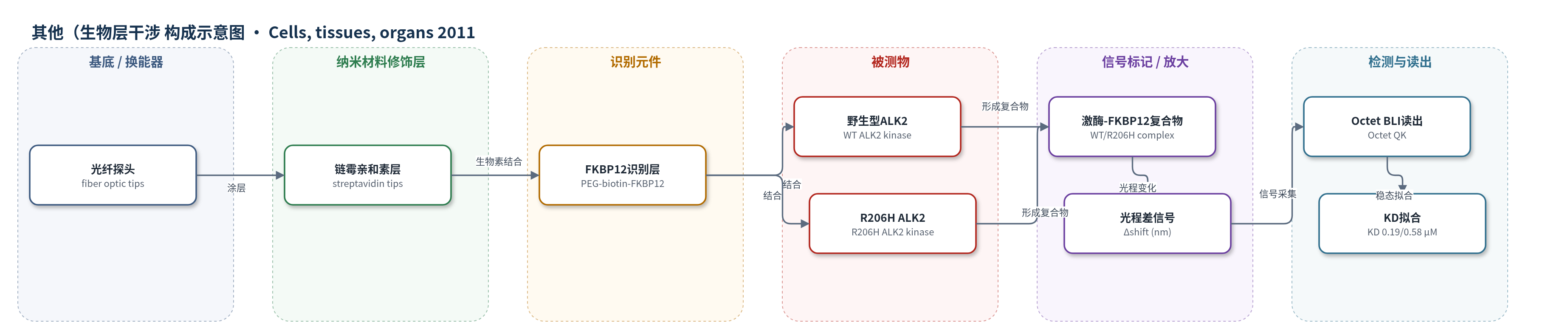
点击图片查看大图 · 依据论文自动绘制
传感器类型
其他(生物层干涉(BLI)光学生物传感器)
检测对象
野生型 ALK2 激酶(wild-type ALK2 kinase)、R206H 突变 ALK2/ACVR1 激酶(R206H ALK2 kinase);样品基质:纯化重组蛋白溶液(25 mM Na HEPES pH 8.0、50 mM arginine-glutamate、150 mM NaCl)
检测原理
BLI检测中,FKBP12经NHS-PEG4-biotin生物素化后固定于链霉亲和素涂层光纤表面,作为识别元件。将野生型或R206H ALK2激酶溶液接触表面,激酶与FKBP12结合后改变生物层界面折射率/光程,产生干涉光程差Δshift。结合相信号随激酶浓度升高并趋于饱和,解离相信号回落。通过稳态响应拟合得到平衡解离常数KD。R206H突变体需更高浓度产生可比信号,KD增大,表明亲和力下降。低于生理pH时非特异结合增强,信号不出现平台,限制pH依赖机制分析。
检测灵敏度
KD = 0.19 ± 0.024 μM (WT);KD = 0.58 ± 0.074 μM (R206H);浓度范围: 0.025–0.45 μM (WT), 0.25–1.75 μM (R206H);5–10倍更高浓度;约3倍亲和力下降
效应效果
三种独立方法一致表明R206H突变并未严重破坏FKBP12结合,而是使其亲和力下降数倍。BLI定量给出野生型KD为0.19±0.024 μM,突变体为0.58±0.074 μM,约3倍下降;突变体通常需要5–10倍更高浓度才能获得可比光程差。低于生理pH时非特异背景显著,尤其突变体,信号不饱和,无法检验pH开关假说。该结果与细胞共免疫沉淀约2倍亲和力下降一致,但不同于细胞报告基因实验显示突变受体不被FKBP12抑制。作者认为FKBP12可能作为BMP/TGF-β梯度读取器,其结合减弱可放大信号输出,解释FOP中BMP信号失调和异位骨化。
传感器的构成
- 换能器基底:FortéBio Octet QK 光纤探头(fiber optic tips),承载生物层干涉信号。
- 表面修饰层:链霉亲和素涂层(streptavidin-coated tips),用于捕获生物素化蛋白。
- 识别元件:NHS-PEG4-biotin 标记的 FKBP12(PEG-biotinylated FKBP12),固定于链霉亲和素表面,作为抑制蛋白/配体。
- 被测物:纯化重组野生型 ALK2 激酶(wild-type ALK2 kinase)和 R206H 突变 ALK2 激酶(R206H ALK2/ACVR1 kinase),以溶液形式接触表面。
- 结合缓冲液:25 mM Na HEPES(pH 8.0)、50 mM arginine-glutamate、150 mM NaCl,维持结合条件并降低非特异结合。
- 信号输出:生物层干涉光程差(Δshift, nm),由激酶-FKBP12 结合引起界面光程变化。
- 读出仪器:Octet QK 光学生物传感器(FortéBio),采集结合/解离曲线并拟合 KD。
中文摘要
经典进行性骨化异常(FOP)中,骨形态发生蛋白I型受体激酶ALK2/ACVR1调控亚域的单一复发突变R206H导致异位骨化。该突变仅将一个精氨酸替换为组氨酸,而组氨酸在生理pH范围内可发生质子化,因此提出pH敏感开关机制,导致突变受体在配体非依赖条件下激活BMP信号。为检验该机制中FKBP12介导的激酶自抑制是否丧失,作者用纯化的野生型和R206H ALK2激酶及FKBP12蛋白进行体外相互作用分析,方法包括native PAGE、HPLC SEC和Octet生物层干涉(BLI)光学生物传感器。结果显示,突变体对抑制蛋白FKBP12的结合仅降低约3倍,而非严重丧失;在低于生理pH时出现明显非特异相互作用,尤其影响突变体,使比较评估受限。结论认为,组氨酸替代导致突变I型受体抑制部分丧失,FKBP12可能作为形态发生梯度读取器参与FOP信号失调。
英文摘要
A single recurrent mutation in the regulatory subdomain of a bone morphogenetic protein type I receptor kinase has been linked to heterotopic ossification in classic fibrodysplasia ossificans progressiva (FOP). As a result of a substitution at 1 residue by only 1 other side chain (Arg206His) in just 1 of the 4 type I BMP receptors (ALK2/ACVR1), soft connective tissues progressively metamorphose through an endochondral process into cartilage that is replaced by bone. The substitution of arginine for histidine, also a basic residue yet with the singular property of ionization/protonation over the physiological pH range, led to the hypothesis of an aberrant, pH-sensitive switch mechanism for the ligand-independent activation of BMP signaling through the mutant receptor kinase in patients presenting with classic FOP. To test a potential aspect of the putative pH-dependent mechanism, i.e. loss of autoinhibition of the kinase mediated by the inhibitory protein FKBP12, in vitrointeraction analyses with purified wild-type and R206H ALK2 kinase and FKBP12 proteins were performed. Interactions between the kinases and inhibitory proteins were analyzed qualitatively and quantitatively by native gel electrophoresis and HPLC size exclusion chromatography and with an optical biosensor (Octet; ForteBio). Binding of inhibitory protein by the R206H mutant was diminished 3-fold relative to the wild type kinase at a physiological pH, yet below this value (<~7.5) pronounced nonspecific interactions, particularly with the mutant, prevented comparative evaluations. In conclusion, substitution with histidine leads to partial loss of inhibition of the mutant type I receptor through diminished binding of FKBP12, which may act as a gradient reader in morphogenetic contexts.