组成图示
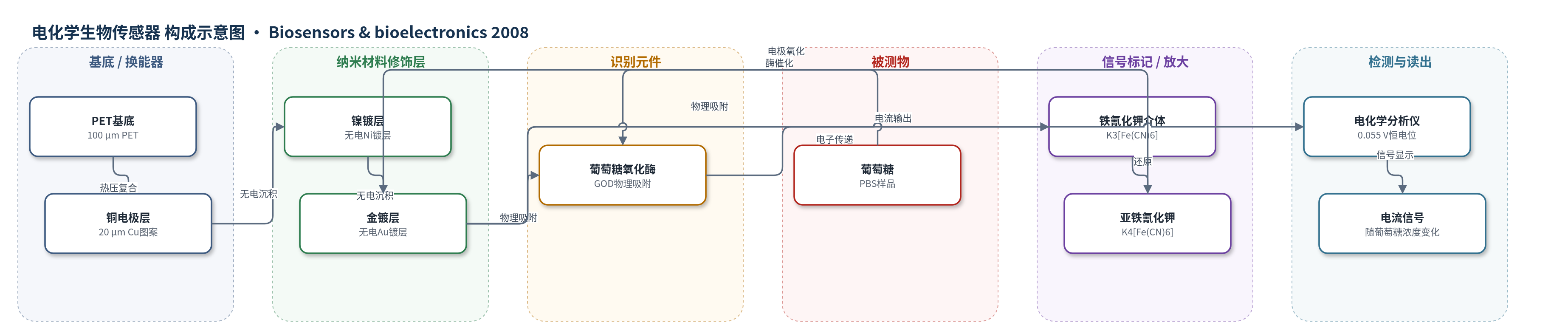
点击图片查看大图 · 依据论文自动绘制
传感器类型
电化学生物传感器
检测对象
葡萄糖(glucose);样品基质:0.1 M PBS 缓冲液(实验),目标为毛细血管血(0.25 µL)
检测原理
GOD 催化葡萄糖氧化为葡萄糖酸,同时铁氰化钾 K3[Fe(CN)6] 作为电子介体接受电子被还原为亚铁氰化钾 K4[Fe(CN)6];亚铁氰化钾在 Au/Ni/Cu 电极表面于 +0.055 V 被氧化回铁氰化钾并释放电子。低电阻金属电极使氧化还原峰位于低电位,减少抗坏血酸、尿酸、对乙酰氨基酚等易氧化物干扰。葡萄糖浓度越高,酶催化产生亚铁氰化钾速率越快,稳态电流越大,电流与葡萄糖浓度在 1.0–33.0 mM 呈线性。无额外化学放大,主要依靠酶催化与介体再生。
检测灵敏度
灵敏度: 0.85 µA mM−1;线性范围: 1.0–33.0 mM;R^2 = 0.9989;校准曲线: y = 9E−07x + 6E−06
效应效果
传感器在 0.055 V 低电位工作,可显著降低抗坏血酸、尿酸、对乙酰氨基酚等易氧化物干扰,但实际血样干扰实验留待后续。响应时间约 3 s,快于丝网印刷碳电极(电阻约 80–1 kΩ,需 0.2–0.7 V)。100 次重复测试相关系数 0.9989,总非线性误差 3.17%,低于 ISO 15197 临床血糖仪 ±7% 要求;不同浓度 CV 为 1.49%–5.54%。电极电阻约 0.01 Ω,可批量生产且均匀,最小样品量 0.25 µL,作者认为可作为无需编码补偿的一次性医疗血糖传感器。
传感器的构成
- 基底:100 µm PET(聚对苯二甲酸乙二醇酯)薄膜,提供绝缘支撑与电极载体
- 铜电极层:20 µm 铜膜(Cu),热压复合并经 UV 光刻/湿法刻蚀形成工作/参比电极图案,提供低电阻导电通路
- 镍镀层:无电沉积镍(Ni)镀层,改善金与铜结合并防止铜氧化
- 金镀层:无电沉积金(Au)镀层,电化学稳定并便于酶固定
- 识别元件:葡萄糖氧化酶(GOD),物理吸附于 5 mm² 传感区,催化葡萄糖氧化
- 电子介体:铁氰化钾(K3[Fe(CN)6])/亚铁氰化钾(K4[Fe(CN)6]),0.1 M 物理吸附,传递电子
中文摘要
本文报道了一种基于无电沉积 Au/Ni/铜低电阻电极的一次性葡萄糖生物传感器。以往对该类生物传感器电极的低电阻与均匀性研究不足。固定在电极上的葡萄糖氧化酶(GOD)有效发挥电子穿梭作用,使葡萄糖可在 0.055 V 下被检测,并显著降低对易氧化共存物的干扰。Au/Ni/铜电极电阻低于 0.01 Ω,有望以均匀电阻批量生产。低电阻使氧化还原峰出现在较低施加电位,从而在 0.055 V 工作电位下获得良好灵敏度并排除常见共存物干扰。该 GOD/Au/Ni/铜传感器响应时间约 3 s,灵敏度 0.85 µA mM−1,线性范围从缓冲液至 33 mM 葡萄糖。传感器重现性优异,相关系数 0.9989(n=100),总非线性误差 3.17%。
英文摘要
This paper presents a glucose biosensor, which was developed using a Au/Ni/copper electrode. Until now, research regarding the low electrical resistance and uniformity of this biosensor electrode has not been conducted. Glucose oxidase (GOD) immobilized on the electrode effectively plays the role of an electron shuttle, and allows glucose to be detected at 0.055 V with a dramatically reduced resistance to easily oxidizable constituents. The Au/Ni/copper electrode has a low electrical resistance, which is less than 0.01 Omega, and it may be possible to mass produce the biosensor electrode with a uniform electrical resistance. The low electrical resistance has the advantage in that the redox peak occurs at a low applied potential. Using a low operating potential (0.055 V), the GOD/Au/Ni/copper structure creates a good sensitivity to detect glucose, and efficiently excludes interferences from common coexisting substances. The GOD/Au/Ni/copper sensor exhibits a relatively short response time (about 3s), and a sensitivity of 0.85 microA mM(-1) with a linear range of buffer to 33 mM of glucose. The sensor has excellent reproducibility with a correlation coefficient of 0.9989 (n=100 times) and a total non-linearity error of 3.17%.