组成图示
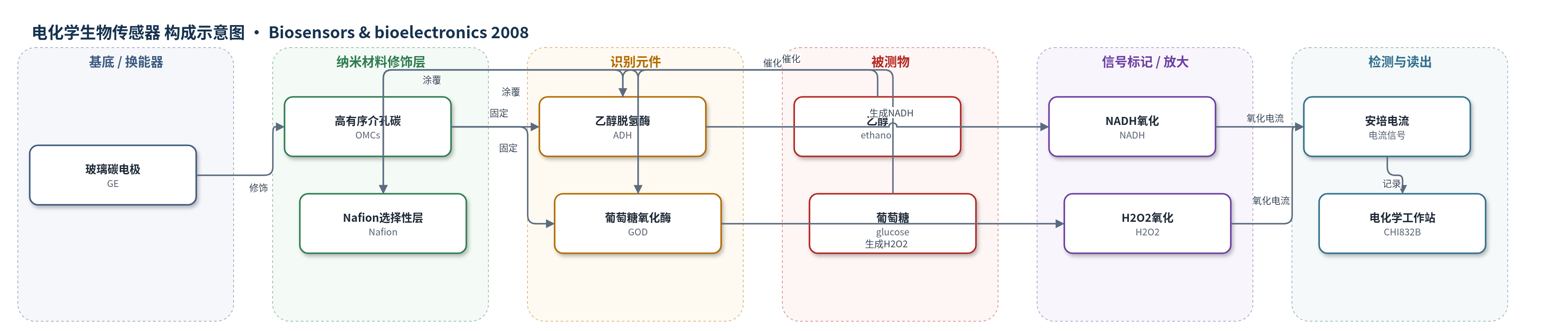
点击图片查看大图 · 依据论文自动绘制
传感器类型
电化学生物传感器
检测对象
乙醇(ethanol)、葡萄糖(glucose);实验样品基质为 0.1 mol/L pH 7.0 磷酸盐缓冲液(PBS),葡萄糖检测时含 10 mmol/L NAD+,应用目标为血浆葡萄糖检测
检测原理
该传感器以 OMCs/GE 为电催化界面。乙醇在 ADH 催化下与 NAD+ 反应生成乙醛和 NADH;葡萄糖在 GOD 催化下氧化生成葡萄糖酸内酯和 H2O2。OMCs 具有高密度边缘平面类缺陷位点、高比表面积和有序介孔结构,可显著降低 NADH 和 H2O2 的氧化过电位,促进电子转移,使产物在较低电位下被直接电化学氧化。安培电流随乙醇或葡萄糖浓度增加而增大。Nafion 作为阳离子选择性屏障和固定剂,减少 AA、UA、EP 等干扰。该体系无额外酶级联或核酸放大,主要依靠 OMCs 的直接电催化和介孔传质增强信号。
检测灵敏度
葡萄糖:LOD: 156.52 μmol l−1 (S/N = 3);线性范围: 0.5–15 mmol l−1;灵敏度: 0.053 μA mmol l−1;相关系数: 0.995
效应效果
OMCs 基传感器较 CNTs 和裸 GE 具有更快响应、更宽线性范围和更低检测限。葡萄糖传感器响应时间 9±1 s,线性范围 0.5–15 mmol/L,灵敏度 0.053 μA mmol/L,LOD 156.52 μmol/L;0.2 mmol/L AA、UA、EP 干扰可忽略;6 个电极 RSD 2.18%;4°C 保存 1 个月电流损失 7.0%;2 mmol/L 葡萄糖搅拌 10 h 后保持 90% 活性。乙醇传感器对 0.2 mmol/L AA、EP、UA 无明显干扰,RSD 4.3%,保存 1 个月损失 9.3%。作者认为其可满足糖尿病常规临床诊断和乙醇检测需求。
传感器的构成
- 基底电极:玻璃碳电极(GE),抛光后作为工作电极和电子换能器
- 纳米材料修饰层:高有序介孔碳(OMCs)/N,N-二甲基甲酰胺(DMF)悬浮液滴涂干燥,形成 OMCs/GE,提供导电通道、高比表面积和边缘缺陷位点
- 识别元件:乙醇脱氢酶(ADH)或葡萄糖氧化酶(GOD),与牛血清白蛋白(BSA)混合后滴涂,分别催化乙醇和葡萄糖氧化
- 交联固定层:戊二醛(glutaraldehyde,40 mmol/L)涂覆,交联固定酶于 OMCs 表面
- 选择性封闭层:Nafion 聚合物(5 wt%)涂覆,作为结合剂和阳离子选择性屏障,降低干扰
中文摘要
本文报道高有序介孔碳(OMCs)对 NADH 和 H2O2 电氧化的优异催化活性,并用于构建基于乙醇脱氢酶(ADH)和葡萄糖氧化酶(GOD)的电化学生物传感器。OMCs 的高密度边缘平面类缺陷位点和大比表面积使 OMCs/玻璃碳电极(OMCs/GE)显著降低 NADH 和 H2O2 氧化过电位,优于碳纳米管修饰电极(CNTs/GE)。因此 Nafion/ADH–OMCs/GE 和 Nafion/GOD–OMCs/GE 可在较低电位下安培检测乙醇和葡萄糖。葡萄糖传感器具有较宽测定范围(500–15,000 μmol L−1)、较高灵敏度(0.053 nA μmol−1)、快速(9±1 s)且稳定(2 mmol L−1 葡萄糖搅拌 10 h 后保持 90% 活性),并能有效抗干扰,可满足糖尿病常规临床诊断需求。与 CNTs 比较表明 OMCs 是构建脱氢酶和氧化酶电化学生物传感器的优良碳电极材料。
英文摘要
In this work, the excellent catalytic activity of highly ordered mesoporous carbons (OMCs) to the electrooxidation of nicotinamide adenine dinucleotide (NADH) and hydrogen peroxide (H(2)O(2)) was described for the construction of electrochemical alcohol dehydrogenase (ADH) and glucose oxidase (GOD)-based biosensors. The high density of edge-plane-like defective sites and high specific surface area of OMCs could be responsible for the electrocatalytic behavior at OMCs modified glassy carbon electrode (OMCs/GE), which induced a substantial decrease in the overpotential of NADH and H(2)O(2) oxidation reaction compared to carbon nanotubes modified glassy carbon electrode (CNTs/GE). Such ability of OMCs permits effective low-potential amperometric biosensing of ethanol and glucose, respectively, at Nafion/ADH-OMCs/GE and Nafion/GOD-OMCs/GE. Especially, as an amperometric glucose biosensor, Nafion/GOD-OMCs/GE showed large determination range (500-15,000 micromoll(-1)), high sensitivity (0.053 nA micromol(-1)), fast (9+/-1s) and stable response (amperometric response retained 90% of the initial activity after 10h stirring of 2 mmoll(-1) glucose solution) to glucose as well as the effective discrimination to the possible interferences, which may make it to readily satisfy the need for the routine clinical diagnosis of diabetes. By comparing the electrochemical performance of OMCs with that of CNTs as electrode material for the construction of ADH- and GOD-biosensors in this work, we reveal that OMCs could be a favorable and promising carbon electrode material for constructing other electrochemical dehydrogenase- and oxidase-based biosensors, which may have wide potential applications in biocatalysis, bioelectronics and biofuel cells.