组成图示
点击图片查看大图 · 依据论文自动绘制
传感器类型
其他(BRET生物传感器)
检测对象
cAMP(环磷酸腺苷,cAMP);样品基质:HEK-293T 细胞胞内环境。
检测原理
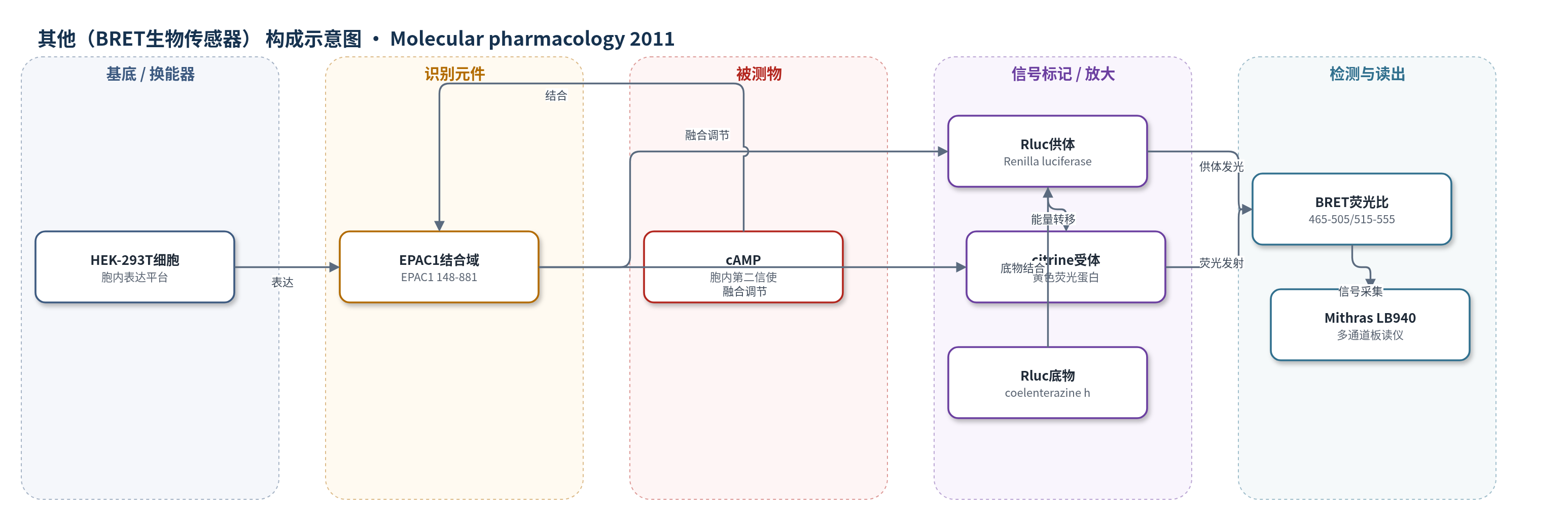
该 BRET cAMP 生物传感器由 Rluc-EPAC1(148–881)-citrine 融合蛋白构成。TAAR1 被 β-PEA 激活后经 Gs 蛋白激活腺苷酸环化酶,使胞内 cAMP 升高;cAMP 结合 EPAC1 的 cAMP 结合域后引起构象变化,改变 Rluc 供体与 citrine 受体之间的距离/取向,从而改变 BRET 效率。加入 coelenterazine h 后 Rluc 发光,能量转移至 citrine 产生荧光;cAMP 升高使 BRET 比值下降。D2R 经 Gi 抑制腺苷酸环化酶,D2R 拮抗剂阻断该抑制,选择性增强 TAAR1 介导的 cAMP 信号,表现为 BRET 信号进一步降低。
检测灵敏度
—
效应效果
该 BRET 法具受体选择性:氟哌啶醇、拉考嗪、氨磺必利仅增强 TAAR1/β-PEA 的 cAMP 反应,不增强异丙肾上腺素激活 β2-AR 的反应;百日咳毒素预处理消除增强,证明依赖 Gi。D2R 共表达使 β-PEA 反应降低约 25%;氟哌啶醇使最大效应增至 209±13%(p<0.001),拉考嗪 195±8%,氨磺必利 252±24%,EC50 变化小。未标记 D2R 使 BRET 降低 53.53±17.66%,D1R 无信号。TAAR1 缺失小鼠中氟哌啶醇诱导的 c-Fos 阳性神经元减少约 30%,木僵行为降低,提示体内生理意义。
传感器的构成
- 表达基底:HEK-293T 细胞,作为 TAAR1、D2R 与 BRET cAMP 探针的胞内表达平台。
- 识别元件:EPAC1 148–881 区(cAMP 结合域),结合 cAMP 后改变构象并调节供体-受体距离。
- 供体标记:人源化 Renilla reniformis luciferase(Rluc),位于 EPAC1 上游,结合底物后产生生物发光。
- 受体标记:citrine/YFP(黄色荧光蛋白),位于 EPAC1 下游,接受 BRET 能量并发射荧光。
- 信号底物:coelenterazine h(5 μM),Rluc 底物,启动 BRET 供体发光。
- 读出装置:Mithras LB940 板读仪,465–505 nm 与 515–555 nm 窗口采集 BRET 信号。
中文摘要
多巴胺受体与其他受体亚型的相互作用可能调节多巴胺相关功能与行为。痕量胺相关受体1(TAAR1)是一种Gs蛋白偶联受体,可被β-苯乙胺(β-PEA)和酪胺等痕量胺激活,并可能通过调节多巴胺能神经元放电或改变多巴胺D2受体(D2R)对配体的反应性影响多巴胺能系统。本研究利用cAMP生物发光共振能量转移(BRET)生物传感器,发现D2R拮抗剂氟哌啶醇、拉考嗪和氨磺必利能选择性增强TAAR1介导的β-PEA诱导cAMP升高。TAAR1与D2R在HEK293细胞中共表达时形成异源二聚体,且该直接相互作用可被氟哌啶醇破坏。在TAAR1缺失小鼠中,氟哌啶醇诱导的纹状体c-Fos表达和木僵行为显著降低。结果表明TAAR1与D2R存在功能性和物理性相互作用,可能在体内调节多巴胺能系统中起关键作用。
英文摘要
The ability of dopamine receptors to interact with other receptor subtypes may provide mechanisms for modulating dopamine-related functions and behaviors. In particular, there is evidence suggesting that the trace amine-associated receptor 1 (TAAR1) affects the dopaminergic system by regulating the firing rate of dopaminergic neurons or by altering dopamine D2 receptor (D2R) responsiveness to ligands. TAAR1 is a Gα(s) protein-coupled receptor that is activated by biogenic amines, "trace amines," such as β-phenylethylamine (β-PEA) and tyramine that are normally found at low concentrations in the mammalian brain. In the present study, we investigated the biochemical mechanism of interaction between TAAR1 and D2R and the role this interaction plays in D2R-related signaling and behaviors. Using a bioluminescence resonance energy transfer biosensor for cAMP, we demonstrated that the D2R antagonists haloperidol, raclopride, and amisulpride were able to enhance selectively a TAAR1-mediated β-PEA increase of cAMP. Moreover, TAAR1 and D2R were able to form heterodimers when coexpressed in human embryonic kidney 293 cells, and this direct interaction was disrupted in the presence of haloperidol. In addition, in mice lacking TAAR1, haloperidol-induced striatal c-Fos expression and catalepsy were significantly reduced. Taken together, these data suggest that TAAR1 and D2R have functional and physical interactions that could be critical for the modulation of the dopaminergic system by TAAR1 in vivo.