组成图示
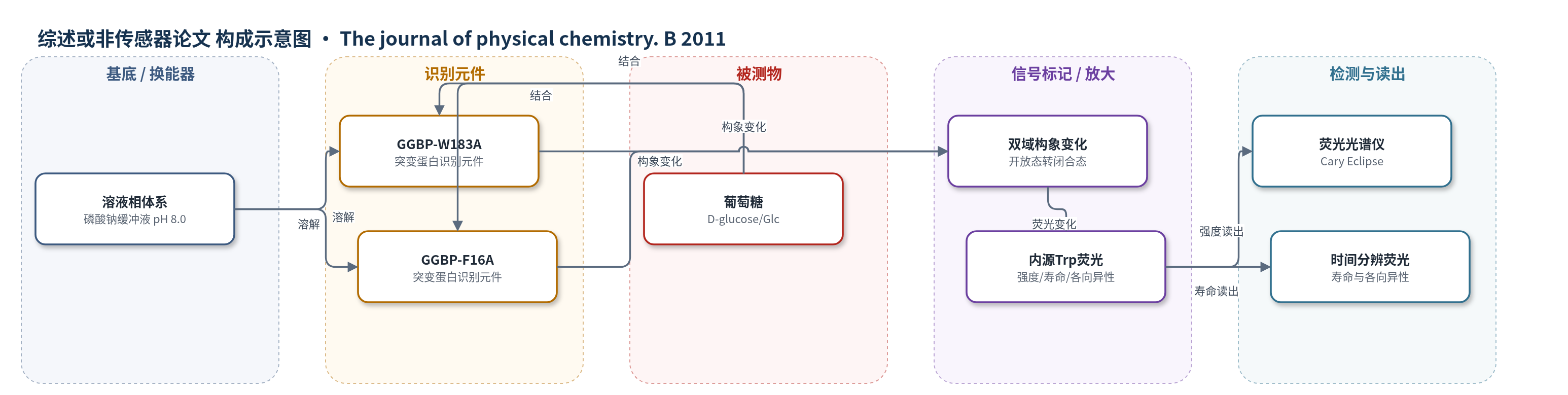
点击图片查看大图 · 依据论文自动绘制
传感器类型
综述或非传感器论文
检测对象
葡萄糖(D-glucose, Glc);样品基质:20 mM 磷酸钠缓冲液(pH 8.0),非实际血液样品
检测原理
GGBP-W183A 或 GGBP-F16A 作为识别元件,葡萄糖进入 N 端与 C 端结构域之间的结合位点,并与极性残基形成氢键网络。W183A/F16A 替换去除芳香残基,使蛋白对葡萄糖的解离常数由野生型约 1 μM 提高到 0.28 mM 和 1.51 mM,从而匹配血糖的毫摩尔浓度范围。葡萄糖结合后,蛋白由开放态向闭合态转变,色氨酸残基微环境、溶剂可及性和结构域稳定性发生改变,导致内源 Trp 荧光强度、寿命和各向异性变化。荧光强度随葡萄糖浓度按结合平衡方程变化,可通过非线性拟合获得 Kd。该方案无酶催化或核酸放大,信号主要来自蛋白构象变化本身。
检测灵敏度
未报道 LOD、线性范围、灵敏度斜率或相关系数;Kd: GGBP-W183A 0.28 ± 0.10 mM;Kd: GGBP-F16A 1.51 ± 0.88 mM。
效应效果
论文未进行实际血液样品检测、选择性/抗干扰、加标回收率或与 ELISA、HPLC、qPCR 等方法的对比。主要表现集中在结合亲和力与结构稳定性:W183A 突变使 Kd 从野生型约 1 μM 提高到 0.28 ± 0.10 mM,F16A 为 1.51 ± 0.88 mM,接近血糖毫摩尔范围。GGBP-W183A 无葡萄糖时 N/C 端域稳定性低于野生型,葡萄糖结合后两域紧密结合,热稳定性 Tm 从 43.8 °C 升至 54.8 °C;GGBP-F16A 稳定性较差,Tm 为 39.5 °C 和 47.6 °C。作者认为 W183A 更适合作为葡萄糖传感探针,但仍需进一步微调。
传感器的构成
- 溶液相介质:20 mM Na-phosphate 缓冲液(pH 8.0),蛋白溶解与葡萄糖结合反应介质
- 识别元件:GGBP-W183A 或 GGBP-F16A 突变蛋白,结合葡萄糖并发生双域构象变化
- 信号标记物:蛋白内源色氨酸(Trp)荧光,作为葡萄糖结合引起的荧光强度/寿命变化信号
- 检测读出:荧光光谱仪(Cary Eclipse)与时间分辨荧光仪,测量荧光强度、寿命和各向异性
中文摘要
大肠杆菌 D-半乳糖/D-葡萄糖结合蛋白(GGBP)是 32 kDa 的典型双域配体结合蛋白,其葡萄糖解离常数处于微摩尔级,因此不适合用于糖尿病患者血液葡萄糖的连续监测。本研究设计、表达并表征了两种 GGBP 突变体,其活性中心分别发生 W183A 或 F16A 氨基酸替换。两种突变体均保留与野生型相似的球状结构,但对葡萄糖的亲和力低于野生型。深入分析表明,GGBP-W183A 在无葡萄糖时其 N 端和 C 端结构域的稳定性低于野生型;而在葡萄糖存在时,两个结构域紧密结合,使蛋白对变性剂的作用更加稳定。相反,GGBP-F16A 无论有无葡萄糖均表现出非常有限的结构稳定性。本文讨论了 Phe16 和 Trp183 在 GGBP 结构与功能特性中的作用,并提出了基于 GGBP 设计新型葡萄糖生物传感器的一般指导原则。
英文摘要
The galactose/glucose-binding protein from E. coli (GGBP) is a 32 kDa protein possessing the typical two-domains structure of the ligand-binding proteins family. GGBP is characterized by low dissociation constant values with respect to glucose binding, displaying an affinity constant for glucose in micromolar range. This feature makes GGBP unsuitable as a sensitive probe for continuous glucose monitoring in blood of diabetic patients. In this work we designed, produced, and characterized two mutant forms of GGBP carrying the following amino acid substitutions in the active center of the protein: W183A or F16A. The two mutant GGBP forms retained a globular structure similar to that of the wild-type GGBP and displayed an affinity for glucose lower than the wild-type GGBP. A deep inspection of the entire set of the obtained results pointed out that the N- and C-terminal domains of GGBP-W183A in the absence of glucose have a stability lower than that of the wild-type protein. In the presence of glucose, the two domains of GGBP-W183A were tightly bound, making the protein structure more stable to the action of denaturing agents. On the contrary, the mutant form GGBP-F16A possesses a very restricted structural stability both in the absence and in the presence of glucose. In this work the role of Phe 16 and W 183 are discussed with regard to the structural and functional features of GGBP. In addition, some general guidelines are reported for the design of a novel glucose biosensor based on the use of GGBP.