组成图示
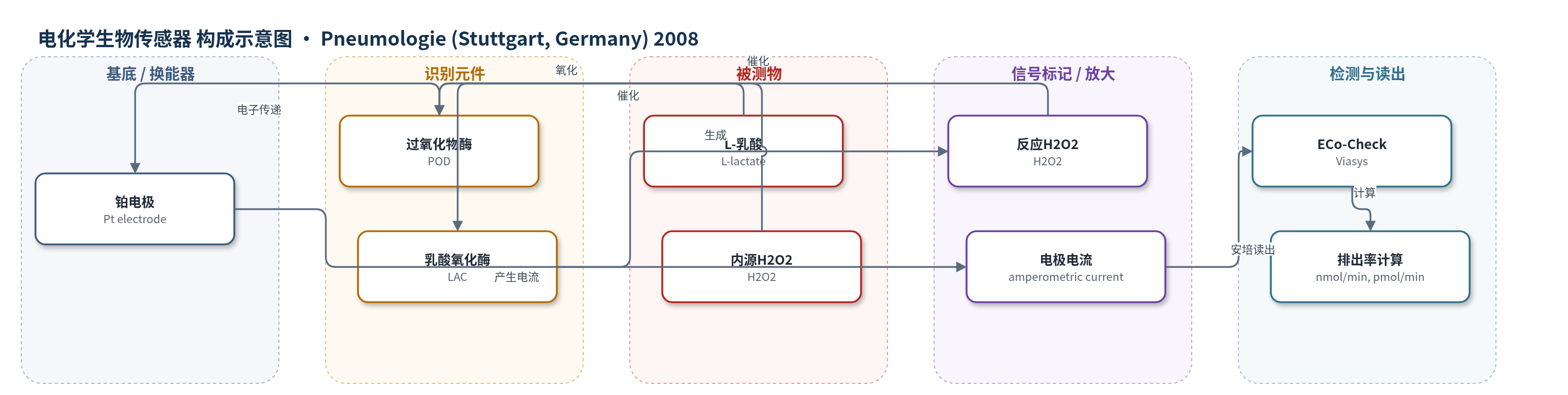
点击图片查看大图 · 依据论文自动绘制
传感器类型
电化学生物传感器
检测对象
L-乳酸(L-lactate)、过氧化氢(H2O2);样品基质:呼出冷凝物(exhaled breath condensate, EBC)
检测原理
EBC样品与缓冲液等体积稀释后注入酶传感器。对于H2O2,过氧化物酶(POD)催化H2O2在铂电极表面发生电化学反应,产生与H2O2浓度相关的法拉第电流。对于L-乳酸,乳酸氧化酶(LAC)特异性氧化L-乳酸生成丙酮酸和H2O2,随后生成的H2O2在铂电极上发生电化学反应并产生电流;电流大小随L-乳酸浓度增加而增加。ECo-Check安培仪记录电流并换算浓度,再结合EBC收集时间计算排出率。内源H2O2对乳酸通道干扰可忽略,因其浓度低于乳酸诱导信号100–1000倍。该方法以酶催化作为生物识别与信号放大,未使用HCR、RCA或CRISPR-Cas等核酸放大策略。
检测灵敏度
测量范围: H2O2 30–3000 nmol/l;L-乳酸 5–150 μmol/l;L-乳酸排出率与能量代谢线性相关: y = 35,9x + 11,4, r = 0,99
效应效果
作者报告该酶传感器对H2O2具有高特异性,灵敏度比化学发光或荧光光度法高2–3倍;内源H2O2对L-乳酸测定的干扰可忽略,因为其浓度比乳酸诱导信号低100–1000倍。H2O2测量系统稳定,无需每日校准;乳酸测量前用校准液校正,且每位受试者使用新传感器。实际EBC样品中,静息即可测得L-乳酸和H2O2;60 W时L-乳酸排出率显著升高,120 W进一步升高,并与能量代谢呈线性相关(r=0.99)。H2O2在60 W升高、120 W下降,未与能量代谢相关,个体内差异较大。作者认为非侵入EBC检测未来可能替代动脉化耳垂血乳酸测定。
传感器的构成
- 换能器电极:铂电极(Pt electrode),H2O2在其表面发生电化学反应并产生安培电流
- 识别元件(H2O2通道):过氧化物酶(Peroxidase, POD),催化H2O2转化并实现安培检测
- 识别元件(L-乳酸通道):乳酸氧化酶(Lactate oxidase, LAC)与过氧化物酶(POD)双酶体系,LAC氧化L-乳酸生成丙酮酸和H2O2
- 样品缓冲层:缓冲液(Pufferlösung),与300 μl EBC等体积稀释,维持酶反应环境并用于系统冲洗
- 校准层:标准液/校准液(Eichlösung),乳酸测量前注入以校正基线
- 读出装置:ECo-Check安培仪(Viasys Health Care),程序控制增益并自动选择测点计算浓度
中文摘要
背景:微型酶传感器使呼出冷凝物(EBC)中炎症标志物和L-乳酸的非侵入性测量成为可能。本研究在19名年轻健康受试者中,于静息及60、120 W稳态自行车负荷下收集100 L呼出气,冷却获得EBC,并在90 min内用ECo-Check安培仪分析。H2O2经过氧化物酶催化后安培检测;L-乳酸经乳酸氧化酶氧化为丙酮酸和H2O2,由双酶传感器检测。结果:静息收集10.6±5.1 min得0.99±0.3 ml EBC;60 W为6.7±1.8 min、1.23±0.47 ml;120 W为4.8±0.8 min、1.09±0.38 ml。静息L-乳酸排出率为3.3±3.1 nmol/min,60 W升至8.4±5.1 nmol/min,120 W为15.0±12.6 nmol/min,与代谢率相关(r=0.99)。H2O2排出率静息为49.1±37.9 pmol/min,60 W升至159±113 pmol/min,120 W降至96.5±49.5 pmol/min。结论:静息即可测得显著L-乳酸和H2O2,负荷下L-乳酸升高并与代谢率相关。
英文摘要
BACKGROUND: The recently developed microenzyme detectors make a non-invasive measurement of inflammatory markers and L-lactate in exhaled breath condensate (EBC) possible. In a group of young and healthy subjects, we examined whether L-lactate and H (2)O (2) can be detected in EBC.
METHODS: During resting conditions as well as at 60 and 120 Watt external load on a cycle ergospirometer 100 l exhaled air were collected under stationary load conditions from 19 healthy subjects. Exhaled breath condensate (EBC) was obtained by cooling the expired air volume. The analysis was performed within 90 min using an ECo-Check amperometer (Viasys Health Care). The H (2)O (2) measurement was performed amperometrically by means of a biosensor after chemical reaction catalysed by peroxidase. Lactate measurements were performed using a bienzyme sensor after lactate oxidase-induced oxidation of L-lactate to pyruvate and H (2)O (2). The rates of release of L-lactate in nmol/min und H (2)O (2) in pmol/min were calculated from the concentrations of L-lactate and H (2)O (2) in the EBC and the time of collection.
RESULTS: At rest 100 l exhaled air were collected in 10.6 +/- 5.1 min, and 0.99 +/- 0.3 ml EBC were obtained, at the 60 Watt step 1.23 +/- 0.47 ml EBC were collected in 6.7 +/- 1.8 min, and at 120 Watt 1.09 +/- 0.38 ml EBC in 4.8 +/- 0.8 min. At rest, there was a mean rate of L-lactate release of 3.3 +/- 3.1 nmol/min, which increased at the 60 Watt step to 8.4 +/- 5.1 nmol/min (p < 0.05), and at 120 Watt to 5.0 +/- 12.6 nmol/min (p < 0.02). The rate of L-lactate was proportional to the metabolic rate (r = 0.99). The rate of H (2)O (2) release at rest was 49.1 +/- 37.9 pmol/min, it increased at 60 Watt to 159 +/- 113 pmol/min (p < 0.05) and decreased at 120 Watt to 96.5 +/- 49.5 pmol/min (p < 0.05).
CONCLUSIONS: Significant measurable concentrations of L-lactate and H (2)O (2) in the exhaled breath condensate were found already under resting conditions. During external load, an increase in the L-lactate concentration was found, correlating with the metabolic rate. H (2)O (2) is an inflammatory marker, its concentration in the EBC was markedly increased during the first step of applied external load, but less during the second. A probable correlation between L-lactate concentration in EBC and arterialized blood will be studied in future investigations.