组成图示
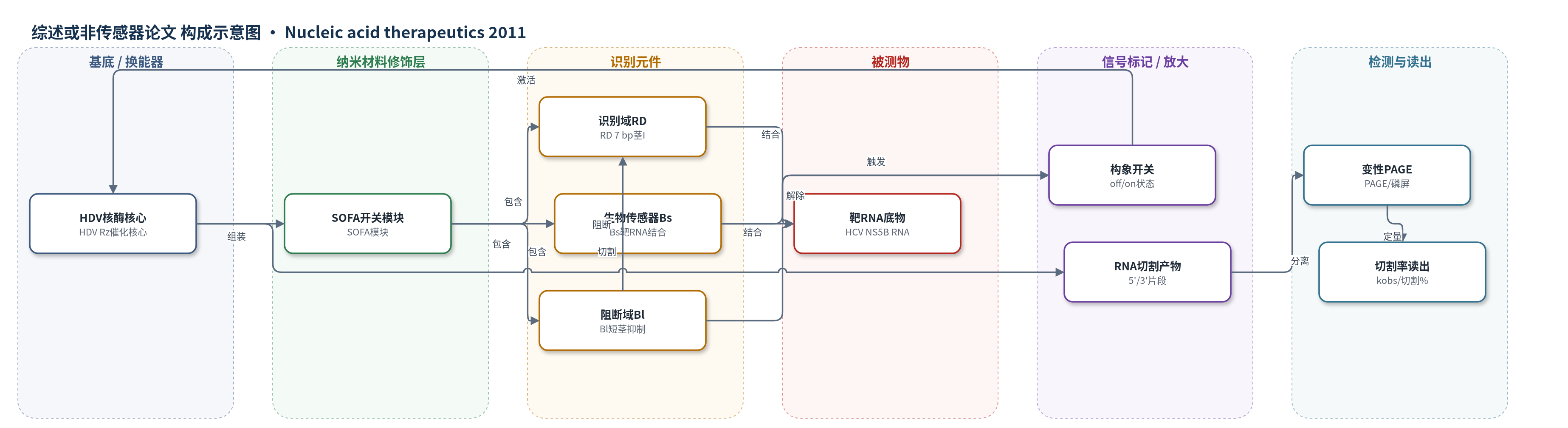
点击图片查看大图 · 依据论文自动绘制
传感器类型
综述或非传感器论文
检测对象
靶RNA底物:HCV NS5B RNA(模型靶标)、HIV RNA、流感A病毒RNA、HBV RNA;样品基质:体外转录RNA溶液/体外切割反应体系
检测原理
SOFA-HDV核酶由HDV核酶催化核心和SOFA模块组成。无靶RNA时,阻断域Bl与识别域RD形成短茎,使核酶处于off状态;当Bs与靶RNA互补结合后,Bl-RD双链被破坏,RD与靶RNA形成茎I,核酶切换为on状态。在Mg2+存在下,HDV核酶催化核心切割靶RNA的G+1位点,产生5'和3'片段。切割产物经变性PAGE和磷屏/放射自显影检测,通过计算kobs和切割百分比反映靶RNA结合与催化效率。设计规则包括避免Bs与茎环III形成≥6 bp内源配对、避免Bl延长至≥6 bp(尤其7 bp含wobble导致自切割)、选择-1/-2位点非G且优选A-2A-1/G+1,并保证靶区可及。
检测灵敏度
原文未报告LOD、线性范围、灵敏度斜率或相关系数。
效应效果
研究以HCV NS5B RNA为模型,比较高评分与低评分SOFA-HDV核酶。高评分组除NS5B-222外,kobs为0.49–0.558 min^-1,3 h切割率>66%,8/9>78%;低评分组最佳kobs仅0.060 min^-1,最高切割率70%,多数kobs≤0.025 min^-1,较最佳低约20倍,t检验p<0.05。SOFA模块通过Bl竞争RD提高特异性;避免Bs与茎环III配对和Bl过度延长可防止失活或自切割。HDV核酶在生理Mg2+(约1 mM)和人蛋白环境中稳定,stabilizer不影响切割。未报告实际样品加标回收率。作者认为该规则可提升SOFA-HDV核酶在功能基因组学和基因治疗中的应用价值。
传感器的构成
- 催化核心:HDV核酶(HDV Rz)双假结结构,提供RNA切割活性
- 识别元件:识别域(RD)与靶RNA形成7 bp茎I,决定切割位点
- 开关识别元件:生物传感器域(Bs)与靶RNA互补结合,触发off/on构象开关
- 抑制元件:阻断域(Bl)与RD形成短茎,维持off状态并提高特异性
- 稳定元件:稳定化茎(stabilizer)连接5'与3'末端,模拟HDV Rz茎II,提高稳定性
- 靶标底物:靶RNA(如HCV NS5B RNA),含RD结合区、间隔区(spacer)和Bs结合区
- 反应离子:Mg2+(体外反应约10 mM),启动核酶折叠与催化
中文摘要
丁型肝炎病毒(HDV)核酶能在人细胞环境中有效工作,是开发基因失活系统的理想候选分子。新一代 SOFA-HDV 核酶通过引入特异性开/关适配体(SOFA)模块,显著提高了核酶的特异性和切割活性。与 RNA 干扰和锤头核酶不同,SOFA-HDV 核酶用于反式切割特定 RNA 的设计过程尚未经历系统优化。本研究旨在改进并明确 SOFA-HDV 核酶的设计流程,同时分析核酶本身和靶 RNA 底物,提出筛选高效核酶的新标准。作者鉴定并表征了核酶生物传感器域(Bs)和阻断域(Bl)以及靶位点中的关键特征,并基于这些特征建立简单规则,以丙型肝炎病毒 NS5B RNA 为模型靶标进行验证。结果表明,避免 Bs 与茎环 III 形成强互补、避免阻断茎过度延长、选择合适切割位点序列和可及靶区,可显著提高核酶切割效率。该方法有望促进 SOFA-HDV 核酶在功能基因组学和基因治疗中的广泛应用。
英文摘要
The Hepatitis Delta Virus (HDV) ribozyme, which is well adapted to the environment of the human cell, is an excellent candidate for the future development of gene-inactivation systems. On top of this, a new generation of HDV ribozymes now exists that benefits from the addition of a specific on/off adaptor (specifically the SOFA-HDV ribozymes) which greatly increases both the ribozyme's specificity and its cleavage activity. Unlike RNAi and hammerhead ribozymes, the designing of SOFA-HDV ribozymes to cleave, in trans, given RNA species has never been the object of a systematic optimization study, even with their recent use for the gene knockdown of various targets. This report aims at both improving and clarifying the design process of SOFA-HDV ribozymes. Both the ribozyme and the targeted RNA substrate were analyzed in order to provide new criteria that are useful in the selection of the most potent SOFA-HDV ribozymes. The crucial features present in both the ribozyme's biosensor and blocker, as well as at the target site, were identified and characterized. Simple rules were derived and tested using hepatitis C virus NS5B RNA as a model target. Overall, this method should promote the use of the SOFA-HDV ribozymes in a plethora of applications in both functional genomics and gene therapy.