组成图示
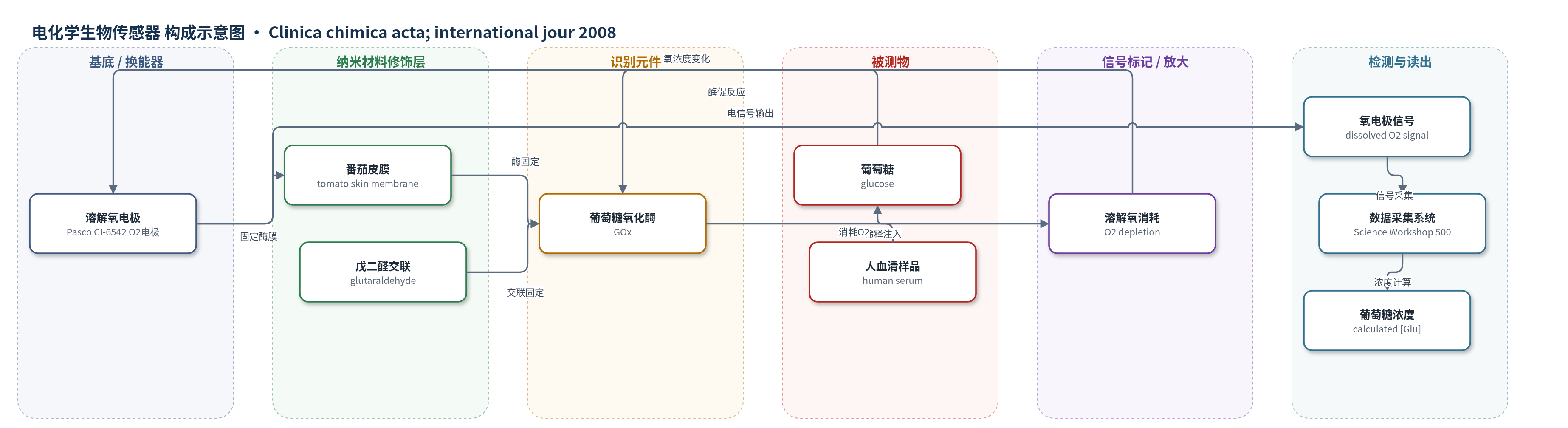
点击图片查看大图 · 依据论文自动绘制
传感器类型
电化学生物传感器
检测对象
葡萄糖(glucose, Glu);样品基质:人血清(human serum,静脉血离心血清,稀释后)
检测原理
该传感器以番茄皮膜为生物固定平台,将葡萄糖氧化酶(GOx)固定于其内表面,再置于Clark型溶解氧电极表面。样品中的葡萄糖扩散进入酶膜,GOx催化葡萄糖氧化反应并消耗溶解氧。葡萄糖浓度越高,单位时间内溶解氧消耗越多,氧电极检测到的溶解氧信号下降越大。系统以磷酸盐缓冲液为介质,通过数据采集系统记录氧信号变化,利用溶解氧下降量与葡萄糖浓度的线性关系进行定量。该方法未使用额外信号放大,直接依赖酶促氧耗产生电化学响应。
检测灵敏度
LOD: 0.20 mmol/l;线性范围: 1.0–30.0 mmol/l;线性回归方程: DO=0.188*[Glucose]−0.0331;r^2 = 0.9986
效应效果
该传感器响应时间为6–8 s,可在1.0–30.0 mmol/l范围内快速测定血清葡萄糖。对300份人血清样品进行临床评价,与Hitachi 7060血糖分析仪比较,误差网格分析显示99.3%结果位于A区、0.7%位于B区,100%落在临床可接受A/B区;F检验和t检验在90%置信水平下无显著差异。30份血清加标回收率为95.0%–110.0%。重复性与日间变异为0.49%–1.80%。25℃储存6个月后保留90%初始响应;抗坏血酸、柠檬酸、尿酸、蔗糖、氨基酚、乳糖和氯化钠干扰轻微。作者认为其制备简单、成本低、响应快、精度高,适合临床血糖监测。
传感器的构成
- 换能器电极:Pasco CI-6542 溶解氧电极(oxygen electrode),检测葡萄糖氧化酶反应引起的溶解氧变化
- 生物膜载体:新鲜番茄皮膜(tomato skin membrane),内表面固定酶,提供生物相容、透气且不透水的固定平台
- 识别元件:葡萄糖氧化酶(glucose oxidase, GOx),催化葡萄糖氧化并消耗溶解氧
- 交联固定剂:戊二醛(glutaraldehyde, GA, 5% w/w),交联固定 GOx 以提高稳定性
- 密封定位件:O形圈(O-ring),将酶膜稳定固定在氧电极表面
- 缓冲介质:磷酸盐缓冲液(phosphate buffer, PB, 0.20 mol/L, pH 6.5),维持酶活性与氧电极检测环境
- 数据采集系统:Science Workshop 500 接口及控制软件(Pasco Scientific),采集并处理溶解氧信号
中文摘要
背景:糖尿病症状治疗需要频繁可靠地评估血糖水平,因此基于葡萄糖氧化酶反应的葡萄糖生物传感器受到关注。番茄皮膜已成功用于包埋葡萄糖氧化酶以制备葡萄糖生物传感器。方法:将葡萄糖氧化酶固定于番茄皮上,酶膜置于氧电极表面,通过溶解氧变化定量葡萄糖浓度。所有血清样品同时用日立7060生化分析仪检测。结果:生物传感器响应与1.0–30.0 mmol/L葡萄糖浓度呈线性关系,检出限为0.20 mmol/L。误差网格分析显示100%结果落在临床可接受A区和B区。F检验和t检验表明两种方法无显著差异。30份血清样品分析回收率为95.0%–110.0%。结论:番茄皮生物传感器具有制备简单、响应快、成本低和灵敏度高等优点,结果比现有临床仪器方法更准确且匹配良好。
英文摘要
BACKGROUND: Glucose biosensors based on enzyme reaction of glucose oxidase were studied because the symptomatic therapy of diabetes mellitus requires reliable assessment of blood glucose level at frequent intervals. Tomato skin membranes have been successfully employed to entrap glucose oxidase for fabrication of glucose biosensor.
METHODS: Glucose oxidase was immobilized onto the tomato skin and the enzyme membrane was then positioned on the surface of an oxygen electrode. The glucose concentration was quantified by the change of dissolved oxygen. All the serum samples were also simultaneously determined by a Hitachi 7060 chemistry analyzer.
RESULTS: The response of the biosensor showed a linear relationship with a concentration range of 1.0-30.0 mmol/l glucose. The limit of detection was 0.20 mmol/l. Error Grid analysis demonstrated that 100% of the results fell within clinically acceptable zones A and B. The F- and t-tests showed no significant differences between the 2 methods. The recovery was 95.0-110.0% for 30 serum samples analysis.
CONCLUSIONS: The tomato skin biosensor possesses the advantages of simple fabrication, fast response time, low cost and high sensitivity. The results of our method are more accurate than and match well with the current clinical instrument method.