组成图示
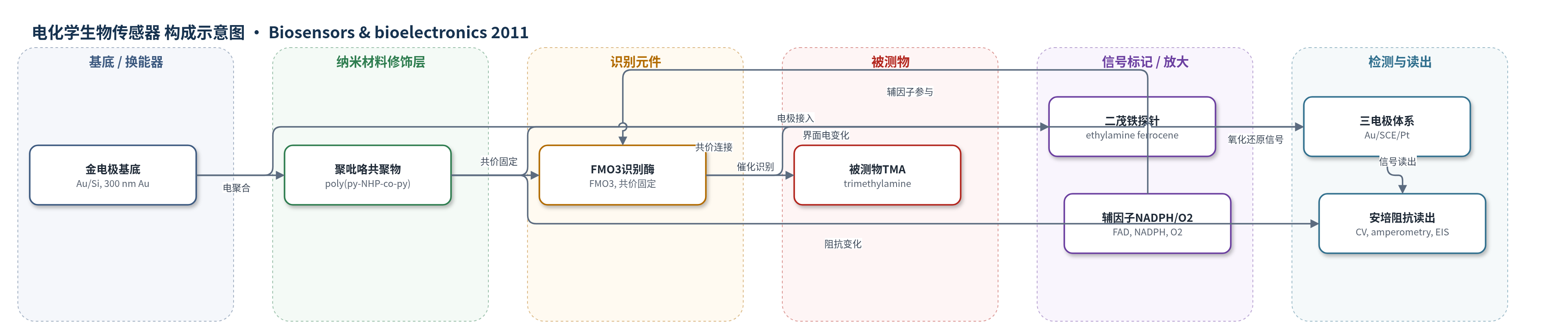
点击图片查看大图 · 依据论文自动绘制
传感器类型
电化学生物传感器
检测对象
三甲胺(trimethylamine, TMA);样品基质:PBS 溶液、鱼提取物(horse-mackerel)
检测原理
FMO3 以 FAD 为辅基,在 NADPH 和 O2 参与下识别并催化三甲胺(TMA)发生单加氧反应,生成三甲胺 N-氧化物(TMAO),同时 NADPH 氧化为 NADP+。该催化循环改变酶界面电荷状态和局部电性质,降低固定在聚吡咯中的乙胺基二茂铁向金电极的电子转移动力学,导致电荷转移电阻增加。安培法在 0.45 V/SCE 监测二茂铁氧化电流,TMA 浓度升高时电流下降;阻抗谱通过 Randles 等效电路提取电荷转移电阻,TMA 浓度升高时阻抗模增大。酶催化过程提供识别与信号放大,使电流/阻抗响应随 TMA 浓度变化。
检测灵敏度
LOD: 0.4 µg mL−1(安培法,S/N=3);安培线性范围: 2.5–10 µg mL−1,回归系数 = 99%;安培灵敏度: 6 (µA/cm2)/µg mL−1;阻抗线性范围: 0.4–10 µg mL−1,回归系数 = 0.95;阻抗动态范围: 0.4–80 µg mL−1(6.5 µmol L−1–1.5 mmol L−1)
效应效果
传感器对 TMA 具有较高选择性,安培法在 2.5–10 µg mL−1 线性,灵敏度 6 (µA/cm2)/µg mL−1,LOD 0.4 µg mL−1,低于 FMO3/Clark 氧电极的 1 mM(59 µg mL−1);阻抗法动态范围 0.4–80 µg mL−1,大于此前电导法 2–40 µg mL−1。6 个电极重现性标准偏差 11%。稳定性方面,5 天后响应下降 10%,两周内基本稳定,摘要称稳定 16 天。鱼提取物中 TMA 由 HPLC 测得 1.9 ± 0.1 µg mL−1,本传感器测得 2 µg mL−1,平均回收率 105%;GC/MS 在保留时间 1.4 min 和 m/z 58 处确认 TMA。作者认为其可用于实际鱼新鲜度快速评估。
传感器的构成
- 基底/换能器电极:金电极(Au/Si,300 nm Au、30 nm Ti),提供导电基底与电化学换能
- 导电聚合物修饰层:聚吡咯共聚物 poly(N-hydroxyphtalimide-pyrrole-co-pyrrole),由吡咯和 py-NHP 电聚合,提供导电基质与 NHP 活性酯位点
- 识别元件:黄素单加氧酶3(FMO3),通过赖氨酸氨基与 NHP 共价酰胺键固定,催化 TMA 单加氧
- 信号标记/氧化还原探针:乙胺基二茂铁(ethylamine ferrocene),通过氨基与 NHP 共价连接,监测界面电性质变化
- 辅因子/电子供体:NADPH、O2 和 FAD,参与 FMO3 催化循环并改变界面电荷状态
- 缓冲介质:PBS(pH 7.0,137 mM NaCl、2.7 mM KCl、0.01 M KH2PO4、0.01 M K2HPO4),提供反应环境
- 读出系统:三电极体系(Au 工作电极、SCE 参比、Pt 对电极)与 Voltalab PGZ 402,进行 CV、安培和 EIS 测量
中文摘要
本文报道了一种用于检测三甲胺(TMA)的电化学安培与阻抗生物传感器,以评估鱼新鲜度。传感器以电聚合的含二茂铁基团功能化聚吡咯为导电基质,通过共价键固定黄素单加氧酶3(FMO3)。FMO3 在黄素腺嘌呤二核苷酸(FAD)辅基、NADPH 辅因子和分子氧参与下催化 TMA 单加氧生成三甲胺 N-氧化物(TMAO)。固定在聚吡咯中的乙胺基二茂铁作为氧化还原探针,用于监测酶催化反应引起的界面电性质变化。传感器经傅里叶变换红外光谱、循环伏安法和阻抗谱表征。在 0.4–80 µg mL−1(6.5 µmol L−1–1.5 mmol L−1)范围内,安培响应随 TMA 浓度增加而下降,阻抗电荷转移电阻相应增加。阻抗法获得 0.4–80 µg mL−1 动态范围,传感器稳定 16 天,并用于鱼提取物中 TMA 检测。
英文摘要
Amperometric and impedimetric biosensor for detecting trimethylamine (TMA) which represents good parameters for estimating fish freshness has been developed. The biosensor is based on a conducting polypyrrole substituted with ferrocenyl, where flavin-containing monooxygenase 3 (FMO3) enzyme was immobilised by covalent bonding. FMO3 catalyzes the monooxygenation TMA to trimethylamine N-oxide (TMO). For catalysis FMO require flavin adenine (FAD) as a prosthetic group, NADPH as a cofactor and molecular oxygen as cosubstrate. Ferrocenyl group substituted on the polypyrrole matrix will serve as redox probe for monitoring the response of the biosensor to TMA. The construction of the biosensor was characterized by FT-IR, cyclic voltammetry and impedance measurements. Detection is done through the analysis of the current of oxidation signal of the ferrocenyl groups and compared to the measurement of impedance related to the electrical properties of the layers. Amperometric and impedimetric response were measured as a function of TMA concentration in range of 0.4 μgm L(-1)-80 μgm L(-1) (6.5 μmol L(-1)-1.5 mmol L(-1)). Amperometric measurements show a decrease in current response which is in correlation with the increase of the charge transfer resistance demonstrated by impedance. Calibration curve obtained by impedance spectroscopy shows a high sensitivity with a dynamic range from (0.4 μgm L(-1) to 80 μgm L(-1)). We demonstrated, using ferrocene as redox probe for catalytic reaction of FMO3, that high sensitivity and dynamic range was obtained. The biosensor was stable during 16 days. The biosensor shows high selectivity and its sensitivity to TMA in real samples was evaluated using fish extract after deterioration during storage.