组成图示
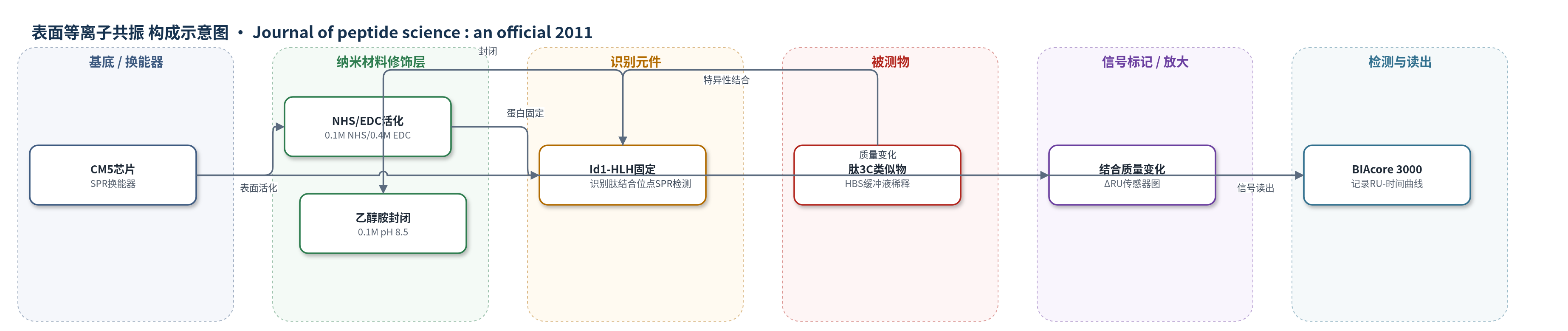
点击图片查看大图 · 依据论文自动绘制
传感器类型
表面等离子共振(SPR)生物传感器
检测对象
肽3C及其N端/C端截短类似物(peptide 3C analogs),样品基质为HBS缓冲液
检测原理
CM5芯片表面羧基经EDC/NHS活化后,与Id1-HLH或全长Id1的氨基形成酰胺键共价固定,再用乙醇胺封闭剩余活化位点。将不同浓度的肽3C类似物以HBS缓冲液流过芯片表面,肽与固定化Id1-HLH发生特异性结合,使芯片表面附近质量增加,局部折射率改变,导致表面等离子共振信号发生位移。BIAcore 3000实时记录结合相、解离相的共振单位(RU)随时间变化,得到传感器图;通过结合/解离动力学或Scatchard分析计算平衡解离常数KD。该法为无标记、实时检测,未使用酶或荧光放大。
检测灵敏度
—
效应效果
SPR显示多数N端和C端截短类似物与Id1-HLH呈剂量非依赖性结合,ΔRU约10–35 RU,提示非特异性;肽3C和3C-CtD4呈剂量依赖性结合,KD分别为3.16 µM和2.77 µM,肽3C对全长Id1的KD为12.50 µM。CD显示α-螺旋含量为7.93%–10.45%,3C-CtD4为10.04%。MTT中多数类似物80 µM无显著抗增殖作用,3C-CtD4在25 µM抑制MCF-7(24 h活力86.5±1.5%)。作者认为其可进一步修饰开发抗癌肽拮抗剂。
传感器的构成
- 基底/换能器:CM5传感器芯片(SPR换能器),提供表面等离子共振检测界面
- 活化层:0.1 M NHS/0.4 M EDC混合液,活化CM5表面羧基以共价固定蛋白
- 识别元件:Id1-HLH蛋白或全长Id1,固定化后特异性结合肽3C类似物
- 封闭剂:0.1 M乙醇胺盐酸盐(pH 8.5),封闭未反应活化位点
- 读出装置:BIAcore 3000生物传感器,记录RU随时间变化的传感器图
中文摘要
Id1蛋白是bHLH转录因子的显性负性拮抗剂,通过与bHLH蛋白形成高亲和力异源二聚体阻止其结合DNA,从而抑制分化相关基因转录,并参与细胞增殖、分化和肿瘤发生。本研究以具有较高Id1亲和力和抑癌活性的肽3C为先导肽,设计并合成了一系列N端和C端截短类似物,采用SPR生物传感器测定各肽与Id1或Id1-HLH结构域的亲和力,用圆二色谱分析二级结构,并用MTT细胞活力实验评估其对MCF-7乳腺癌细胞的作用。结果显示,肽3C和肽3C-CtD4对Id1-HLH亲和力较高,平衡解离常数分别为3.16和2.77 µM;截短肽的α-螺旋含量在7.93%至10.45%之间。MTT结果表明这些肽总体未表现出明显抗增殖作用,但SPR结果提示肽3C和3C-CtD4具有进一步修饰以增强Id1-HLH亲和力和抗癌活性的潜力。
英文摘要
Id1 proteins, inhibitors of differentiation or DNA binding, act as dominant negative antagonists of the bHLH family of transcription factors, which play an important role in cellular development, proliferation, and differentiation. The mechanism of Id proteins is to antagonize bHLH proteins by forming high-affinity heterodimers with other bHLH proteins, thereby preventing them from binding to DNA and inhibiting transcription of differentiation-associated genes. Our goal is to study the SARs of a peptidic antagonist of Id1, peptide 3C, which exhibits high affinity for Id1 and inhibitory effect on the proliferation of cancer cells. A series of N-terminal- and C-terminal-deleted analogs of peptide 3C were designed, synthesized, and characterized. Affinity of each peptide for Id1 or Id1-HLH domain was determined by SPR-based biosensor. The secondary structure of each peptide was studied by CD spectroscopy. Biological effect of each peptide in breast cancer cell (MCF-7) was analyzed by the MTT cell viability assay. Results demonstrated that peptide 3C and peptide 3C-CtD4 exhibited higher affinity for Id1-HLH and the equilibrium dissociation constants (K(D) ) were 3.16 and 2.77 µM, respectively. CD results indicated that the percentage of α-helix (%) in the secondary structure of deleted peptides were different, ranging from 7.93 to 10.45%. Although MTT results showed that treatment of MCF-7 with these peptides did not cause antiproliferative effects in cancer cells, SPR results demonstrated that the high-affinity peptides 3C and 3C-CtD4 are promising for further modifications to enhance their affinity for Id1-HLH and antiproliferative effects in cancer cells and for the development of peptidic antagonists as anticancer agents.