组成图示
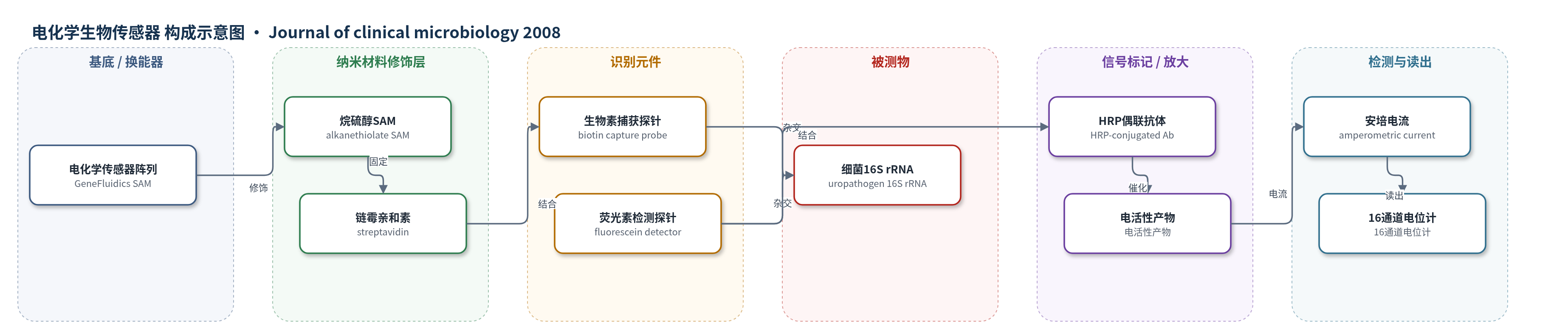
点击图片查看大图 · 依据论文自动绘制
传感器类型
电化学生物传感器
检测对象
尿路病原菌16S rRNA(uropathogen 16S rRNA),包括大肠埃希菌(Escherichia coli)、肺炎克雷伯菌(Klebsiella pneumoniae)、奇异变形杆菌(Proteus mirabilis)、铜绿假单胞菌(Pseudomonas aeruginosa)、粪肠球菌(Enterococcus faecalis)等;样品基质:细菌裂解液、临床尿液。
检测原理
生物素化捕获探针经链霉亲和素固定于烷硫醇自组装单分子层修饰的电化学传感器表面。细菌裂解释放的16S rRNA在20–25°C与捕获探针杂交,3'-荧光素标记检测探针再与靶标另一区域杂交,形成DNA-RNA夹心。HRP偶联抗体结合检测探针后,HRP催化未具名电化学底物生成电活性产物;该产物在电极界面发生氧化还原,产生安培电流。每个HRP分子可催化大量底物,实现酶促信号放大,因此电流随结合HRP量、16S rRNA拷贝数及细菌浓度增加而增大。探针杂交位置需位于16S rRNA第18螺旋凸起区,10–20 nt短探针可保持室温杂交信号,过长探针可能形成发夹结构而降低信号。
检测灵敏度
LOD: approximately 330 cells(E. coli-specific 15-mer probe pairs)
效应效果
室温(20–25°C)下,10 nt探针即可产生显著电流,10–20 nt探针信号与长度正相关;大肠埃希菌15-mer探针灵敏度约330 cells,接近65°C 35-mer体系的280 cells。短探针可区分仅1 nt差异的肺炎克雷伯菌与奇异变形杆菌。16通道阵列用11–23 nt探针可区分7组尿路病原菌,正确识别5种目标菌,并将肺炎克雷伯菌与肠杆菌属区分。弱交叉反应可借通用探针信号判别。重复实验标准差为<100 nA时0.099 log units、>100 nA时0.062 log units。作者认为其无需温控,适合临床尿液快速病原菌鉴定。
传感器的构成
- 基底/换能器:微加工电化学传感器阵列(GeneFluidics),表面为烷硫醇自组装单分子层(alkanethiolate SAM),提供电化学生物识别界面
- 修饰层:链霉亲和素(streptavidin)固定于SAM,用于结合生物素化捕获探针
- 识别元件:5'-生物素化捕获探针(biotinylated capture probes)与3'-荧光素标记检测探针(fluorescein-labeled detector probes),室温杂交细菌16S rRNA形成DNA-RNA夹心
- 信号标记物:辣根过氧化物酶(HRP)偶联抗体,结合检测探针并催化电化学底物生成电活性产物
- 读出装置:16通道电位计(16-channel potentiostat)进行安培检测(amperometric detection)
中文摘要
作者此前已证明DNA生物传感器可快速检测尿路病原菌:捕获探针与检测探针同细菌16S rRNA杂交,在传感器表面形成DNA-RNA夹心;辣根过氧化物酶(HRP)偶联抗体结合检测探针,通过酶促反应放大杂交信号。既往研究采用35-mer寡核苷酸探针并在65°C杂交。为便于床旁检测,本研究考察20–25°C室温杂交下探针长度与靶标位置对信号强度的影响。结果显示,信号强度随16S rRNA第18螺旋种属特异性凸起区杂交位置显著变化;短至10 nt的探针即可产生显著电化学信号,且10–20 nt探针的信号强度与探针长度相关。大肠埃希菌特异性15-mer探针对的灵敏度约为330个细胞。较短探针可区分仅相差1个核苷酸的肺炎克雷伯菌与奇异变形杆菌16S rRNA靶序列。由11–23 nt探针组成的探针面板可区分7组尿路病原菌。结论:作者开发了用于室温电化学传感器种属特异性识别尿路病原菌的短寡核苷酸探针。
英文摘要
We have previously demonstrated the clinical validity of the rapid detection of uropathogens by use of a DNA biosensor. This assay involves the hybridization of capture and detector probe pairs with bacterial 16S rRNA target molecules to form a DNA-RNA sandwich on the sensor surface. Horseradish peroxidase-conjugated antibody binds to the detector probe to enzymatically amplify the hybridization signal. These previous studies involved the hybridization of bacterial 16S rRNA target sequences with 35-mer oligonucleotide probe pairs at 65 degrees C. Achievement of point-of-care technology will be greatly facilitated by ambient-temperature detection. The purpose of this study was to examine the effects of probe length and target location on signal intensity using hybridization temperatures of 20 to 25 degrees C. Signal intensity was found to vary dramatically with hybridization location in the species-specific bulge region of 16S rRNA helix 18. Probe pairs of as short as 10 nucleotides in length were able to produce a significant electrochemical signal, and signal intensity was correlated with probe length for probes of 10 to 20 nucleotides in length. The sensitivity of the Escherichia coli-specific 15-mer probe pairs was approximately 330 cells. These shorter probes allowed differentiation of Klebsiella pneumoniae from Proteus mirabilis 16S rRNA target sequences differing by a single nucleotide. A panel of oligonucleotide probe pairs ranging from 11 to 23 nucleotides in length was able to distinguish among seven groups of urinary tract pathogens. In conclusion, we have developed short oligonucleotide probe pairs for the species-specific identification of uropathogens at ambient temperature by use of an electrochemical sensor.