组成图示
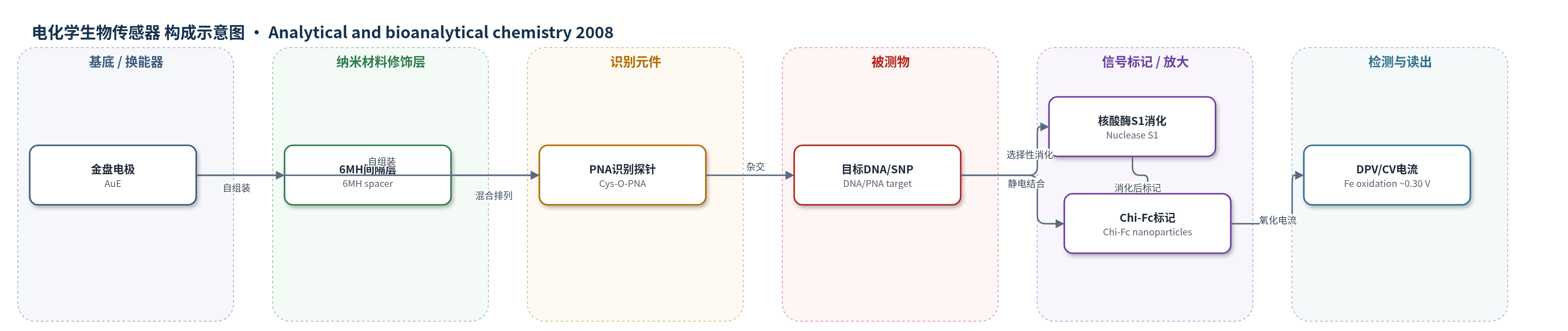
点击图片查看大图 · 依据论文自动绘制
传感器类型
电化学生物传感器
检测对象
单核苷酸多态性(SNP)目标DNA寡核苷酸、转基因(GMO)非对称PCR产物、乙醇脱氢酶(ALDH)相关PCR产物;样品基质包括DNA寡核苷酸溶液、Roundup Ready大豆基因组DNA、人类头发提取基因组DNA。
检测原理
PNA探针固定于金电极表面,与目标DNA杂交形成PNA/DNA双链。完全互补双链结构稳定且对Nuclease S1有抗性,保留表面负电DNA骨架;含SNP或非互补序列在错配位点结构扰动,使DNA链暴露并被Nuclease S1选择性水解,随后洗脱。Chi-Fc因壳聚糖正电基团与DNA磷酸骨架静电结合,其负载的二茂铁在约0.30 V发生氧化,DPV峰电流与表面保留的完整双链量成正比。因此完全互补目标产生高电流,SNP/非互补经酶切后电流降低,实现SNP判别。
检测灵敏度
LOD: 1 fM (S/N=3)
效应效果
该传感器对完全互补DNA与SNP、非互补DNA具有明显选择性:完全互补杂交经Nuclease S1处理后仍保留高电流,而A-G、A-C、A-A等SNP及非互补序列均呈低电流。PNA探针耐核酸酶消化,可连续使用10次;Chi-Fc在PBS 4°C保存3个月稳定,二茂铁释放量RSD为1.6%(n=5)。实际样品中,非对称PCR扩增的Roundup Ready大豆GMO片段产生高响应,非互补ALDH PCR片段低响应;PNA介导PCR可区分Caucasian与Japanese供体ALDH突变等位基因。作者认为该方法可用于高通量多SNP基因分型。
传感器的构成
- 基底/换能器:金盘电极(AuE,i.d. 1.6 mm/2 mm²),提供电子转导与电化学信号读出。
- 识别元件自组装层:半胱氨酸修饰PNA探针(Cys-O-ACC ACC ACT TC-NH2)通过Cys在金表面形成自组装单分子层,特异性识别目标DNA/PNA。
- 间隔/封闭层:6-巯基己醇(6MH)与PNA探针共组装,降低空间与静电阻碍并提高杂交效率。
- 核酸酶处理层:Nuclease S1(单链DNA特异性核酸酶)选择性水解含SNP或非互补的DNA链,保留完整PNA/DNA双链。
- 信号标记物:二茂铁偶联壳聚糖纳米颗粒(Chi-Fc,ferrocene-conjugated chitosan nanoparticles),正电壳聚糖静电结合DNA磷酸骨架,二茂铁在约0.30 V氧化产生电流。
- 电化学介质/读出:PBS/Tris缓冲液与DPV/CV三电极系统(Ag/AgCl参比、Pt辅助),读取二茂铁氧化峰电流。
中文摘要
本文报道一种基于核酸酶活性与电活性生物纳米颗粒的电化学生物传感器,用于快速分析核酸并检测单核苷酸多态性(SNP)。金电极表面固定中性肽核酸(PNA)探针,并与6-巯基己醇形成混合自组装单分子层。当PNA探针与完全互补目标DNA杂交后,带正电的二茂铁偶联壳聚糖纳米颗粒(Chi-Fc)静电结合到DNA磷酸骨架上,在约0.30 V产生强二茂铁氧化电流;而含SNP或非互补序列因双链结构扰动可被单链DNA特异性核酸酶S1选择性水解,导致Chi-Fc结合减少、电流降低。该方法对目标DNA寡核苷酸的检出限为1 fM(S/N=3)。作者进一步用非对称PCR检测转基因大豆样品中的GMO,并用PNA介导PCR扩增检测与乙醇脱氢酶(ALDH)相关的真实人类DNA SNP,表明壳聚糖纳米颗粒在分析检测与基因分型中具有应用潜力。
英文摘要
Here we report an electrochemical biosensor that would allow for simple and rapid analysis of nucleic acids in combination with nuclease activity on nucleic acids and electroactive bionanoparticles. The detection of single-nucleotide polymorphisms (SNPs) using PNA probes takes advantage of the significant structural and physicochemical differences between the full hybrids and SNPs in PNA/DNA and DNA/DNA duplexes. Ferrocene-conjugated chitosan nanoparticles (Chi-Fc) were used as the electroactive indicator of hybridization. Chi-Fc had no affinity towards the neutral PNA probe immobilized on a gold electrode (AuE) surface. When the PNA probe on the electrode surface hybridized with a full-complementary target DNA, Chi-Fc electrostatically attached to the negatively-charged phosphate backbone of DNA on the surface and gave rise to a high electrochemical oxidation signal from ferrocene at approximately 0.30 V. Exposing the surface to a single-stranded DNA specific nuclease, Nuclease S1, was found to be very effective for removing the nonspecifically adsorbed SNP DNA. An SNP in the target DNA to PNA made it susceptible to the enzymatic digestion. After the enzymatic digestion and subsequent exposure to Chi-Fc, the presence of SNPs was determined by monitoring the changes in the electrical current response of Chi-Fc. The method provided a detection limit of 1 fM (S/N = 3) for the target DNA oligonucleotide. Additionally, asymmetric PCR was employed to detect the presence of genetically modified organism (GMO) in standard Roundup Ready soybean samples. PNA-mediated PCR amplification of real DNA samples was performed to detect SNPs related to alcohol dehydrogenase (ALDH). Chitosan nanoparticles are promising biomaterials for various analytical and pharmaceutical applications.