组成图示
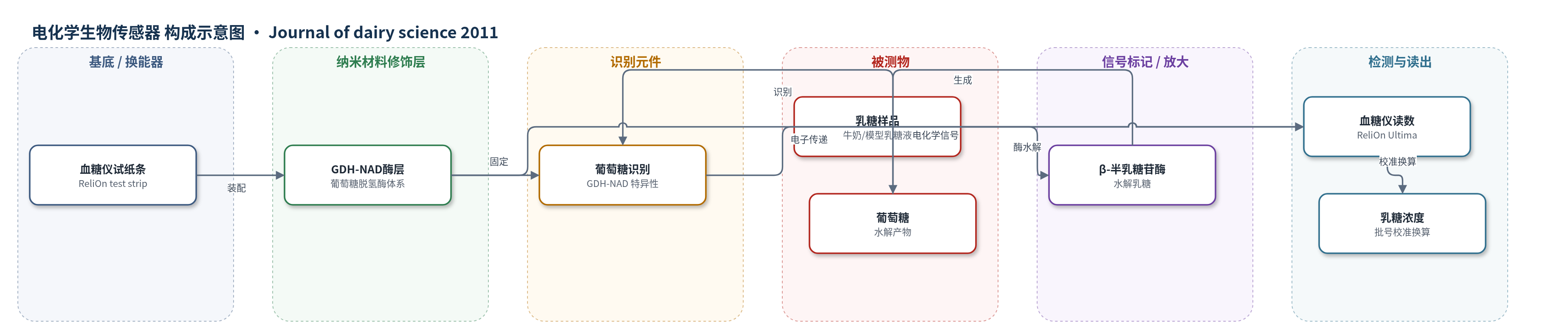
点击图片查看大图 · 依据论文自动绘制
传感器类型
电化学生物传感器
检测对象
乳糖(lactose);样品基质:生乳(raw milk)、乳糖模型溶液、乳制品
检测原理
样品稀释后加入β-半乳糖苷酶,在40°C孵育10 min,乳糖被水解为等摩尔葡萄糖和半乳糖。葡萄糖进入ReliOn血糖试纸后,被GDH-NAD体系特异性识别并催化氧化,NAD作为辅因子接受电子,试纸内电化学元件将氧化还原反应转换为电流信号,血糖仪读取并显示葡萄糖浓度(mg/dL)。由于每分子乳糖产生一分子葡萄糖,葡萄糖读数与原始乳糖浓度呈化学计量正比;再根据试纸批号校准方程换算为乳糖%。GDH-NAD对半乳糖无交叉反应,因此水解产生的半乳糖不干扰信号。方法无额外信号放大,主要依靠酶水解和电化学换能实现定量。
检测灵敏度
LOD: 未报告;线性范围: 血糖仪工作范围 20–500 mg/dL(0.02–0.5%, wt/vol);乳糖模型验证 1.9–6.5%;校准 0.05–0.38%;牛奶校准 2、3、4、5、6%;相关系数: r = 0.999;r2: 0.991、0.990、0.994、0.996、0.994(通用);0.988、0.990、0.990、0.994、0.994(批号);斜率: 0.855;1.032、1.008、1.054、1.070、1.033(通用);0.980、0.995、0.940、0.987、1.025(批号)
效应效果
方法以HPLC为参考进行验证。血糖仪之间无显著差异,但试纸批号影响显著;半乳糖(0–0.4%)不干扰GDH-NAD读数。模型液CV均<5%,最低1.99%,其余2.3–4.2%。通用校准斜率1.008–1.070,r2 0.990–0.996,平均CV 3.8%;批号校准斜率0.940–1.025,r2 0.988–0.994,平均CV 3.1%,平均百分比差<4%。生乳中两批试纸平均偏差分别为-0.05%和0.08%,批间CV 1.4–3.3%、平均2.2%。全程10–12 min,单次试纸约$0.40,适合乳企快速常规检测。
传感器的构成
- 换能器试纸:ReliOn Ultima 血糖仪试纸条(test strip),内置电化学传感元件,作为信号换能器
- 识别元件:葡萄糖脱氢酶-烟酰胺腺嘌呤二核苷酸体系(GDH-NAD),特异性识别葡萄糖
- 辅因子:NAD(烟酰胺腺嘌呤二核苷酸),作为GDH辅因子传递电子
- 电子供体:葡萄糖(glucose),由乳糖水解产生,在GDH-NAD反应中提供电子
- 样品前处理酶:β-半乳糖苷酶(β-galactosidase/lactase),将乳糖水解为葡萄糖和半乳糖
- 检测仪器:ReliOn Ultima 血糖仪,读取试纸电化学信号并显示葡萄糖mg/dL
中文摘要
现有乳制品中乳糖测定方法耗时繁琐,常需昂贵设备和熟练技术人员。本研究开发一种快速、常规测定乳制品乳糖的新方法。该方法利用β-半乳糖苷酶快速水解乳糖,随后用商用血糖仪测定生成的葡萄糖。血糖仪经过多年研发和临床验证,已被糖尿病患者广泛用于血糖监测。研究通过系列实验建立并验证方法:首先确定乳糖近乎完全水解所需的温度和时间;其次评估不同血糖仪及试纸批号对结果的影响,发现血糖仪之间无显著差异,而试纸批号之间存在显著差异;随后用1.9%–6.5%乳糖模型溶液验证方法,并与HPLC参考方法比较;最后用于测定生乳中的乳糖含量。结果表明,该方法具有快速、低成本、适合乳品生产现场常规检测的潜力。
英文摘要
Current methods for lactose measurement in dairy products are time consuming and tedious and may require expensive equipment and skilled technicians. The aim of this research was to develop a novel and rapid method for the routine measurement of lactose in dairy products. The proposed method is based on the rapid hydrolysis of lactose using β-galactosidase and subsequently measuring glucose using a blood glucose meter. Blood glucose meters were developed after decades of research and clinical trials and are used extensively worldwide by individuals with diabetes to monitor their blood glucose levels. The method was developed and validated in a series of experiments. In the first experiment, temperature and time required for the near-complete hydrolysis of lactose were determined. Subsequently, the influence of glucose meters and their test strip lots were evaluated. We found that meters were not significantly different. However, the test strip lots were significantly different from each other. In the second experiment, the proposed method was validated using different concentrations of lactose solutions (1.9-6.5%) and compared with a HPLC-based reference method. In the third experiment, the proposed method was used to determine the lactose content of raw milk. The proposed method shows potential for rapid, routine, and low-cost measurement of lactose in milk and other dairy products.