组成图示
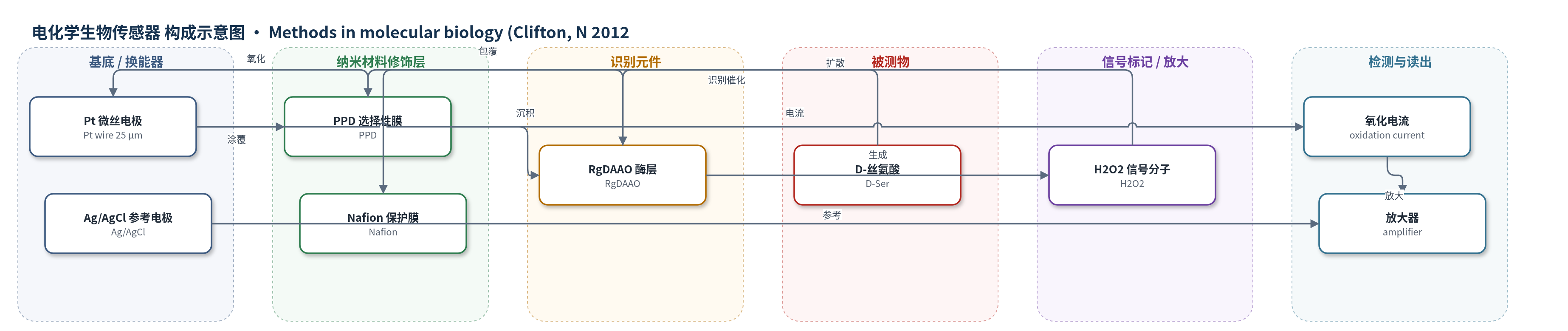
点击图片查看大图 · 依据论文自动绘制
传感器类型
电化学生物传感器
检测对象
D-氨基酸(D-amino acids,含 D-Ala、D-Asp、D-Glu、D-Ser 等);样品基质:食品(奶酪、牛奶等)及大鼠脑组织/脑内微环境
检测原理
RgDAAO 以绝对立体特异性识别 D-氨基酸,在分子氧存在下催化氧化脱氨,将 D-氨基酸转化为相应 α-酮酸和 NH3,并生成等摩尔 H2O2。H2O2 扩散至 Pt 或石墨工作电极,在 +400 mV 或 +500 mV 下被氧化,产生与 D-氨基酸浓度相关的安培电流;响应可用 Michaelis–Menten 方程描述。微电极中 PPD 膜允许 H2O2 透过并阻挡内源氧化分子,Nafion 膜保护酶层;固定化 RgDAAO 变体可扩大底物范围并降低表观 Km,提高复杂食品基质中的检测能力。
检测灵敏度
线性范围: 0–50 μM D-Ser
效应效果
该传感器选择性良好:PPD 膜使内源氧化分子干扰降低 97–99%,而 D-Ser 响应仅降低 12%;植入大鼠皮层后灵敏度下降约 13.2%,响应时间约 2 s。食品检测中,1 mM D-Ala 加标牛奶回收几乎完全,+400 mV 下未见干扰;奶酪中总 D-氨基酸约 6.1 mM(6.7 mg/g),与文献一致,且可分辨 D-Glu、D-Asp、D-Ala 组成。Specialities 型无酶时对 10 mM H2O2 和 1 mM D-Ala/丙酮酸无响应,属第三代直接电子转移。方法快速(10–15 min)、成本低(约 0.5 €/电极),适合食品质控与脑内 D-Ser 监测。
传感器的构成
- 微电极基底:Pt 微丝(25 μm × 150 μm),氧化 H2O2 产生电流
- 选择性膜:PPD 膜,覆盖 Pt 丝,允许 H2O2 扩散并阻挡内源氧化分子
- 识别/催化元件:RgDAAO 野生型或 M213R/M213G/T60A/Q144R/K152E 变体,氧化 D-氨基酸生成 H2O2
- 固定化载体:Amberzyme Oxirane 载体,共价固定 RgDAAO 变体(Specialities 传感器)
- 保护层:Nafion 膜,覆盖酶层,保护植入脑内时酶活性
- 换能器电极:石墨盘/丝网印刷石墨工作电极与 Ag/AgCl 参考电极,用于安培检测
- 信号读出:patch-clamp amplifier/electrochemistry amplifier,记录氧化电流
中文摘要
食品中 D-氨基酸可由高温、极端 pH 等加工过程或掺假、微生物污染产生,因此食品质量控制日益重要。常规食品分析需要简单、易用的方法,生物传感器常能满足要求。基于酶促立体特异性反应的生物传感器可用于检测和定量食品中的 D-氨基酸。来自酵母 Rhodotorula gracilis 的 D-氨基酸氧化酶(DAAO)具有绝对立体特异性、高转换数、与 FAD 辅因子紧密结合以及较宽底物特异性,是理想生物催化剂。此外,哺乳动物中枢神经系统中主要的 D-氨基酸 D-丝氨酸(D-Ser)局部浓度改变与多种神经和精神疾病相关,定量该神经调节剂对生物、医学和药物研究具有重要意义。近期已开发基于 R. gracilis DAAO 的酶微生物传感器,用于体内检测 D-丝氨酸。
英文摘要
The presence of D-amino acids in foods is promoted by harsh technological processes (e.g., high temperature or extreme pH values) or can be the consequence of adulteration or microbial contamination (D-amino acids are major components of the bacterial cell wall). For this reason, quality control is becoming more and more important both for the industry (as a cost factor) and for consumer protection. For routine food analysis and quality control, simple and easily applicable analytical methods are needed: biosensors can often satisfy these requirements. The use of an enzymatic, stereospecific reaction could confer selectivity to a biosensor for detecting and quantifying D-amino acids in foodstuffs. The flavoenzyme D-amino acid oxidase from the yeast Rhodotorula gracilis is an ideal biocatalyst for this kind of application because of its absolute stereospecificity, very high turnover number with various substrates, tight binding with the FAD cofactor, and broad substrate specificity. Furthermore, alterations in the local brain concentrations of D-serine (predominantly D-amino acid in the mammalian central nervous system) have been related to several neurological and psychiatric diseases. Therefore, quantifying this neuromodulator represents an important task in biological, medical, and pharmaceutical research. Recently, an enzymatic microbiosensor, also using R. gracilis D-amino acid oxidase as biocatalyst, was developed for detecting D-serine in vivo.