组成图示
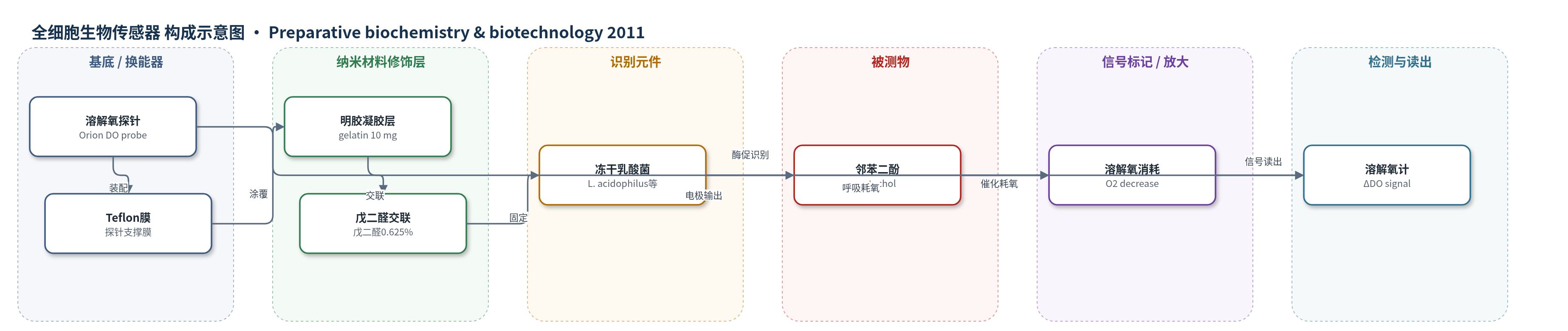
点击图片查看大图 · 依据论文自动绘制
传感器类型
全细胞生物传感器
检测对象
酚类化合物(phenolic compounds, PCs,以邻苯二酚 catechol 为模型底物);样品基质:合成废水、工业废水、乳品(巴氏奶、开菲尔、酸奶)
检测原理
冻干乳酸菌细胞被明胶/戊二醛固定在溶解氧探针 Teflon 膜上,细胞内多酚氧化酶(polyphenol oxidase)作为识别与催化元件。样品中的酚类化合物(以邻苯二酚 catechol 为代表)扩散进入生物活性层,被多酚氧化酶氧化为相应醌类并生成水,同时消耗溶解氧;细胞呼吸活性随底物浓度增加而增强,导致反应体系中溶解氧浓度下降。Clark 溶解氧电极将氧浓度变化转换为电化学信号,溶解氧计记录反应前后溶解氧浓度差 ΔDO。在 0.5–5.0 mM 范围内,ΔDO 与邻苯二酚浓度呈线性关系,响应时间约 18 min。该传感器无外加电子供体或化学放大,主要依靠全细胞酶促氧化与呼吸耗氧实现信号放大。
检测灵敏度
线性范围: 0.5–5.0 mM;R^2 = 0.9981
效应效果
传感器对邻苯二酚响应最高(100%),L-Dopa 89.2%、resorcin 87.63%、phenol 37.11%、orcinol 22.77%、p-cresol 5.15%;pyrogallol 表观 227.83%,但作者归因于碱性自然吸氧,故认为邻苯二酚选择性最佳。1.0 mM 邻苯二酚重复性 n=7,平均 1.022 mM,SD ±0.045,CV 4.39%。连续 11 次测量,7 次后开始失活;4°C 储存 18 天仅损失 22% 活性。实际样品稀释后测定,合成废水 1.0 mM 测得 0.87±0.04 mM、2.5 mM 测得 2.11±0.07 mM;工业废水和多种乳品检测值与报告值接近。作者认为其简单、快速、直接,适合乳品与环境废水酚类常规分析。
传感器的构成
- 换能器电极:溶解氧探针(Orion 3 star DO probe),通过 Clark 氧电极检测溶解氧消耗。
- 支撑膜:Teflon 膜(溶解氧探针膜),承载生物活性层并允许底物与氧扩散。
- 固定基质:明胶(gelatin, 10 mg),形成凝胶层包埋乳酸菌细胞。
- 交联固定剂:戊二醛(glutaraldehyde, 0.625%),交联明胶并将细胞固定于膜表面。
- 识别元件:冻干乳酸菌细胞(lyophilized Lactobacillus cells,含 L. bulgaricus、L. acidophilus、S. thermophilus,10 mg),提供多酚氧化酶活性并催化邻苯二酚氧化。
- 工作介质:磷酸盐缓冲液(50 mM phosphate buffer, pH 8.0),维持细胞酶活性和反应 pH。
- 信号读出:溶解氧计(dissolved oxygen meter),记录反应前后溶解氧浓度差 ΔDO。
中文摘要
酚类化合物(PCs)在工业生产中广泛使用,其灵敏、准确、快速、经济测定很重要。此前已有基于纯多酚氧化酶、植物组织和微生物的酚类生物传感器,但尚无基于含多酚氧化酶的乳酸菌属构建微生物酚类生物传感器的研究。本研究采用不同形态的乳酸菌作为生物传感器酶源,比较其测定酚类化合物的性能,包括冻干乳酸菌细胞(含 L. bulgaricus、L. acidophilus、Streptococcus thermophilus)、纯 L. acidophilus、纯 L. bulgaricus 以及在 MRS 肉汤中经邻苯二酚适应的 L. acidophilus 和 L. bulgaricus。以邻苯二酚为底物,将乳酸菌细胞用明胶和戊二醛固定形成生物活性层,基于细胞在有无邻苯二酚时呼吸活性差异,用溶解氧计测定耗氧量。在 0.5–5.0 mM 范围内响应与邻苯二酚浓度呈线性,响应时间 18 min。优化得到最适菌量 10 mg,磷酸盐缓冲液 pH 8.0、50 mM,37.5°C。还考察底物特异性、操作和储存稳定性,并在合成废水、工业废水和乳品中测定酚类水平。
英文摘要
Different branches of industry need to use phenolic compounds (PCs) in their production, so determination of PCs sensitively, accurately, rapidly, and economically is very important. For the sensitive determination of PCs, some biosensors based on pure polyphenol oxidase, plant tissue and microorganisms were developed before. But there has been no study to develop a microbial phenolic compounds biosensor based on Lactobacillus species, which contain polyphenol oxidase enzyme. In this study, we used different forms of Lactobacillus species as enzyme sources of biosensor and compared biosensor performances of these forms for determination of PCs. For this purpose, we used lyophilized Lactobacillus cells (containing L. bulgaricus, L. acidophilus, Streptococcus thermophilus), pure L. acidophilus, pure L. bulgaricus, and L. acidophilus- and L. bulgaricus adapted to catechol in Lactobacilli MRS Broth. The most suitable form was determined and optimization studies of the biosensor were carried out by using this form. For preparing the bioactive layer of the biosensor, the Lactobacillus cells were immobilized in gelatin by using glutaraldehyde. In the study, we used catechol as a substrate. Phenolic compound determination is based on the assay of the differences on the respiration activity of the cells on the oxygen meter in the absence and the presence of catechol. The microbial biosensor response depends directly on catechol concentration between 0.5 and 5.0 mM with 18 min response time. In the optimization studies of the microbial biosensor the most suitable microorganism amount was found to be 10 mg, and also phosphate buffer (pH 8.0; 50 mM) and 37.5 °C were obtained as the optimum working conditions. In the characterization studies of the microbial biosensor some parameters such as substrate specificity on the biosensor response and operational and storage stability were examine. Furthermore, the determination of PC levels in synthetic wastewater, industrial wastewater, and milk products was investigated by using the developed biosensor under optimum conditions.