组成图示
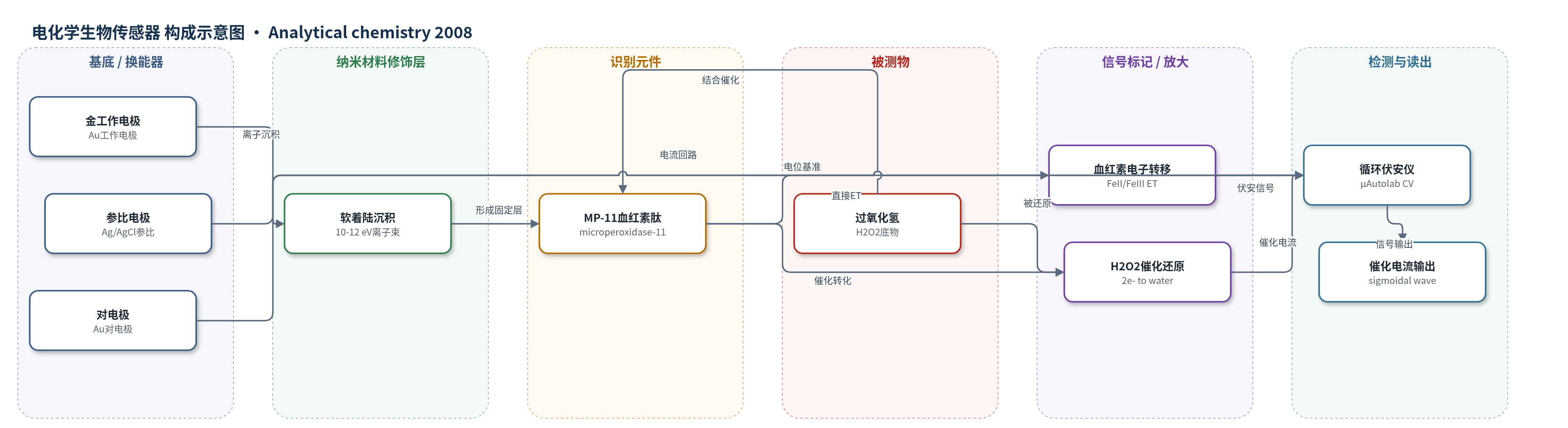
点击图片查看大图 · 依据论文自动绘制
传感器类型
电化学生物传感器
检测对象
过氧化氢(H2O2,hydrogen peroxide),样品基质为 0.05 M PBS(pH 7.0)含 0.1 M KCl 缓冲液(N2 饱和)
检测原理
MP-11 通过软着陆直接固定于金电极表面,血红素中心与电极紧密接触,实现无中介直接电子转移。在循环伏安中,MP-11 的 FeII/FeIII 氧化还原对产生可逆峰;加入 H2O2 后,血红素中心与 H2O2 反应生成类似过氧化物酶 Compound I/II 的活性中间体,催化 H2O2 两电子还原为水。催化周转使电子转移电流放大,峰形由峰状变为 sigmoidal 催化波。稳态还原峰电流随 H2O2 浓度增加而线性增大,MP-11a 线性范围 0.010–0.095 mM,MP-11b 为 0.015–0.110 mM;超过 0.15 mM 后酶逐渐失活,电流下降。
检测灵敏度
线性范围: 0.010–0.095 mM(MP-11a);0.015–0.110 mM(MP-11b)
效应效果
软着陆固定化重现性约4%,MP-11层经强水洗后仍稳定,说明与金表面结合牢固;催化活性一周内下降约10%,长期稳定性良好。MP-11a 比 MP-11b 保持更好的生物催化活性和更可逆的电化学行为,作者认为其 H2O2 催化灵敏度高于化学或物理固定 MP-11 电极。该电极无需固定化基质或连接分子,可实现无中介直接电子转移,适合用作生物传感器换能器或生物燃料电池阴极元件。
传感器的构成
- 基底/换能器电极:金工作电极(Au,1 mm)屏印电极(SPE),提供电子转移界面
- 参比电极:Ag/AgCl 参比电极(198 mV vs NHE),提供稳定电位基准
- 对电极:金对电极(Au),完成电化学回路
- 识别/催化元件:微过氧化物酶-11(MP-11,血红素十一肽)软着陆固定于 Au 表面,提供血红素 FeII/FeIII 直接电子转移与 H2O2 催化活性
- 沉积前驱体:质量选择 [MP-11+H]2+(MP-11a)或 [MP-11+2H]3+(MP-11b)离子,低动能(10–12 eV)软着陆形成强结合首层与弱吸附层
- 电解液/电子供体:0.05 M PBS(pH 7.0)含 0.1 M KCl,H2O2 作为底物/电子供体被催化还原为水
中文摘要
本研究将微过氧化物酶-11(MP-11)通过离子软着陆沉积到屏印电极的金工作电极表面,并用飞行时间二次离子质谱(TOF-SIMS)证实完整蛋白沉积。软着陆与电化学技术联用,可获取沉积特征的独特信息。作者通过循环伏安实验并结合 Marcus 理论建模,对直接电子转移性质进行了完整表征,计算得到电子转移速率常数、形式氧化还原电位和重组能。结果表明,由双电荷离子和三电荷离子沉积的 MP-11 具有不同构象和表面结合强度。MP-11 与金表面强相互作用及功能化电极的长期稳定性,使该方法优于现有固定化方法,适用于无中介、无桥接的生物电化学电子转移应用,如生物传感器换能器或生物燃料电池电极元件。
英文摘要
Microperoxidase-11 (MP-11) was first soft landed onto the gold surface of a screen-printed electrode. Intact protein deposition was verified by time-of-flight secondary ion mass spectrometry. The coupling of soft landing with electrochemical techniques allowed unique information to be obtained about the deposition features. A full characterization of the direct electron-transfer properties was performed by modeling data obtained from cyclic voltammetry experiments; calculated values of kinetic electron-transfer constant, formal redox potential, and reorganization energy allow us to hypothesize the mechanism involved in soft landing immobilization and demonstrate the different conformation of the enzyme deposited from two different charged species. The strong interaction between MP-11 and the gold surface and long-term stability of the functionalized electrode characterizes the peculiar features of this procedure, which enhance its power with respect to the existing immobilization procedure and ensure its suitability for those practical applications that could benefit from an unmediated bridgeless bioeletrochemical electron transfer (e.g., biosensor transducers or electrode elements in biofuel cells).