组成图示
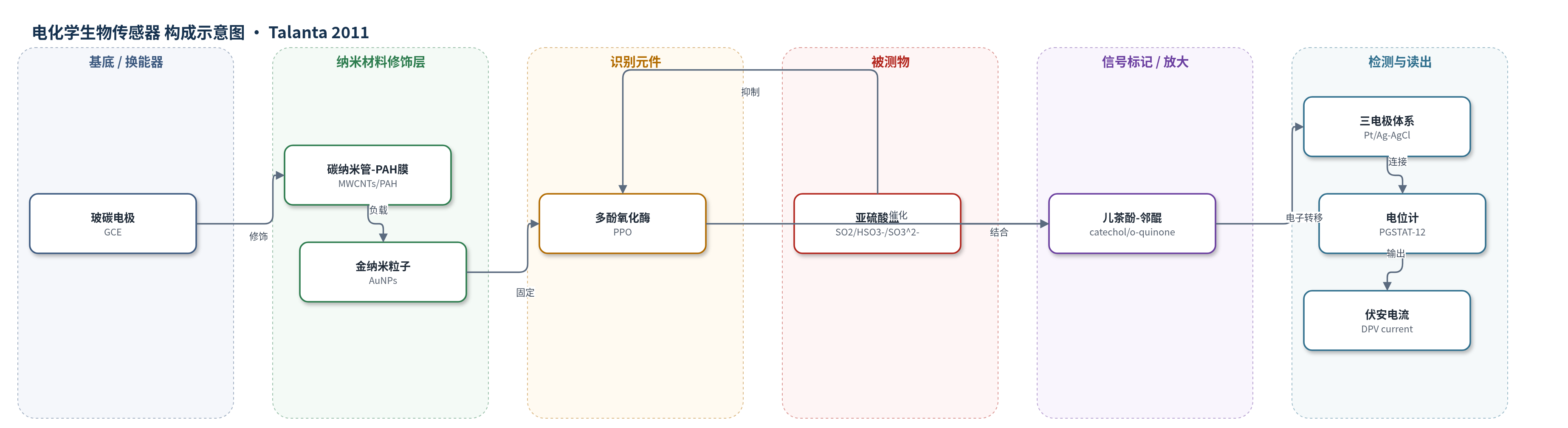
点击图片查看大图 · 依据论文自动绘制
传感器类型
电化学生物传感器
检测对象
亚硫酸盐(sulfite,SO2/HSO3−/SO3^2−);样品基质:白葡萄酒、红葡萄酒
检测原理
该传感器采用间接抑制法检测亚硫酸盐。PPO在电极表面以分子氧为电子受体催化儿茶酚氧化为邻醌,邻醌/儿茶酚在AuNPs-MWCNTs-PAH/GCE上发生氧化还原,产生可测量的伏安峰电流(文中以阳极峰电流Iap表征)。MWCNTs和AuNPs提高电子转移速率与电活性面积,PAH膜稳定纳米材料并辅助固定酶,从而放大信号。当样品中存在亚硫酸盐时,亚硫酸盐一方面直接抑制PPO活性,另一方面作为强亲核试剂与邻醌反应,降低可电活性邻醌/儿茶酚循环浓度,使峰电流随亚硫酸盐浓度增加而下降。通过差分脉冲伏安法读取峰电流变化,即可反推亚硫酸盐浓度。
检测灵敏度
LOD: 0.4 μmol L−1;线性范围: 0.5–22 μmol L−1;r = 0.9962;回归方程(原文): Iap/μA = 6.34 × 10⁻⁸ + 0.122 [c/(mol L−1)]
效应效果
该传感器对葡萄酒中常见干扰物(抗坏血酸、山梨酸钠、乙醇、蔗糖)在1:1、1:10、10:1比例下基本无显著干扰;抗坏血酸1:10时误差约10%,但样品中不存在且可去除。日内重复性RSD为1.4%(n=10,8.0 μmol/L),5天日间偏差≤2.4%,三个独立传感器RSD为3.9%。修饰液2周稳定性阴极电流下降约10%,传感器4周存储后下降约11%。六份葡萄酒标准加入回收率为91.8%–108%;DPV结果与碘量法无显著差异(配对t=0.654<2.571,95%置信),相对误差为0.6%、−1.2%、4.0%、−1.3%、−1.3%、−2.1%,适合快速、低成本常规检测。
传感器的构成
- 基底/换能器电极:玻碳电极(GCE),抛光后作为工作电极与电子转导基底
- 纳米材料修饰层:酸氧化多壁碳纳米管(MWCNTs)与聚(烯丙基胺盐酸盐)(PAH)复合膜,增强导电性、增大电活性面积并稳定分散
- 纳米粒子层:金纳米粒子(AuNPs,平均直径约29 nm),提供酶固定位点并增强信号转导
- 交联连接层:半胱胺(CYS)与戊二醛(GA),用于将PPO共价固定于AuNPs表面
- 识别元件:多酚氧化酶(PPO,来自甘薯粗提物),催化儿茶酚氧化为邻醌并受亚硫酸盐抑制
- 底物/信号介质:儿茶酚(catechol)及其氧化产物邻醌(o-quinone),在电极上发生可逆氧化还原产生电流
- 支持电解质:0.1 mol/L磷酸盐缓冲液(PBS,pH 7.0),维持酶活性与离子导电
中文摘要
本文提出以多壁碳纳米管(MWCNTs)和聚(烯丙基胺盐酸盐)(PAH)膜中金纳米粒子(AuNPs)修饰玻碳电极(GCE),用于构建多酚氧化酶(PPO)生物传感器。PPO取自甘薯(Ipomoea batatas)粗提物,通过半胱胺(CYS)和戊二醛(GA)固定于AuNPs上。分析方法基于亚硫酸盐对PPO催化儿茶酚氧化及邻醌还原过程的抑制作用,以及亚硫酸盐与邻醌的反应。在优化条件下采用差分脉冲伏安法(DPV)检测,亚硫酸盐在0.5–22 μmol/L范围内线性,检出限为0.4 μmol/L。将该传感器用于白葡萄酒和红葡萄酒中总亚硫酸盐的间接测定,采用标准加入法,结果与AOAC碘量滴定参考方法在95%置信水平下无显著差异,表明该传感器可用于食品与饮料中快速、低成本的亚硫酸盐监测。
英文摘要
The modification of a glassy carbon electrode with multi-walled carbon nanotubes and gold nanoparticles within a poly(allylamine hydrochloride) film for the development of a biosensor is proposed. This approach provides an efficient method used to immobilize polyphenol oxidase (PPO) obtained from the crude extract of sweet potato (Ipomoea batatas (L.) Lam.). The principle of the analytical method is based on the inhibitory effect of sulfite on the activity of PPO, in the reduction reaction of o-quinone to catechol and/or the reaction of o-quinone with sulfite. Under the optimum experimental conditions using the differential pulse voltammetry technique, the analytical curve obtained was linear in the concentration of sulfite in the range from 0.5 to 22 μmol L(-1) with a detection limit of 0.4 μmol L(-1). The biosensor was applied for the determination of sulfite in white and red wine samples with results in close agreement with those results obtained using a reference iodometric method (at a 95% confidence level).