组成图示
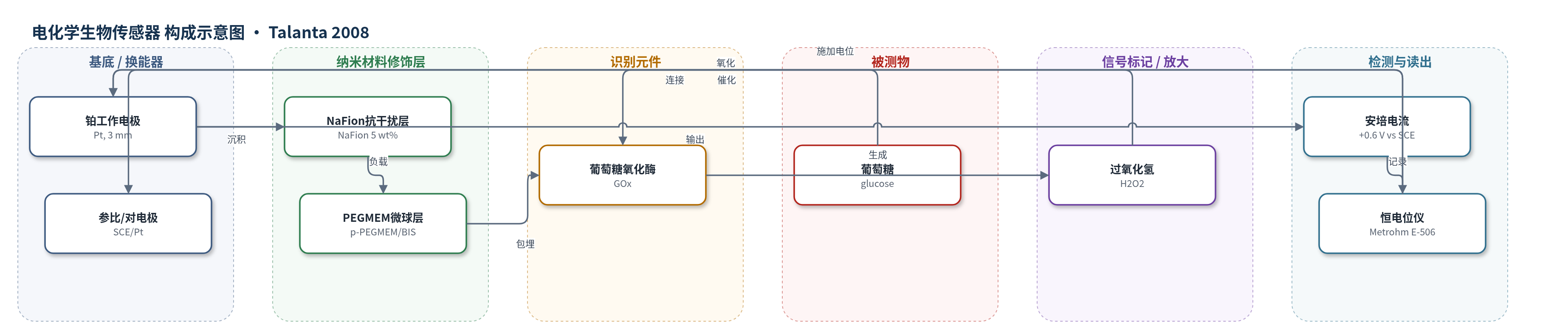
点击图片查看大图 · 依据论文自动绘制
传感器类型
电化学生物传感器
检测对象
葡萄糖(glucose);样品基质:人血清(human serum)、磷酸盐/醋酸磷酸盐缓冲液
检测原理
葡萄糖扩散进入p-PEGMEM水凝胶微球后,被包埋的葡萄糖氧化酶(GOx)催化氧化,反应消耗O2并生成H2O2。H2O2扩散至铂工作电极,在+0.6 V vs SCE发生氧化,电子转移产生稳态安培电流。电流大小随葡萄糖浓度升高而增大,在2.0×10⁻⁶至7.6×10⁻³ M范围内线性。NaFion负电荷聚电解质层可排斥尿酸和抗坏血酸等负电干扰物,提高选择性。微球的交联度决定孔结构和体积相变行为,从而影响底物扩散、酶微环境和响应强度。
检测灵敏度
LOD: 1 μM;线性范围: 2.0×10⁻⁶–7.6×10⁻³ M;灵敏度: 17.78 mA M−1 cm−2;R^2 = 0.9985
效应效果
NaFion修饰后,0.25 mM尿酸和抗坏血酸的干扰信号消失,葡萄糖响应基本保持。人血清中GOx-NaFion传感器与己糖激酶参考法偏差为-0.1%至-1.3%,RSD<2.3%;未修饰传感器结果偏高1.0%–4.5%。加标回收率为94.8%–101.5%。重复性RSD为5.7%(0.25 mM,10次),重现性RSD为0.88%(5 mM,3个电极)。传感器在-4°C磷酸盐缓冲液中保存520天后仍保留85%初始响应。作者称与类似微球及层状自组装/沉积体系相比,检出限降低约10倍、线性范围提高至少一个数量级、稳定性由30/150天延长至520天,适用于血清葡萄糖监测。
传感器的构成
- 工作电极:铂(Pt)电极,直径3 mm,抛光后作为安培换能器,检测H2O2氧化电流
- 抗干扰修饰层:NaFion 5 wt%薄膜,负电荷聚电解质,排斥尿酸(UA)和抗坏血酸(AA)等负电干扰物
- 酶固定化微球层:p-PEGMEM微球,由PEGMEM单体、BIS交联剂、APS/TEMED引发体系和Span 80乳化剂制备,包埋GOx并提供底物扩散通道
- 识别/催化元件:葡萄糖氧化酶(GOx,Aspergillus niger),催化葡萄糖氧化并生成H2O2
- 固定/覆盖层:透析膜(12,000–14,000 MWCO),机械固定微球并覆盖电极表面
- 信号换能物:过氧化氢(H2O2),在Pt电极+0.6 V vs SCE处氧化,产生与葡萄糖浓度相关的安培电流
- 缓冲介质:0.05 M醋酸/0.05 M磷酸盐缓冲液(pH 6.5),维持酶活性和离子环境
中文摘要
本文合成聚乙二醇甲基醚甲基丙烯酸酯(PEGMEM)微球,并将葡萄糖氧化酶(GOx)包埋于微球内部,用于构建安培葡萄糖生物传感器。通过考察微球制备中单体浓度和交联剂含量对传感器响应的影响,优化了酶固定化条件,最佳条件为0.21 M PEGMEM单体和0.74%交联度。进一步研究了工作电位、pH、温度和酶负载量等参数对传感器性能的影响,并测定了灵敏度、线性范围、响应时间和检出限。该传感器用于人血清中葡萄糖的测定,并在电极表面沉积NaFion层以抑制尿酸和抗坏血酸等常见干扰物。结果表明,NaFion修饰后干扰信号显著降低,传感器使用寿命至少可达520天。
英文摘要
Poly(ethylene glycol) methyl ether methacrylate (PEGMEM) microparticles were synthesized and glucose oxidase (GOx) was immobilized within the microparticles. An amperometric biosensor was fabricated using the microparticles with GOx as biological component. The enzyme immobilization method was optimized by investigating the influence of monomer concentration and cross-linker content used in the preparation of the microparticles in the response of the biosensor. The best analytical results were obtained with the microparticles prepared with 0.21 M PEGMEM and 0.74% cross-linking. Furthermore, we have investigated the influence on the biosensor behaviour of parameters such as working potential, pH, temperature and enzymatic load. In addition, analytical properties such as sensitivity, linear range, response time and detection limit were determined. The biosensor was used to determine glucose in human serum samples and to avoid common interferents present in human serum such as uric and ascorbic acids. A Nafion layer was deposited on the electrode surface with satisfactory results. The useful lifetime of the biosensor was at least 520 days.