组成图示
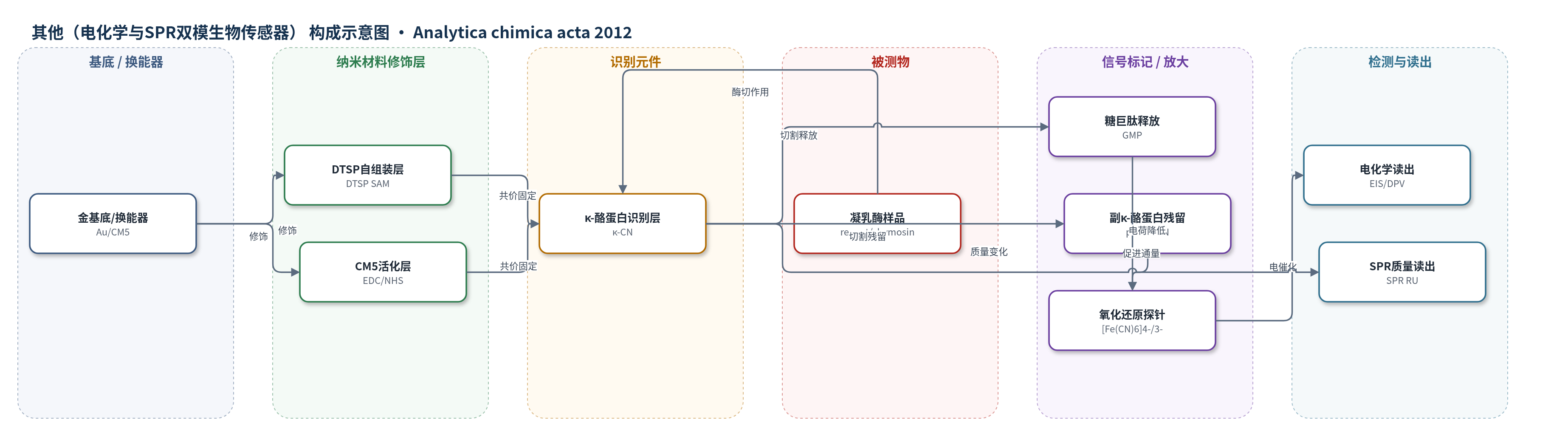
点击图片查看大图 · 依据论文自动绘制
传感器类型
其他(电化学与SPR双模生物传感器)
检测对象
凝乳酶凝血活性(rennet clotting activity,主要活性成分凝乳蛋白酶 chymosin);样品基质:商业固体或液体凝乳酶样品,溶于20 mM咪唑缓冲液(pH 5–6.5)
检测原理
固定于金表面的κ-CN带负电,阻碍六氰合铁(II)/(III)接近电极。凝乳酶中的凝乳蛋白酶识别并切割κ-CN的Phe105–Met106键,释放可溶性糖巨肽,留下带正电的副κ-酪蛋白。该酶切使传感界面净负电荷降低、传感层部分降解,氧化还原探针向电极的通量增加,六氰合铁偶联电催化增强,EIS电荷转移电阻降低、DPV峰电流增大,信号变化随凝乳酶活性增加而增大。SPR模式无标记,固定κ-CN被切割后表面质量减少,SPR角/RU下降,实时反映凝乳酶凝血活性。
检测灵敏度
原文未报告LOD、线性范围、灵敏度斜率或相关系数。
效应效果
传感器成功用于多种商业固体和液体凝乳酶样品。EIS在30 ℃和室温下重现性优于5%,DPV相对标准偏差为10–12%,因此EIS更可靠。与Berridge参考法相比,EIS所得凝血力单位比分别为1.78和2.55,接近参考法的1.69和2.68;DPV为1.30和1.93。孵育时间由15 min降至5 min,响应时间较人工酪蛋白微粒传感器由60 min显著缩短。SPR空白CM5芯片对凝乳酶无响应,非特异吸附低,CM5/κ-CN芯片给出浓度依赖信号。作者认为EIS适合常规分析和现场应用。
传感器的构成
- 基底/换能器:金电极(Au)或再生CM5金芯片,提供电子转导或SPR换能
- 修饰层:DTSP自组装单层(SAM),提供亲水性和与伯胺反应位点
- SPR修饰层:再生羧甲基化葡聚糖(CM5)表面,经EDC/NHS活化形成NHS酯
- 识别元件:κ-酪蛋白(κ-CN),共价固定于DTSP或CM5表面,作为凝乳酶底物
- 信号探针:六氰合铁(II)/(III)([Fe(CN)6]4−/3−),用于CV/DPV/EIS读出
- 去活化/封闭:乙醇胺(ethanolamine),用于SPR表面残余NHS酯去活化
中文摘要
本文首次报道基于κ-酪蛋白(κ-CN)的电化学和表面等离子共振(SPR)生物传感器,用于评估凝乳酶(rennet)凝血活性。电化学传感器构建于修饰有双硫代双N-琥珀酰亚胺基丙酸酯(DTSP)自组装单层的金电极上;SPR在再生羧甲基化葡聚糖(CM5)金表面进行。两种传感器均共价固定κ-CN。电化学传感器用循环伏安、差分脉冲伏安和电化学阻抗谱(EIS),以六氰合铁(II)/(III)为氧化还原探针,研究固定κ-CN与凝乳蛋白酶(chymosin)的相互作用。凝乳酶在Phe105–Met106键切割κ-CN,释放可溶性糖巨肽(GMP),并留下带正电的不溶性副κ-酪蛋白。表面净负电荷降低和传感层部分降解增加氧化还原探针通量,使金表面电催化增强,产生信号变化。SPR在无氧化还原探针下进行,SPR角变化仅归因于固定κ-CN切割。作者考察实验变量并成功应用于实际样品,EIS所得商业固体或液体样品凝血力单位比与参考法几乎相同,重现性优于5%。
英文摘要
We report for the first time the development of kappa-casein (κ-CN)-based electrochemical and surface plasmon resonance (SPR) biosensors for the assessment of the clotting activity of rennet. Electrochemical biosensors were developed over gold electrodes modified with a self-assembled monolayer of dithiobis-N-succinimidyl propionate, while SPR measurements were performed on regenerated carboxymethylated dextran gold surfaces. In both types of biosensor, κ-CN molecules were immobilized onto modified gold surfaces through covalent bonding. In electrochemical biosensors, interactions between the immobilized κ-CN molecules and chymosin (the active component of rennet) were studied by performing cyclic voltammetry, differential pulsed voltammetry, and electrochemical impedance spectroscopy (EIS) measurements, using hexacyanoferrate(II)/(III) couple as a redox probe. κ-CN is cleaved by rennet at the Phe105-Met106 bond, producing a soluble glycomacropeptide, which is released to the electrolyte, and the positively charged insoluble para-κ-casein molecule, which remains attached to the surface of the electrode. This induced reduction of the net negative charge of the sensing surface, along with the partial degradation of the sensing layer, results in an increase of the flux of the redox probe, which exists in the solution, and consequently, to signal variations, which are associated with the increased electrocatalysis of the hexacyanoferrate(II)/(III) couple on the gold surface. SPR experiments were performed in the absence of the redox probe and the observed SPR angle alterations were solely attributed to the cleavage of the immobilized κ-CN molecules. Various experimental variables were investigated and under the selected conditions the proposed biosensors were successfully tried to real samples. The ratios of the clotting power units in various commercial solid or liquid samples, as they are calculated by the EIS-based data, were almost identical to those obtained with a reference method. In addition, EIS measurements showed an excellent reproducibility, lower than 5%.