组成图示
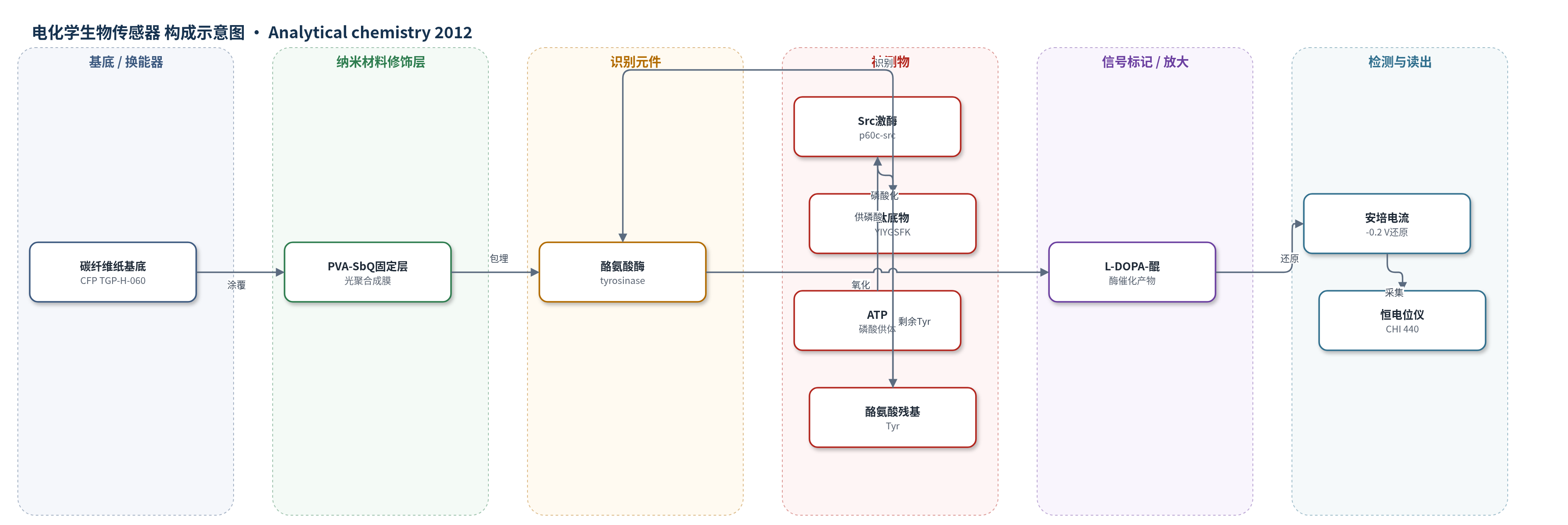
点击图片查看大图 · 依据论文自动绘制
传感器类型
电化学生物传感器
检测对象
蛋白酪氨酸激酶活性(protein tyrosine kinase activity,模型酶 Src/p60c-src);样品基质:重组 Src 反应缓冲液、HeLa 细胞裂解液
检测原理
先在试管中进行 Src 激酶反应:Src 以 ATP 为磷酸供体磷酸化肽底物 YIYGSFK 中的酪氨酸残基,生成磷酸酪氨酸 pTyr。酪氨酸酶可催化未磷酸化 Tyr 氧化为 L-DOPA 和 L-DOPA-quinone,但 pTyr 因羟基被磷酸化而不被酪氨酸酶识别。因此激酶活性越高,剩余 Tyr 越少。取反应液至酶电极,在 -0.2 V vs Ag/AgCl 下,L-DOPA-quinone 被还原产生安培电流;电流与剩余 Tyr 成正比,与 Src 活性呈负相关。加入激酶抑制剂可抑制磷酸化,使剩余 Tyr 增加,电流回升。该方法无标记、无需固定肽底物,可重复测量。
检测灵敏度
LOD: 0.23 U/mL (Src, S/N ≥3);线性范围: 1.9–237.6 U/mL (Src);LOD: 50 nM (p60c-src substrate I, S/N ≥3);线性范围: 0.1–10 μM (p60c-src substrate I, R^2 = 0.998);灵敏度: 2.21 ± 0.04 μA μM−1 cm−2 (Tyr, R^2 = 0.997)
效应效果
对 pTyr 无响应,10 μM pTyr 不干扰 Tyr 测定,Tyr/pTyr 混合 R^2=0.998,r=0.996。3 μM p60c-src substrate I 重复 12 次 RSD 3.72%,可重复使用且无需再生。与既往 Src 电化学方法(10–200 U/mL、LOD 5 U/mL)相比,本文 1.9–237.6 U/mL、LOD 0.23 U/mL。200 nM PP2 和 88 nM Src inhibitor-1 分别抑制约 65%、58%,IC50 约 45 nM;PD153035 仅抑制约 14%,staurosporine 呈 ATP 依赖抑制。HeLa 裂解液经 EGF 处理后 Src 活性升高(p<0.05),具药物筛选潜力。
传感器的构成
- 基底电极:碳纤维纸 CFP(TGP-H-060),经 N2 等离子体预处理,提供导电基底与电子转导
- 固定成膜层:聚乙烯醇吡啶甲基硫酸盐功能化材料 PVA-SbQ,与酶混合涂覆并光聚合,固定酶并增强界面稳定性
- 识别催化元件:酪氨酸酶 tyrosinase(EC 1.14.18.1),催化未磷酸化 Tyr 氧化,区分 Tyr 与 pTyr
- 交联稳定层:戊二醛 glutaraldehyde 蒸气,交联 PVA-SbQ/酪氨酸酶,提高重复使用稳定性
- 信号标记物:无外源标记,酪氨酸酶催化生成 L-DOPA-quinone 作为电化学信号源
- 工作介质:PBS 缓冲液(pH 6.8/6.5),维持酶活性并提供离子导电环境
中文摘要
本文报道了一种简单、低成本、可重复且无标记的蛋白酪氨酸激酶活性检测方法,基于酪氨酸酶构建安培生物传感器。该方法利用磷酸化可阻断酪氨酸酶催化氧化肽中酪氨酸或酪氨酸残基的特性:当使用 p60c-src 特异性肽底物 p60c-src substrate I 时,可快速测定 p60c-src 蛋白酪氨酸激酶(Src)的活性。该传感器对 Src 活性高度敏感,线性动态范围为 1.9–237.6 U/mL,最低检测限为 0.23 U/mL。值得注意的是,酪氨酸激酶活性可在该传感器上重复测量而无需再生。多种激酶抑制剂对 Src 活性的抑制效应也可在该传感器上测定:Src 特异性抑制剂 PP2 和 Src inhibitor I 能有效抑制 Src 活性,而表皮生长因子受体抑制剂 PD153035 无效;通用激酶抑制剂 staurosporine 则以 ATP 浓度依赖方式抑制 Src 活性。结果表明,该酪氨酸激酶生物传感器可有效测量酪氨酸激酶活性及其对不同试剂的响应行为。
英文摘要
This work presents a simple, low-cost and reusable label-free method for detecting protein tyrosine kinase activity using a tyrosinase-based amperometric biosensor (tyrosine kinase biosensor). This method is based on the observation that phosphorylation can block the tyrosinase-catalyzed oxidation of tyrosine or tyrosyl residue in peptides. Therefore, the activity of p60c-src protein tyrosine kinase (Src) on the developed tyrosine kinase biosensor could be quickly determined when its specific peptide substrate, p60c-src substrate I, was used. The tyrosine kinase biosensor was highly sensitive to the activity of Src with a linear dynamic range of 1.9-237.6 U/mL and the lowest detection limit of 0.23 U/mL. Interestingly, the tyrosine kinase activity can be measured using the developed tyrosine kinase biosensor repetitively without regeneration. The inhibitory effect of various kinase inhibitors on the Src activity could be determined on the tyrosine kinase biosensor. Src-specific inhibitors, PP2 and Src inhibitor I, effectively suppressed Src activity, whereas PD153035, an inhibitor of the epidermal growth factor receptor, was ineffective. Staurosporine, a universal kinase inhibitor, inhibited Src activity in an ATP concentration-dependent manner. These results suggests that the activities of tyrosine kinases and their behaviors toward various reagents can be effectively measured using the developed tyrosine kinase biosensor.