组成图示
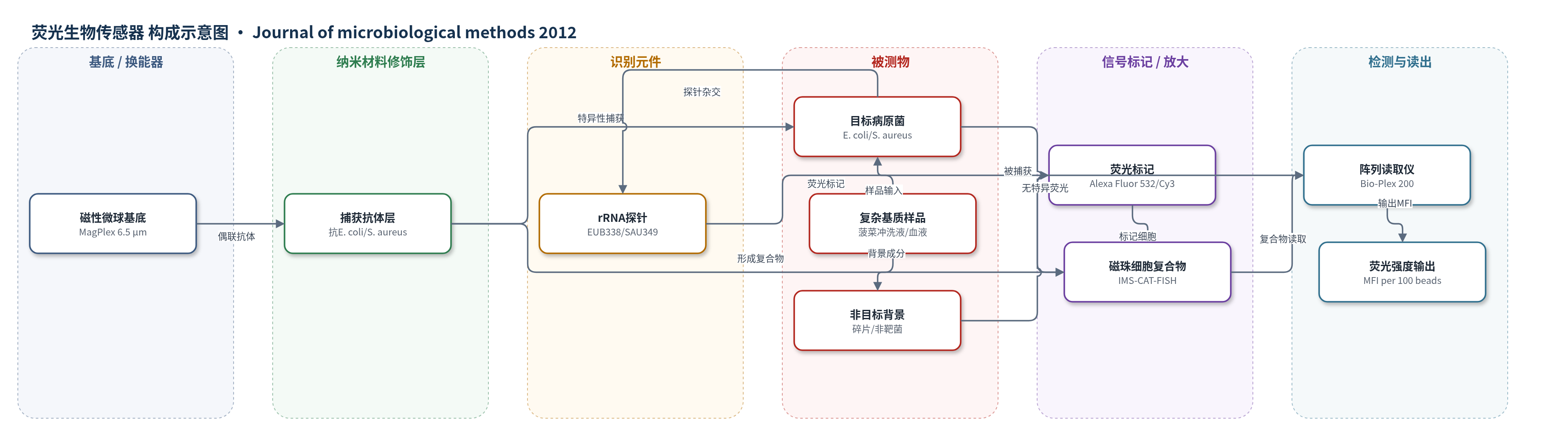
点击图片查看大图 · 依据论文自动绘制
传感器类型
荧光生物传感器
检测对象
大肠杆菌O157:H7(Escherichia coli O157:H7)、金黄色葡萄球菌(Staphylococcus aureus);样品基质:PBS、菠菜冲洗液、羊血/血液培养物
检测原理
CAT-FISH首先用methacarn固定细菌,避免PFA交联破坏表面抗原,同时保持16S rRNA可及。液相FISH中,荧光标记的EUB338或SAU349探针与目标菌内部rRNA杂交,形成细胞内荧光标记;非目标菌或碎片即使被抗体非特异结合,也不含目标rRNA探针荧光。随后,偶联捕获抗体的MagPlex磁珠通过表面抗原-抗体反应捕获目标菌,形成磁珠-细胞复合物。洗涤后,复合物在Bio-Plex 200中激发,读取每颗磁珠表面捕获细胞的平均荧光强度。目标菌浓度升高时,被捕获的荧光细胞数增加,平均荧光强度或SALOD随之升高;文中观察到每增加一个对数浓度信号约增加一个对数,至10^6 cells/ml饱和。该方法以核酸和蛋白双重识别提高特异性。
检测灵敏度
LOD: PBS中约10^3 cells/ml;E. coli O157:H7:10^3 cells/ml偶发检出、10^4 cells/ml常规检出;S. aureus:>10^3 cells/ml持续阳性;信号在10^6 cells/ml饱和。
效应效果
methacarn固定使E. coli O157:H7抗体结合优于PFA,杂交后仍比PFA高约两个对数;S. aureus经lysostaphin或nisin裂解后均可检测。细胞计数阵列中,E. coli O157:H7在PBS的检出限与标准抗体法相当。菠菜冲洗液加标0.9 CFU/ml富集后,加标样平均相对荧光信号为583.1±200.6,未加标26.1±6.2,PBS对照21.4±2.3。羊血培养物加标约2 CFU/ml S. aureus后,加标样信号562.2±106.4,未加标32.4±4.3,缓冲对照35.2±2.1。标准抗体法中菠菜碎片非特异结合产生背景,CAT-FISH因探针只标记细胞而消除背景,可用于复杂基质高置信度检测。
传感器的构成
- 换能器/捕获载体:MagPlex磁性微球(6.5±0.2 μm,Luminex,荧光区33),提供磁性分离与荧光编码基底。
- 识别元件:偶联于磁珠的捕获抗体(goat anti-E. coli O157:H7或rabbit anti-S. aureus),经amine coupling kit偶联,特异性捕获目标菌。
- 核酸识别/信号标记:荧光标记16S rRNA寡核苷酸探针(EUB338或SAU349,5′-Alexa Fluor 532或Cy3),与目标菌rRNA杂交产生内部荧光。
- 洗涤/分散介质:PBS和PBST(含0.05% Tween 20),用于去除非特异结合并悬浮磁珠-细胞复合物。
- 读出系统:Bio-Plex 200细胞计数阵列读取仪(high PMT),检测每孔100颗磁珠的平均荧光强度。
中文摘要
病原菌生物传感器检测常受混合群体中敏感性和特异性限制。本文开发一种双标记方法,使液相荧光原位杂交(FISH)与捕获抗体靶向检测(CAT-FISH)相结合。以大肠杆菌O157:H7和金黄色葡萄球菌为代表菌,评估处理工艺对FISH荧光强度和抗体识别的影响。替代固定液methacarn优于标准固相多聚甲醛(PFA)固定,可同时保留FISH探针杂交和表面抗原抗体结合。CAT-FISH处理细胞可被FISH探针标记,经荧光细胞计数阵列珠进行磁免疫分离捕获,并用细胞计数阵列生物传感器检测。PBS中检出限与标准抗体法相当(约10^3 cells/ml),方法还成功应用于两种复杂基质。虽然展示了磁免疫捕获和细胞计数阵列检测,CAT-FISH可适用于任何抗体荧光检测平台,并可通过引入荧光标记抗体进一步提高灵敏度。由于阳性鉴定常需高置信度,CAT-FISH提供核酸和蛋白两个特异性水平。通过合理选择FISH探针和捕获抗体,CAT-FISH可快速、高置信度地从复杂基质中检测目标病原菌。
英文摘要
Pathogen detection using biosensors is commonly limited due to the need for sensitivity and specificity in detecting targets within mixed populations. These issues were addressed through development of a dual labeling method that allows for both liquid-phase fluorescence in situ hybridization (FISH) and capture antibody targeted detection (CAT-FISH). CAT-FISH was developed using Escherichia coli O157:H7 and Staphylococcus aureus as representative bacteria, and processing techniques were evaluated with regard to FISH intensities and antibody recognition. The alternative fixative solution, methacarn, proved to be superior to standard solid-phase paraformaldehyde fixation procedures, allowing both FISH labeling and antibody recognition. CAT-FISH treated cells were successfully labeled with FISH probes, captured by immunomagnetic separation using fluorescent cytometric array beads, and detected using a cytometric array biosensor. CAT-FISH treated cells were detectable with LODs comparable to the standard antibody-based technique, (~10(3)cells/ml in PBS), and the technique was also successfully applied to two complex matrices. Although immunomagnetic capture and detection using cytometric arrays were demonstrated, CAT-FISH is readily applicable to any antibody-based fluorescence detection platform, and further optimization for sensitivity is possible via inclusion of fluorescently tagged antibodies. Since the confidence level needed for positive identification of a detected target is often paramount, CAT-FISH was developed to allow two separate levels of specificity, namely nucleic acid and protein signatures. With proper selection of FISH probes and capture antibodies, CAT-FISH may be used to provide rapid detection of target pathogens from within complex matrices with high levels of confidence.