组成图示
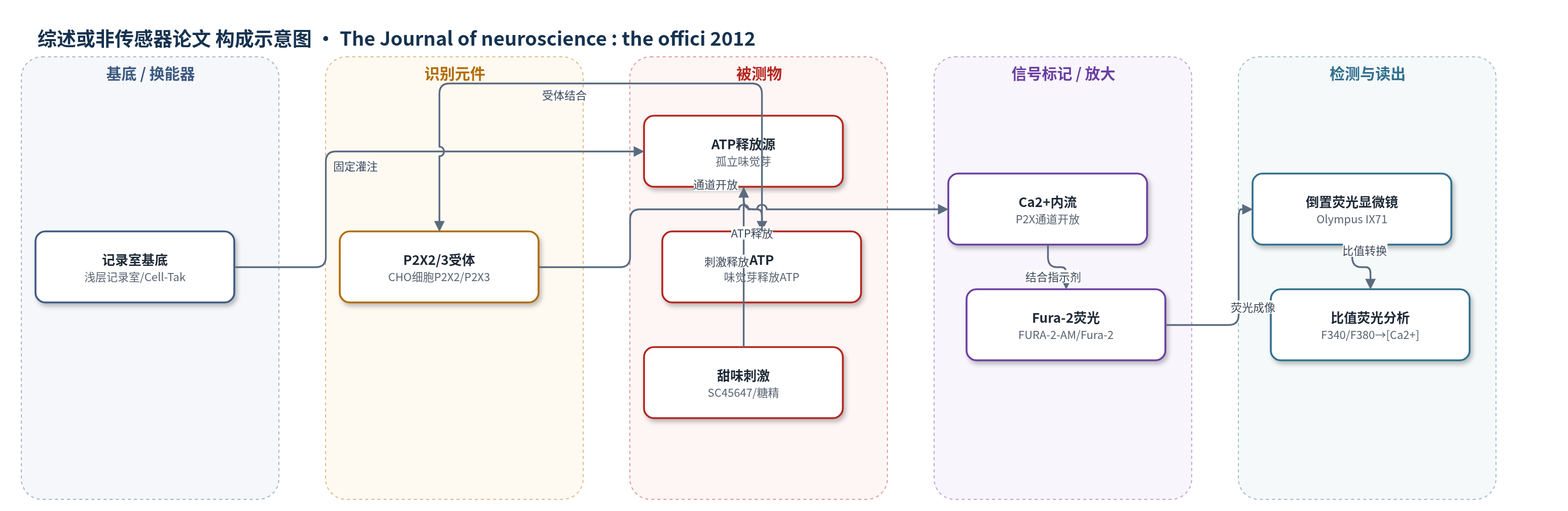
点击图片查看大图 · 依据论文自动绘制
传感器类型
综述或非传感器论文
检测对象
ATP(三磷酸腺苷,ATP);样品基质:Tyrode’s buffer 中孤立味觉芽释放物(甜味刺激为 SC45647/糖精,苦味刺激为 cycloheximide/denatonium)
检测原理
孤立味觉芽在甜味刺激下通过 pannexin 1 半通道释放 ATP。释放的 ATP 扩散至表达 P2X2/P2X3 受体的 CHO 生物传感器细胞,与受体结合后激活 P2X 阳离子通道,导致 Ca2+ 内流。细胞内 Fura-2 指示剂结合 Ca2+,其 340 nm 与 380 nm 激发荧光比值随胞内 Ca2+ 浓度升高而改变。倒置荧光显微镜采集 ratiometric 图像,Imaging Workbench 将 F340/F380 转换为 [Ca2+],从而反映 ATP 释放量。腺苷经 A2B 受体增强甜味刺激引起的 ATP 释放,因此 ATP 生物传感器信号随腺苷存在而升高;苦味刺激不产生该增强。
检测灵敏度
原文未报告 LOD、线性范围、灵敏度斜率或 R^2。
效应效果
腺苷 50 μM 显著增强甜味刺激诱发的受体细胞 Ca2+ 响应(p=0.02,n=8),对苦味(p=0.40,n=7)和鲜味(p=1.00,n=9)无影响。ATP 生物传感器显示 5 μM 腺苷增强甜味 ATP 释放(p=0.02,n=8),A2B 拮抗剂 MRS1706 250 nM 降低甜味 ATP 释放(p=0.01,n=8),苦味无影响(p=0.64,n=6;MRS1706 p=0.13,n=6)。单细胞 RT-PCR 显示 Adora2b 与 Tas1r2 正相关(r=0.59,p=0.003;r=0.77,p<0.001;r=0.84,p=0.001),与苦味受体负相关(r=-0.53,p=0.009;r=-0.59,p=0.003)。NT5E 主要位于 III 型细胞,Nt5e-/- 缺失酶活。作者主张腺苷是甜味自分泌神经调质。
传感器的构成
- 基底/样品室:浅层记录室,Cell-Tak 固定孤立味觉芽,Tyrode’s buffer 灌注,作为 ATP 释放来源
- 识别元件:CHO 细胞膜 P2X2/P2X3 ATP 受体,识别味觉芽释放的 ATP 并开放阳离子通道
- 信号标记物:FURA-2-AM 钙指示剂,ATP 激活 P2X 通道后 Ca2+ 内流引起 340/380 nm 荧光比值变化
- 换能/读出系统:Olympus IX71 倒置荧光显微镜、20×水浸物镜与 Fura-2 光学系统,采集 ratiometric 荧光图像
- 分析软件:Imaging Workbench 6.0,将 F340/F380 比值转换为 [Ca2+] 信号
中文摘要
哺乳动物味觉芽以三磷酸腺苷(ATP)作为神经递质。味觉受体(II型)细胞通过缝隙连接半通道将 ATP 分泌到味觉芽狭窄的细胞外间隙,ATP 既兴奋初级感觉传入纤维,也刺激邻近味觉芽细胞。本文证明,小鼠轮廓乳头味觉芽中的胞外 ATP 可被酶解为腺苷,该核苷酸作为自分泌神经调质选择性增强甜味。在舌片制备中,局部施加人工甜味剂诱发的受体细胞 Ca2+ 动员被 50 μM 腺苷显著增强;腺苷不影响苦味或鲜味响应,也不影响突触前(III型)味觉细胞。作者还使用生物传感器细胞测量孤立味觉芽的递质释放,发现 5 μM 腺苷增强甜味而非苦味刺激诱发的 ATP 释放。单细胞 RT-PCR 显示许多受体细胞表达腺苷受体 Adora2b,而突触前和胶质样(I型)细胞很少表达;Adora2b 与甜味受体亚基 Tas1r2 表达显著相关。腺苷主要由突触前细胞表达的胞外 5′-核苷酸酶 NT5E 生成,其次为前列腺酸性磷酸酶 ACPP。结果表明,味觉接收过程中释放的 ATP 被降解为腺苷,尤其对甜味产生正调节。
英文摘要
Mammalian taste buds use ATP as a neurotransmitter. Taste Receptor (type II) cells secrete ATP via gap junction hemichannels into the narrow extracellular spaces within a taste bud. This ATP excites primary sensory afferent fibers and also stimulates neighboring taste bud cells. Here we show that extracellular ATP is enzymatically degraded to adenosine within mouse vallate taste buds and that this nucleoside acts as an autocrine neuromodulator to selectively enhance sweet taste. In Receptor cells in a lingual slice preparation, Ca(2+) mobilization evoked by focally applied artificial sweeteners was significantly enhanced by adenosine (50 μM). Adenosine had no effect on bitter or umami taste responses, and the nucleoside did not affect Presynaptic (type III) taste cells. We also used biosensor cells to measure transmitter release from isolated taste buds. Adenosine (5 μM) enhanced ATP release evoked by sweet but not bitter taste stimuli. Using single-cell reverse transcriptase (RT)-PCR on isolated vallate taste cells, we show that many Receptor cells express the adenosine receptor, Adora2b, while Presynaptic (type III) and Glial-like (type I) cells seldom do. Furthermore, Adora2b receptors are significantly associated with expression of the sweet taste receptor subunit, Tas1r2. Adenosine is generated during taste stimulation mainly by the action of the ecto-5'-nucleotidase, NT5E, and to a lesser extent, prostatic acid phosphatase. Both these ecto-nucleotidases are expressed by Presynaptic cells, as shown by single-cell RT-PCR, enzyme histochemistry, and immunofluorescence. Our findings suggest that ATP released during taste reception is degraded to adenosine to exert positive modulation particularly on sweet taste.