组成图示
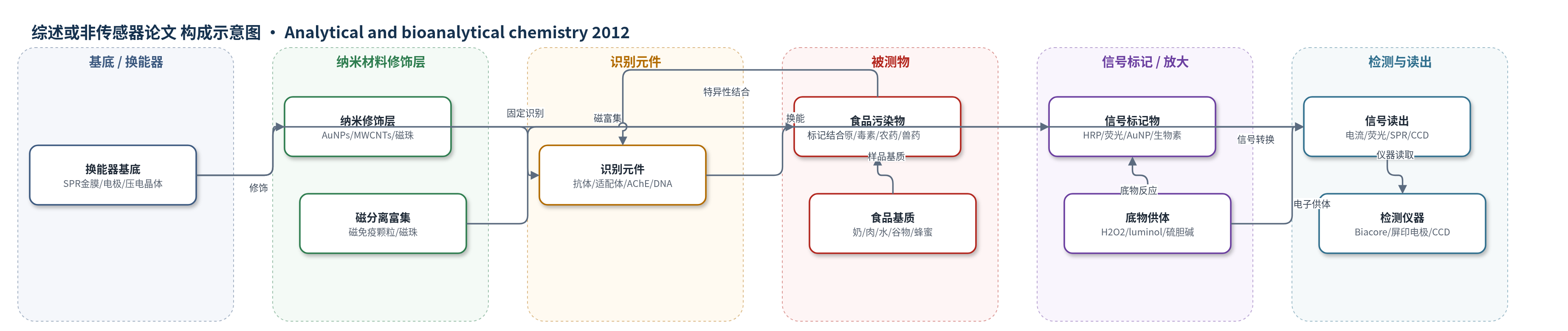
点击图片查看大图 · 依据论文自动绘制
传感器类型
综述或非传感器论文
检测对象
病原菌(Salmonella、E. coli O157:H7、Listeria monocytogenes、Bacillus cereus、Staphylococcus aureus 等)、毒素(staphylococcal enterotoxins A/B、ricin、abrin、botulinum neurotoxins A/B、aflatoxin M1/B1、ochratoxin A、deoxynivalenol、T2/HT-2、zearalenone、paralytic/amnesic/diarrhoeic shellfish poisoning toxins、saxitoxin、domoic acid、okadaic acid 等)、农药(organophosphates、carbamates、organochlorines、pyrethroids、paraoxon-ethyl、monocrotophos、parathion、carbaryl、cypermethrin、permethrin、DDT 等)、兽药残留(fluoroquinolones、nitroimidazoles、tetracyclines、sulfonamides、β-lactams、chloramphenicol、neomycin、gentamicin、kanamycin、norfloxacin、clenbuterol 等);样品基质:奶、肉、苹果汁、水、谷物/小麦/玉米、婴儿食品、蜂蜜、蛋、鱼、血清、尿液、贝类、番茄、饮料等。
检测原理
综述中的生物传感器通常由生物识别元件与换能器组成。抗体、适配体、DNA探针、噬菌体或全细胞特异性结合病原菌、毒素、农药或兽药残留;乙酰胆碱酯酶(AChE)等酶则因农药抑制而活性下降。结合或抑制事件引起界面质量、折射率、导电性、电化学活性或荧光/发光状态变化。SPR、电化学、压电、荧光、发光等换能器将界面变化转换为可测信号。小分子污染物多采用竞争/抑制法,大分子病原菌多采用夹心法。HRP、荧光染料、金纳米颗粒、生物素-链霉亲和素、磁珠、碳纳米管等用于信号放大;PCR、金纳米颗粒标记、酶催化沉积和磁分离富集可进一步提高灵敏度。信号随目标物浓度增加而增强或抑制程度增大,最终由仪器读出。
检测灵敏度
综述未报告单一传感器灵敏度;文中列举代表性数值:E. coli O157:H7 奶中 LOD 5×10^3 CFU/ml,线性范围 5×10^3–5×10^5 CFU/ml;B. cereus 六种食品 LOD 62.7、40.7、35.3、88.4、72.6、58.0 CFU/ml;Salmonella enterica 蛋/鸡 LOD 10^2 CFU/ml;L. monocytogenes 即食肉 LOD 10^2 CFU/25 g;E. coli O157:H7 PCR-压电 LOD 5.3×10^2 CFU/ml;E. coli 肉汁线性范围 10^2–10^7 CFU/ml,LOD 500 CFU/ml;S. enterica 集成电化学线性范围 10^2–10^8 CFU/ml;aflatoxin M1 奶中 LOD 0.01 ng/ml 与 0.6 pg/ml;ochratoxin A 小麦 7 pg/ml;deoxynivalenol 小麦 LOD 57 μg/kg、小麦制品 9 μg/kg、玉米婴儿食品 6 μg/kg;paralytic shellfish poisoning toxins 贝类 LOD 2–50 ng/ml;domoic acid 蛤 LOD 约 3 μg/kg;okadaic acid 贻贝 LOD 126 ng/g,工作范围 31–74 μg/kg,LOD 31 μg/kg;organophosphates 饮用水 LOD 10^-10 M;carbamates 番茄工作范围 5×10^-5–75×10^-5 mol/l;organophosphates/carbamates 水/蔬菜/饮料 2 μg/l;paraoxon-ethyl LOD 1×10^-9 M;monocrotophos LOD 10 nM;cypermethrin 水 LOD 0.0005 ppm,线性范围 0.0025–2 ppm;permethrin 线性范围 1–300 ppm;flumequine 血清 LOD 15 ng/ml、肌肉 24 ng/ml;13 种 fluoroquinolones 蛋 LOD 1 ng/ml、鱼 1.5 ng/ml、禽肉 <0.5 ng/ml;nitroimidazoles 鸡肌肉/肾/肝/蛋/血清/奶 <1 μg/kg。
效应效果
综述认为生物传感器相比放射免疫分析、ELISA、荧光/发光免疫分析具有自动化、重现性更好、速度快和实时分析优势。微生物法通常需2–10天,部分PCR-生物传感器约3 h完成;ATP法可区分活菌与死菌,结果接近平板计数。选择性方面,抗体/适配体/酶/全细胞可区分目标,但AChE法受重金属、去污剂和非目标农药抑制,全细胞光系统II法也非完全特异。基质干扰明显:牛奶使SEB荧光阵列灵敏度降低约1个数量级;多毒素磁珠法受基质干扰降至低ng/L,但仍低于口服LD50两到三个数量级;麻痹性贝毒SPR法回收率约60%,与认证方法比较仍可用于筛查。去氧雪腐镰刀菌烯醇SPR法无需基质匹配校准曲线。
传感器的构成
- 换能器/基底:SPR金膜/光学波导、屏印电极/玻碳电极/碳糊电极、压电晶体、微悬臂梁,用于将识别事件转换为光学、电化学、质量或声学信号
- 纳米材料修饰层:金纳米颗粒(AuNPs)、多壁碳纳米管(MWCNTs)、单壁碳纳米管(SWNTs)、磁纳米颗粒,用于增强电子转移、形成导电网络或磁分离富集
- 识别元件:抗体、适配体、乙酰胆碱酯酶(AChE)、DNA探针、噬菌体、全细胞,用于特异性结合或抑制病原菌、毒素、农药和兽药残留
- 信号标记物:辣根过氧化物酶(HRP)、荧光染料、金纳米颗粒标记寡核苷酸、生物素-链霉亲和素、磁珠,用于产生或放大信号
- 底物/电子供体:H2O2、luminol、5-methylphenazinium methyl sulfate、acetylthiocholine、thiocholine、3-indolyl acetate,用于酶促反应、电化学或发光信号
- 样品富集/预处理:磁免疫颗粒、溶剂萃取、固相萃取、离心/过滤,用于去除食品基质干扰并富集分析物
中文摘要
食品产量增加及微生物和化学污染威胁,使食品工业和监管机构迫切需要快速、低成本的分析方法以保障消费者健康。虽然色谱和质谱等精密技术结果更准确、更具结论性,但筛查方法通量更高、成本更低、对操作人员培训要求更低。生物传感器将生物识别元件(酶、抗体、受体)与换能器结合,产生与识别元件和分析物相互作用程度成正比的信号。当前生物传感仪器应用多样,食品分析是新兴且不断增长的领域。与放射免疫分析、酶联免疫吸附试验、荧光免疫分析和发光免疫分析相比,生物传感器在食品分析中具有自动化、重现性更好、分析速度快和可实时分析等优势。本文先简要回顾历史,再综述2007年1月至2010年12月生物传感器用于食品污染物检测的最新进展,重点介绍病原菌、毒素、农药和兽药残留检测,并强调在食品基质中给出数据的研究。共同发展方向包括多重检测和便携化。生物传感器目前在食品安全中已具有重要作用,技术、试剂和样品处理的进步将巩固其地位。
英文摘要
Increases in food production and the ever-present threat of food contamination from microbiological and chemical sources have led the food industry and regulators to pursue rapid, inexpensive methods of analysis to safeguard the health and safety of the consumer. Although sophisticated techniques such as chromatography and spectrometry provide more accurate and conclusive results, screening tests allow a much higher throughput of samples at a lower cost and with less operator training, so larger numbers of samples can be analysed. Biosensors combine a biological recognition element (enzyme, antibody, receptor) with a transducer to produce a measurable signal proportional to the extent of interaction between the recognition element and the analyte. The different uses of the biosensing instrumentation available today are extremely varied, with food analysis as an emerging and growing application. The advantages offered by biosensors over other screening methods such as radioimmunoassay, enzyme-linked immunosorbent assay, fluorescence immunoassay and luminescence immunoassay, with respect to food analysis, include automation, improved reproducibility, speed of analysis and real-time analysis. This article will provide a brief footing in history before reviewing the latest developments in biosensor applications for analysis of food contaminants (January 2007 to December 2010), focusing on the detection of pathogens, toxins, pesticides and veterinary drug residues by biosensors, with emphasis on articles showing data in food matrices. The main areas of development common to these groups of contaminants include multiplexing, the ability to simultaneously analyse a sample for more than one contaminant and portability. Biosensors currently have an important role in food safety; further advances in the technology, reagents and sample handling will surely reinforce this position.