组成图示
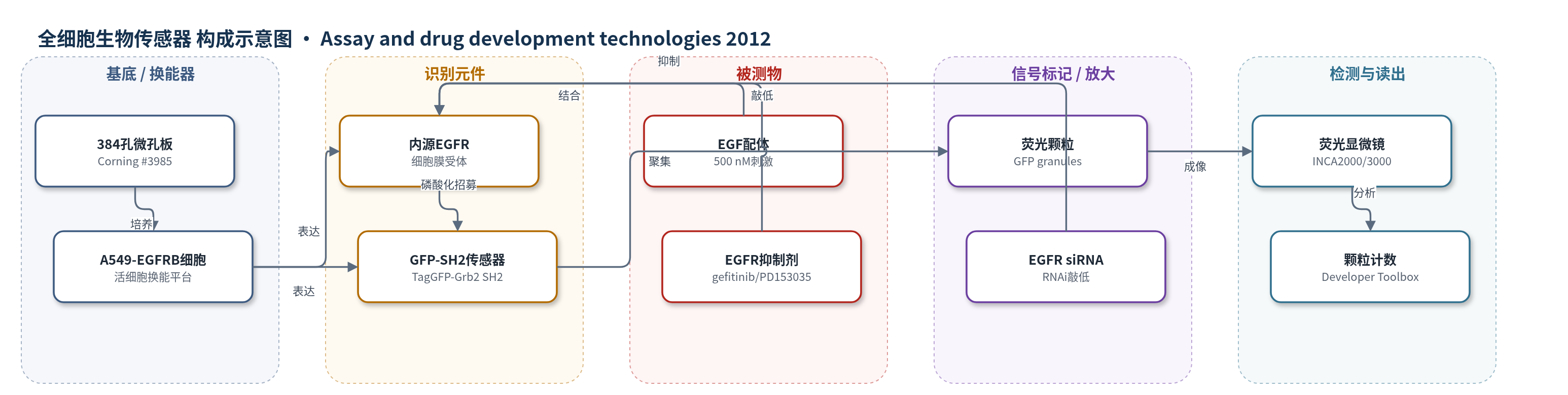
点击图片查看大图 · 依据论文自动绘制
传感器类型
全细胞生物传感器
检测对象
内源 EGFR 活性/EGFR 调节剂(EGFR activity/modulators),样品基质:活细胞(A549-EGFRB 细胞培养体系,384 孔板)
检测原理
EGF 与 A549-EGFRB 细胞膜上的内源 EGFR 结合后,诱导受体二聚化、内化和胞内域酪氨酸磷酸化。稳定表达的 TagGFP-Grb2 SH2 融合蛋白通过两个串联 SH2 结构域识别磷酸化酪氨酸,被招募至激活的 EGFR 并随受体聚集/内吞形成 GFP 荧光颗粒。颗粒数量随 EGFR 激活程度增加而增加;EGFR 抑制剂阻断磷酸化或 siRNA 降低受体表达时,颗粒形成减少或消失。自动荧光显微镜采集 GFP 通道图像,Developer Toolbox 1.7 进行对象分割并计数颗粒,同时用 Hoechst 核计数评估细胞毒性,从而将 EGFR 功能转换为可定量荧光信号。
检测灵敏度
原文未报告 LOD、线性范围、灵敏度斜率或 R^2。
效应效果
该检测在384孔板中稳健:高/低对照CV为13%和14%,平均颗粒计数10,700对500,噪声比21:1,Z′=0.56。仅EGF诱导颗粒形成,heregulin-β1及其他RTK配体/细胞因子无显著诱导;EGFR siRNA敲低和erlotinib抑制均消除颗粒形成。26个效应物初筛中,仅dasatinib、calyculin A、PD 153035和gefitinib降低颗粒计数;前两者细胞毒性,PD 153035与gefitinib IC50分别为2.2和19 nM且无细胞毒性。quinacrine和sunitinib因自荧光呈假阳性。与重组激酶筛选相比,可保留细胞内信号与内吞过程。作者认为该活细胞高通量方法适用于化学库和RNAi库筛选EGFR调节剂。
传感器的构成
- 细胞换能平台:A549-EGFRB 人肺腺癌细胞(A549-EGFRB cells),稳定表达 EGFR 生物传感器并承载内源 EGFR,作为活细胞检测基质。
- 识别元件:内源 EGFR(epidermal growth factor receptor),位于细胞膜,结合 EGF 后发生酪氨酸磷酸化并介导信号转导。
- 信号报告元件:TagGFP-Grb2 SH2 融合蛋白(GFP-SH2 biosensor),由 TagGFP 与两个串联 Grb2 SH2 结构域组成,识别磷酸化 EGFR 并聚集形成荧光颗粒。
- 刺激配体:EGF(epidermal growth factor),以 500 nM 刺激 EGFR 激活,诱导颗粒形成。
- 调节剂/抑制剂:gefitinib、PD 153035、erlotinib 等 EGFR 抑制剂,用于阻断 EGFR 活性并验证检测特异性。
- 核酸干扰元件:EGFR siRNA(small interfering RNA),通过 RNAi 敲低 EGFR 表达以验证颗粒形成依赖 EGFR。
- 成像读出系统:IN Cell Analyzer 2000/3000(INCA2000/INCA3000)或 Leica TCS AOBS SP2 共聚焦显微镜,配合 Hoechst 核染色与 GFP 通道,经 Developer Toolbox 1.7 分析颗粒计数。
中文摘要
传统药物发现主要依赖重组激酶筛选,导致许多受体酪氨酸激酶(RTK)抑制剂在细胞中活性不佳。为在天然环境中筛选 RTK 调节剂,作者将一种绿色荧光蛋白(GFP)标记的 Src 同源 2 结构域(SH2)生物传感器引入 A549 细胞,作为内源表皮生长因子受体(EGFR)活性的替代报告系统。受体被激活后,通过活细胞中形成的绿色荧光颗粒数量来测量 EGFR 功能。本文描述了该检测的微型化,并通过化学抑制和 RNA 干扰敲低 EGFR 证明其特异性,二者均可完全消除颗粒形成。在初步筛选中,吉非替尼(gefitinib)和 PD 153035 被鉴定为活性化合物。该方法可在高通量格式中用于筛选化学库和 RNAi 库,以发现新的 EGFR 调节剂。
英文摘要
Traditional drug discovery efforts have resulted in the approval of a handful of receptor tyrosine kinase (RTK) inhibitors; however, their discovery relied solely on screening recombinant kinases, often with poor cellular activity outcome. The ability to screen RTKs in their natural environment is sought as an alternative approach. We have adapted a novel strategy utilizing a green fluorescent protein-labeled SRC homology 2 domain-based biosensor as a surrogate reporter of endogenous epidermal growth factor receptor (EGFR) activity in A549 cells. Upon activation of the receptor, EGFR function in live cells is measured by the number of green granules that form. Here we describe assay miniaturization and demonstrate specificity for EGFR through its chemical inhibition and RNAi-dependent knockdown resulting in complete abrogation of granule formation. Gefitinib and PD 153035 were identified as hits in a pilot screen. This approach allows for the identification of novel EGFR modulators in high-throughput formats for screening chemical and RNAi libraries.