组成图示
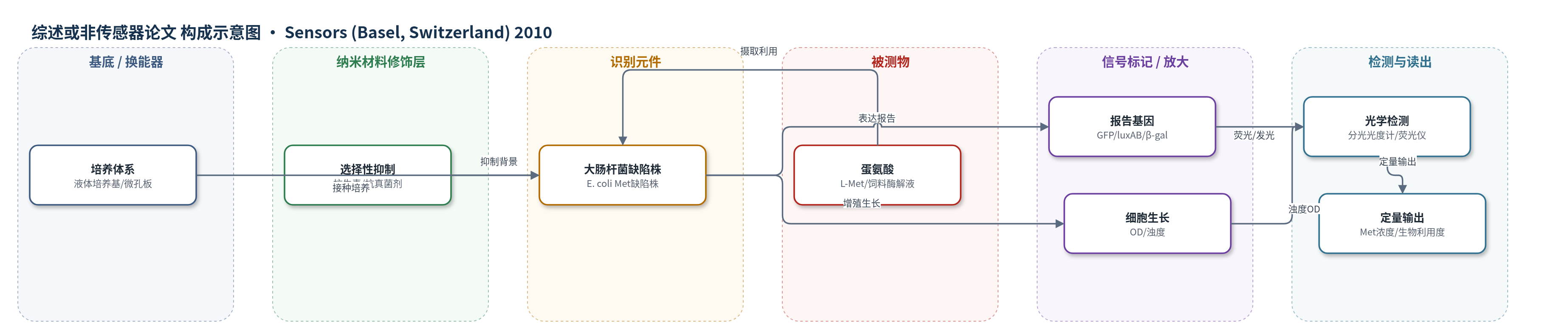
点击图片查看大图 · 依据论文自动绘制
传感器类型
综述或非传感器论文
检测对象
蛋氨酸(methionine, Met);样品基质:饲料及饲料原料(经 pronase/peptidase 酶解的饲料蛋白水解液、加标饲料样品)
检测原理
该综述提出的大肠杆菌全细胞生物传感器以遗传改造的蛋氨酸营养缺陷株为识别与换能元件。缺陷株因 met 操纵子相关基因(如 metF、metA、metB、metC、metH、metE 等)缺失或插入而不能合成蛋氨酸;饲料经 pronase/peptidase 酶解后,外源 L-蛋氨酸经 MetD 高亲和 ABC 转运体或 MetP 低亲和转运体进入细胞,解除生长限制并支持细胞增殖。细胞生长量可用 OD 浊度读出;若携带报告基因,则蛋氨酸浓度驱动 GFP 荧光、luxAB 发光或 β-半乳糖苷酶活性,信号随 Met 浓度升高而增强。选择性抗生素/抗真菌剂抑制背景微生物,提高特异性。
检测灵敏度
原文未报告所讨论大肠杆菌蛋氨酸生物传感器的 LOD、线性范围、灵敏度斜率或相关系数。综述中引用数值:微孔板 E. coli 蛋氨酸缺陷株对蛋氨酸线性响应至 26.8 µM;硝酸盐 lux 传感器检测水平 5 × 10⁻⁵ mol L–1 (0.3 ppm);葡萄糖传感器线性范围 0.05–0.1 mM, R2 = 0.99;乙醇传感器可测至 50 mM, 相关系数 0.998;β-半乳糖苷酶法蛋氨酸 Spearman 相关系数 0.95。
效应效果
综述认为微生物法比动物试验更快、更便宜,适合常规饲料检测。已有 E. coli 蛋氨酸缺陷株可定量饲料中结晶蛋氨酸,饲料基质影响小,加标回收率为 71–80%。β-半乳糖苷酶法与化学法比较,蛋氨酸 Spearman 相关系数 0.95。同类大肠杆菌赖氨酸缺陷株与鸡生物测定相关系数 0.94,支持全细胞法可行性。GFP 法无需额外试剂,但饲料自荧光和光散射可能干扰;选择性培养基可短期抑制背景菌,长期仍可能失效。lux 法比 OD 敏感约 10 倍,但需自诱导剂/醛类且设备昂贵。作者主张通过定向遗传改造构建更特异的大肠杆菌蛋氨酸传感器,用于饲料营养快速评估。
传感器的构成
- 培养体系基底:液体培养基与微孔板/试管,用于承载大肠杆菌培养与信号读出(原文提及 nutrient medium、microtiter plates)
- 选择性抑制层:抗生素与抗真菌剂组合,抑制饲料背景微生物,避免非特异 OD/酶活干扰(原文提及 antibiotic and antifungal agents)
- 识别/生物换能元件:大肠杆菌蛋氨酸营养缺陷株(Escherichia coli, E. coli methionine auxotroph),通过摄取外源蛋氨酸实现生长或报告信号
- 遗传修饰元件:met 操纵子相关基因(metA、metB、metC、metH、metE、metF、metJ、metR、metK、yagD)缺失/转座子插入,阻断蛋氨酸合成
- 转运元件:MetD 高亲和 ABC 转运体(Abc、YaeE、YaeC)与 MetP 低亲和转运体,介导 L-/D-蛋氨酸进入细胞
- 信号标记/报告元件:绿色荧光蛋白(GFP,如 Gfpmut3)、荧光素酶 luxAB、β-半乳糖苷酶(β-galactosidase)或细胞浊度(OD)
- 样品前处理/基质:饲料原料经 pronase 和 peptidase 酶解,释放可被大肠杆菌利用的蛋氨酸
- 读出装置:分光光度计、荧光分光光度计、荧光素酶检测仪,用于测量 OD、荧光或发光
中文摘要
蛋氨酸是动物必需氨基酸,常被视为饲料配方中首要限制性氨基酸。饲料中蛋氨酸缺乏或过量均会导致动物生产性能下降并增加环境污染,因此需要准确定量和合理添加。目前动物生物测定是评价蛋氨酸生物利用度的行业标准,但耗时、昂贵且受法规限制,且多种干扰因素会影响其变异性和时效性。基于微生物对外源营养(如蛋氨酸)响应的微生物测定法快速、廉价,并能较准确、一致地估算饲料及饲料原料中可消化蛋氨酸。本综述讨论开发基于大肠杆菌的微生物生物传感器用于蛋氨酸生物利用度定量,概述蛋氨酸合成与调控通路,以及构建可用于常规生物测定的蛋氨酸营养缺陷株所需的遗传改造。未来利用大肠杆菌蛋氨酸生物传感器有望实现廉价、快速的蛋氨酸定量,并及时评估饲料营养特征。
英文摘要
Methionine is an essential amino acid for animals and is typically considered one of the first limiting amino acids in animal feed formulations. Methionine deficiency or excess in animal diets can lead to sub-optimal animal performance and increased environmental pollution, which necessitates its accurate quantification and proper dosage in animal rations. Animal bioassays are the current industry standard to quantify methionine bioavailability. However, animal-based assays are not only time consuming, but expensive and are becoming more scrutinized by governmental regulations. In addition, a variety of artifacts can hinder the variability and time efficacy of these assays. Microbiological assays, which are based on a microbial response to external supplementation of a particular nutrient such as methionine, appear to be attractive potential alternatives to the already established standards. They are rapid and inexpensive in vitro assays which are characterized with relatively accurate and consistent estimation of digestible methionine in feeds and feed ingredients. The current review discusses the potential to develop Escherichia coli-based microbial biosensors for methionine bioavailability quantification. Methionine biosynthesis and regulation pathways are overviewed in relation to genetic manipulation required for the generation of a respective methionine auxotroph that could be practical for a routine bioassay. A prospective utilization of Escherichia coli methionine biosensor would allow for inexpensive and rapid methionine quantification and ultimately enable timely assessment of nutritional profiles of feedstuffs.