组成图示
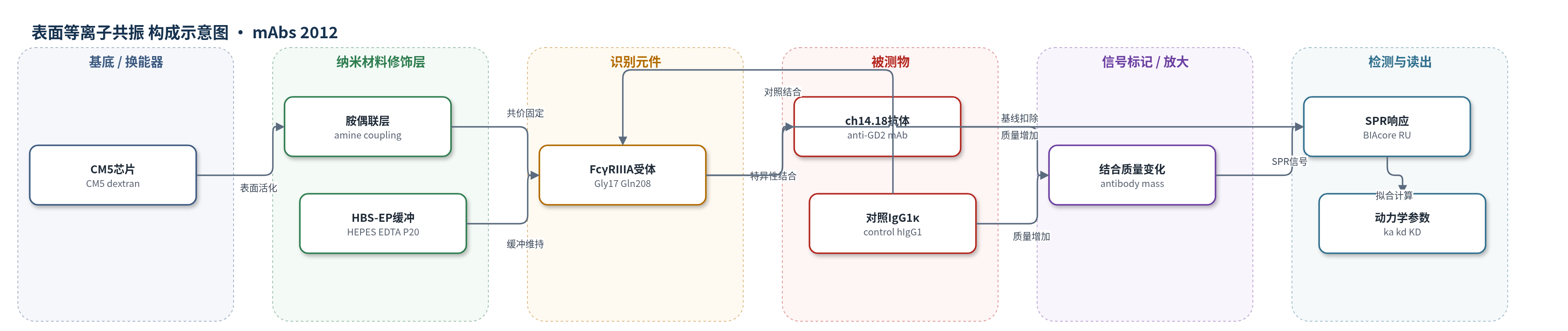
点击图片查看大图 · 依据论文自动绘制
传感器类型
表面等离子共振(SPR)生物传感器
检测对象
ch14.18 嵌合抗 GD2 单克隆抗体(ch14.18, anti-GD2 mAb)、人 IgG1κ 对照(hIgG1κ);样品基质:PBS 制剂经 HBS-EP 缓冲液稀释的溶液
检测原理
SPR 检测采用无标记方式。FcγRIIIA 受体经胺偶联共价固定于 CM5 传感器芯片表面,固定密度约 300 RU。ch14.18 抗体在 HBS-EP 缓冲液中流过芯片时,其 Fc 区与表面 FcγRIIIA 结合,界面质量增加,改变表面等离子体共振条件,使响应单位(RU)上升;停止注射后抗体解离,RU 下降。通过 5 μM 至 39.06 nM 的 2 倍稀释系列获得剂量依赖结合曲线,并用 1:1 结合模型拟合结合速率常数 ka、解离速率常数 kd,计算平衡解离常数 KD。每次注射后用 0.05% SDS 再生表面,实现多次循环。信号强度随 ch14.18 浓度增加而增加,可用于比较不同批次的 FcγRIIIA 结合一致性。
检测灵敏度
未报告 LOD、线性范围、灵敏度斜率、相关系数;报告 KD 平均 0.505 μM,CV% = 8.74。
效应效果
SPR 传感器图高度可重复,>100 次结合/再生循环后首尾 5 μM 参考品最大结合差异 <1%;24 次独立 KD 平均 0.505 μM,CV% 8.74,日内 CV 1.51–15.60%;30、50、75 μL/min 流速下排除质量传输限制;ch14.18 与 hIgG1κ 对照 KD 均约 0.5 μM。整体分析显示 ch14.18 为单分散单体,MW 145–150 kDa,单体纯度 >95%;DLS 强度加权 MW 168–170 kDa(CV 0.52%),RH 5.3–5.4 nm(CV 0.66%);cIEF 主要峰 CV <5%;PBS 5 mg/mL 2–8°C 稳定 >5 年。方法用于工艺变更、放大和稳定性监测。
传感器的构成
- 基底/换能器:CM5 传感器芯片(carboxymethyl dextran, CM5),提供 SPR 换能表面和羧基偶联位点
- 偶联修饰层:胺偶联试剂(amine coupling reagent kit,10 mM sodium acetate pH 5.5),活化 CM5 表面并共价固定 FcγRIIIA
- 识别元件:FcγRIIIA 受体(Gly17 Gln208,C-terminal 6 His-tag,R&D Systems),固定密度约 300 RU,用于结合 ch14.18 Fc 区
- 运行缓冲层:HBS-EP(HEPES buffered saline, 3 mM EDTA, 0.005% P20),维持结合条件并降低非特异吸附
- 再生层:0.05% SDS 溶液,每次注射后解离捕获抗体,实现 >100 次循环复用
- 对照通道:未固定 FcγRIIIA 的 CM5 流路,用于扣除非特异结合
- 被测物:ch14.18 参考品/待测抗体(anti-GD2 mAb)及 hIgG1κ 对照,以 2 倍稀释注入
- 信号读出:BIAcore SPR 仪器记录响应单位(RU)随时间变化,用于计算结合/解离动力学
中文摘要
Ch14.18 是靶向双唾液酸神经节苷脂 GD2 的鼠-人嵌合单克隆抗体,已在儿童高危神经母细胞瘤治疗中显示疗效。为应对工艺变更和制造放大带来的产品可比性问题,需对电荷异质性、糖基化谱、分子状态与聚集、Fcγ 受体结合亲和力及功能活性进行系统表征。本文报道了内部开发并确认的成像毛细管等电聚焦(imaged cIEF)用于电荷异质性,分析尺寸排阻色谱联用在线静态/动态光散射(SEC-MALS/DLS)和批式动态光散射用于聚集检测,表面等离子共振(SPR)生物传感器用于 Fcγ 受体-抗体相互作用动力学,PNGase F 消化后 2-氨基苯甲酸标记 HPLC 和毛细管电泳用于 N-糖谱与 N-糖分析,以及补体依赖细胞毒性(CDC)等生物活性检测。通过日内和日间比较建立方法一致性与重现性,并将方法应用于稳定性及产品特性变化监测。结果显示,PBS 中 5 mg/mL 的 ch14.18 在 2–8°C 储存超过 5 年保持稳定。
英文摘要
Ch14.18 is a mouse-human chimeric monoclonal antibody to the disialoganglioside (GD2) glycolipid. In the clinic, this antibody has been shown to be effective in the treatment of children with high-risk neuroblastoma, either alone or in combination therapy. Extensive product characterization is a prerequisite to addressing the potential issues of product variability associated with process changes and manufacturing scale-up. Charge heterogeneity, glycosylation profile, molecular state and aggregation, interaction (affinity) with Fcγ receptors and functional or biological activities are a few of the critical characterization assays for assessing product comparability for this antibody. In this article, we describe the in-house development and qualification of imaged capillary isoelectric focusing to assess charge heterogeneity, analytical size exclusion chromatography with online static and dynamic light scattering (DLS), batch mode DLS for aggregate detection, biosensor (surface plasmon resonance)-based Fcγ receptor antibody interaction kinetics, N-glycoprofiling with PNGase F digestion, 2-aminobenzoic acid labeling and high performance liquid chromatography and N-glycan analysis using capillary electrophoresis. In addition, we studied selected biological activity assays, such as complement-dependent cytotoxicity. The consistency and reproducibility of the assays are established by comparing the intra-day and inter-day assay results. Applications of the methodologies to address stability or changes in product characteristics are also reported. The study results reveal that the ch14.18 clinical product formulated in phosphate-buffered saline at a concentration of 5 mg/ml and stored at 2-8°C is stable for more than five years.