组成图示
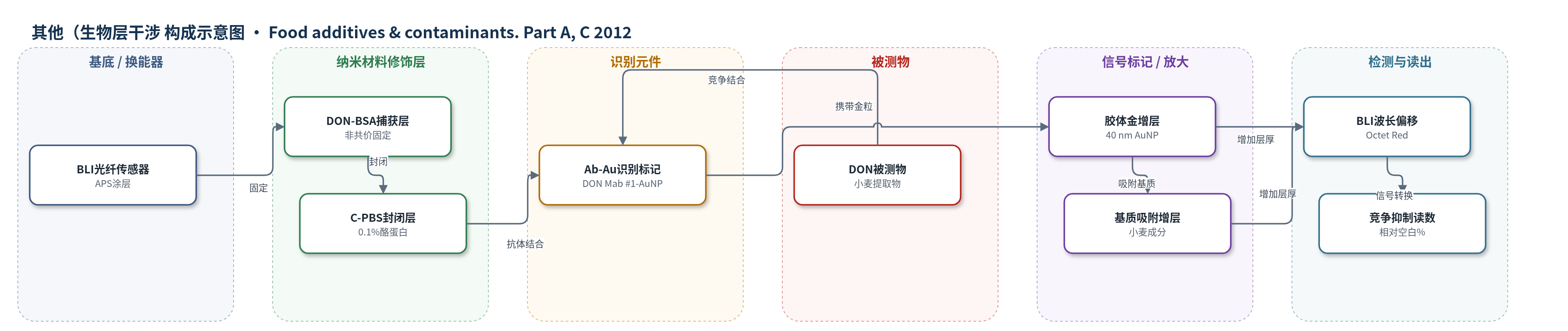
点击图片查看大图 · 依据论文自动绘制
传感器类型
其他(生物层干涉(BLI)生物传感器)
检测对象
脱氧雪腐镰刀菌烯醇(deoxynivalenol, DON,呕吐毒素);样品基质:小麦粉/小麦提取物(0.02 M 磷酸提取,PBS-T 稀释)
检测原理
传感器将 DON-BSA 偶联物非共价固定于 BLI 光纤的 APS 表面,并用 C-PBS 封闭。检测时,小麦提取物中的 DON 与 Ab-Au 在溶液中结合,从而竞争性地减少 Ab-Au 与表面 DON-BSA 的结合。Ab-Au 结合到尖端会增加生物层厚度,BLI 通过参考光束与尖端界面反射光的干涉产生波长偏移;结合层越厚,偏移越大。由于竞争抑制,DON 浓度越高,表面结合的 Ab-Au 越少,相对空白信号越低。胶体金显著增大抗体尺寸,放大厚度变化;小麦基质成分可能进一步吸附于胶体金复合物,使层厚增加更明显。检测无需洗脱,可用 Gly/DMF 再生。
检测灵敏度
LOD: 0.09 mg kg^-1;LOQ: 0.35 mg kg^-1;校准范围: 1.07–714 ng mL^-1(相当于小麦 0.03–20 mg kg^-1);r^2 = 0.9698;线性回归斜率: 1.188
效应效果
Ab-Au 在小麦基质中使 BLI 信号较缓冲液约放大 6 倍。定量法每样品约 6 min,定性法约 4 min;干燥传感器可室温储存 6 个月且无需预条件化。加标小麦回收率为 83%–128%,0.2–5 mg/kg 平均 103%(RSD 12%)。40 个天然污染小麦与 HPLC-UV 比较 r^2=0.9698,斜率 1.188,存在约 19% 高估。定性法将 29 个高于 0.5 mg/kg 样品判为阳性、10 个低于阈值判为阴性,仅 1 个恰为 0.5 mg/kg 样品判为阴性,总体 39/40 正确。传感器可复用 12 个循环,漂移约 1.5%/循环;空白对照归一化使校准 RSD 由 10.4% 降至 6.4%。
传感器的构成
- 基底/换能器:Octet Red 光学纤维 BLI 传感器,表面氨基丙基硅烷(APS)涂层,提供固定化界面并产生干涉光信号
- 捕获层:DON-BSA 偶联物(deoxynivalenol–bovine serum albumin)非共价固定于 APS 表面,作为抗原捕获元件
- 封闭层:0.1% 酪蛋白-PBS(C-PBS,casein in 10 mM PBS,pH 7.2),封闭非特异结合位点
- 稳定/储存层:15% 蔗糖处理后干燥储存,降低传感器漂移并便于复用
- 识别-信号标记物:DON 单克隆抗体 DON Mab #1 与 40 nm 胶体金非共价偶联(Ab-Au),识别 DON 并增加结合层厚度
- 信号放大介质:胶体金(colloidal gold, AuNP)及小麦基质成分,增加传感器尖端结合层厚度,放大 BLI 波长偏移
- 再生/平衡介质:Gly/DMF(0.1 M glycine pH 3 与 DMF 4:1)再生;C-PBS 平衡
中文摘要
脱氧雪腐镰刀菌烯醇(DON)是由某些镰刀菌产生、可污染小麦、大麦和玉米的真菌毒素,影响动物健康与食品安全。为快速监测小麦中 DON,作者基于生物层干涉(BLI)原理开发了一种免疫传感器。通过采用一抗—胶体金偶联物(Ab-Au)对信号进行放大,传感器响应显著增强;且放大效应在小麦基质中明显高于缓冲液,提示基质成分可能参与增强。增强后的信号支持建立快速定性和定量检测方法。方法检出限为 0.09 mg/kg,定量限为 0.35 mg/kg;小麦加标 0.2–5 mg/kg 的平均回收率为 103%(RSD 12%)。定量法与参考色谱法对 40 个天然污染小麦样品比较良好(r^2=0.9698),定性法可准确将同组 40 个样品分类为高于或低于 0.5 mg/kg 阈值。结果表明,BLI 技术可用于小麦中 DON 的快速检测。
英文摘要
Deoxynivalenol (DON) is a toxin produced by certain species of Fusarium fungi that can infest wheat, barley and corn. The fungi cause diseases in crops worldwide and some of the secondary metabolites, such as DON, can adversely affect animal health and food safety. To monitor DON in wheat rapidly, a biosensor using the principle of biolayer interferometry (BLI) was developed. The signal from the sensor was substantially amplified through the use of a primary antibody-colloidal gold conjugate. The amplification was much greater in the presence of wheat matrix than in buffered solution, suggesting matrix components may have contributed to the enhancement. The improved signal provided by the amplification allowed for the development of rapid qualitative and quantitative assays. The limit of detection of the method was 0.09 mg kg(-1); the limit of quantitation was 0.35 mg kg(-1). Recovery from wheat spiked over the range from 0.2 to 5 mg kg(-1) averaged 103% (RSD = 12%). The quantitative assay compared favourably (r(2) = 0.9698) with a reference chromatographic method for 40 naturally contaminated wheats. The qualitative assay was able to classify accurately the same group of 40 samples as either above or below a 0.5 mg kg(-1) threshold. These results suggest that the BLI technique can be used to measure DON in wheat rapidly.