组成图示
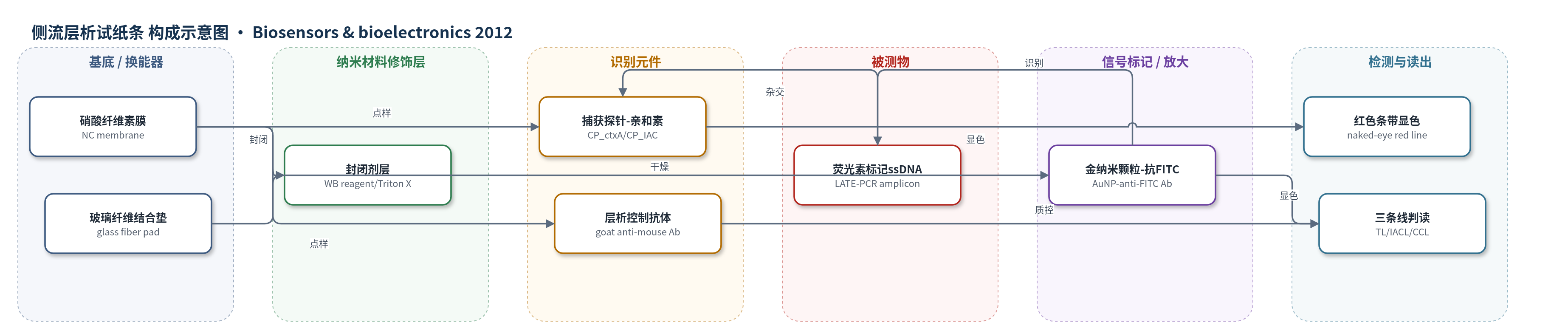
点击图片查看大图 · 依据论文自动绘制
传感器类型
侧流层析试纸条
检测对象
霍乱毒素基因 ctxA 单链 PCR 扩增产物(ctxA ssDNA amplicon)、内部扩增对照 IAC 单链 PCR 扩增产物(IAC ssDNA amplicon);样品基质:PCR 产物、加标粪便样品、纯基因组 DNA、霍乱弧菌培养物
检测原理
该传感器以 LATE-PCR 作为前处理放大策略:不对称引物在指数扩增后耗尽限制性引物,使过量荧光素标记引物线性扩增产生大量荧光素标记单链 ctxA 或 IAC 产物。将 PCR 产物与含 PEG 3350 和 MgCl2 的杂交缓冲液混合后加样,毛细作用使样品迁移至硝酸纤维素膜检测区。固定于膜上的生物素化捕获探针通过 NeutrAvidin 锚定,与互补单链靶标在室温下杂交;随后结合垫释放的金纳米颗粒-抗 FITC 抗体复合物结合捕获产物的 5′ 荧光素标记。金纳米颗粒在检测线聚集,表面等离子共振产生红色条带,条带强度随靶标量增加而增强。IAC 线验证扩增过程,层析控制线验证试纸条流动。
检测灵敏度
LOD: 0.3 ng;LOD: 1 pg;LOD: 10 CFU/ml
效应效果
在 164 株细菌评估中,94 株产毒霍乱弧菌均呈阳性,70 株非产毒霍乱弧菌及其他细菌均呈阴性,敏感性和特异性均为 100%。与 GM1-ELISA 结果完全一致,但耗时、人力和仪器需求更低。对 0、0.3、1 和 10 ng 合成靶标重复测试(n=5)显示条带响应高度一致;1 pg 基因组 DNA 和 10 CFU/ml 培养霍乱弧菌的 LATE-PCR 可重复性(n=9)良好。试纸条在 25、37 和 45 ℃ 保存 30 天后信号损失极小,推算室温货架期至少 3 个月。作者认为该低成本、免冷链、免额外设备的试纸条适合现场和即时检测。
传感器的构成
- 试纸条基底:层压硝酸纤维素膜(NC membrane)作为检测区载体,玻璃纤维垫(glass fiber pad)作为结合垫,纤维素纤维垫(cellulose fiber pad)作为缓冲液应用垫,吸收垫(absorbent pad)吸收液体。
- 捕获识别层:生物素化捕获探针 CP_ctxA 和 CP_IAC 与 NeutrAvidin 偶联后点样于 NC 膜检测区,用于原位捕获互补单链 PCR 产物。
- 质控识别层:羊抗鼠 IgG 抗体(goat anti-mouse Ab)点样于层析控制线(CCL),捕获过量金标记抗体以验证层析流动。
- 信号标记层:40 nm 胶体金纳米颗粒(AuNPs)偶联小鼠抗 FITC 抗体(anti-FITC Ab),干燥于玻璃纤维结合垫,用于识别荧光素标记靶标。
- 封闭层:Western blocking reagent 与 Triton X-100 封闭 NC 膜剩余蛋白结合位点,降低非特异结合。
- 运行/杂交介质:含 PEG 3350 和 MgCl2 的杂交缓冲液与含 PB、Triton X-100 的运行缓冲液,促进室温杂交和毛细迁移。
中文摘要
分子扩增技术通过靶向独特遗传序列,可快速鉴定病原微生物,并为临床治疗和流行病学监测提供依据。本文报道了一种干试剂条格式的核酸侧流生物传感器(NALFB),可在室温(22–25 ℃)下对单链聚合酶链式反应(PCR)扩增产物进行序列特异性检测。该传感器与线性-指数后 PCR(LATE-PCR)联用,利用高级不对称 PCR 提高荧光素标记单链扩增产物的产量;固定在试纸条上的捕获探针在条带原位与互补靶标杂交,随后偶联金纳米颗粒的抗荧光素抗体结合捕获产物的荧光素标记,形成肉眼可见的红色条带。以霍乱毒素基因(ctxA)为靶标,该传感器可检测产毒霍乱弧菌。合成靶 DNA 的视觉检出限为 0.3 ng,纯基因组 DNA 为 1 pg;对 164 株霍乱弧菌及非霍乱弧菌细菌的评估显示敏感性和特异性均为 100%。该低成本室温试纸条无需预热缓冲液或额外设备,可简化 PCR 扩增产物的序列特异性分析。
英文摘要
In the field of diagnostics, molecular amplification targeting unique genetic signature sequences has been widely used for rapid identification of infectious agents, which significantly aids physicians in determining the choice of treatment as well as providing important epidemiological data for surveillance and disease control assessment. We report the development of a rapid nucleic acid lateral flow biosensor (NALFB) in a dry-reagent strip format for the sequence-specific detection of single-stranded polymerase chain reaction (PCR) amplicons at ambient temperature (22-25°C). The NALFB was developed in combination with a linear-after-the-exponential PCR assay and the applicability of this biosensor was demonstrated through detection of the cholera toxin gene from diarrheal-causing toxigenic Vibrio cholerae. Amplification using the advanced asymmetric PCR boosts the production of fluorescein-labeled single-stranded amplicons, allowing capture probes immobilized on the NALFB to hybridize specifically with complementary targets in situ on the strip. Subsequent visual formation of red lines is achieved through the binding of conjugated gold nanoparticles to the fluorescein label of the captured amplicons. The visual detection limit observed with synthetic target DNA was 0.3 ng and 1 pg with pure genomic DNA. Evaluation of the NALFB with 164 strains of V. cholerae and non-V. cholerae bacteria recorded 100% for both sensitivity and specificity. The whole procedure of the low-cost NALFB, which is performed at ambient temperature, eliminates the need for preheated buffers or additional equipment, greatly simplifying the protocol for sequence-specific PCR amplicon analysis.