组成图示
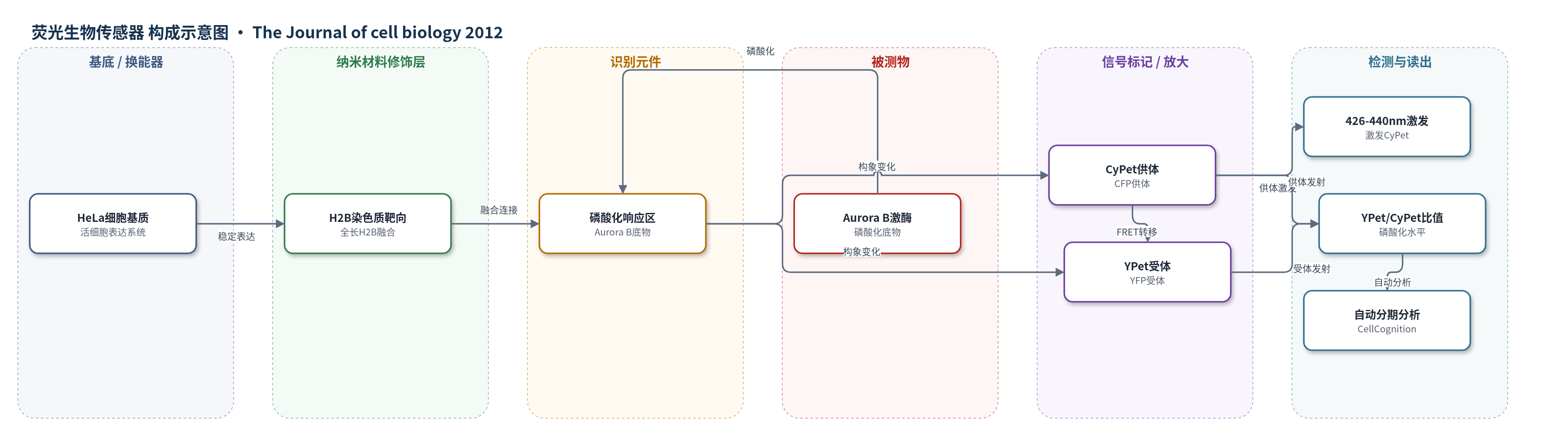
点击图片查看大图 · 依据论文自动绘制
传感器类型
荧光生物传感器
检测对象
Aurora B 底物磷酸化(Aurora B substrate phosphorylation);样品基质:活 HeLa 细胞染色质/细胞质
检测原理
该 FRET 生物传感器由 CyPet 供体、YPet 受体和 Aurora B 底物磷酸化响应区组成,并通过 H2B 融合靶向染色质。当 Aurora B 激酶磷酸化响应区时,探针构象改变,CyPet 与 YPet 间距或取向变化,FRET 效率降低。用 426–440 nm 光激发 CyPet,分别采集 467–492 nm 的 CyPet 发射和 529–556 nm 的 YPet 发射,计算 YPet/CyPet 比值;比值越低表示磷酸化水平越高。信号随 Aurora B 活性或底物磷酸化程度变化,无需酶促放大,直接以 FRET 比色读出,并可经 CellCognition 自动进行有丝分裂分期。
检测灵敏度
原文未报告 LOD、线性范围、灵敏度斜率或相关系数。
效应效果
该 FRET 探针用于 225 个人源磷酸酶 RNAi 筛选,每基因 3 条 siRNA、2 个重复,Aurora B 敲低可验证性抑制探针磷酸化。Repo-Man 敲低使蛋白降至 7–13%,Sds22 降至约 50%,二者或 PP1 催化亚基敲低均延迟后期去磷酸化;PP2A 未确认。Mklp2 敲低使 Aurora B 滞留染色体,2 µM ZM1 加速去磷酸化。Sds22/Repo-Man 敲低显著增加后期桥和滞后染色体(n>500,P<0.001),双核率未升高(3.1±0.5%、2.8±0.7%、3.1±0.3%),Dsn1 pSer100 升高,说明其保证染色体忠实分离。
传感器的构成
- 表达/定位层:全长核心组蛋白 H2B 融合,将 FRET 探针靶向染色质;细胞质版本去除 H2B 后定位于细胞质
- 供体荧光蛋白层:CyPet(CFP for energy transfer),作为 FRET 供体,426–440 nm 激发后发射 467–492 nm
- 受体荧光蛋白层:YPet(YFP for energy transfer),作为 FRET 受体,发射 529–556 nm
- 识别/响应元件:Aurora B 底物磷酸化响应区(Aurora B substrate phosphorylation site),被 Aurora B 磷酸化后发生构象变化
- 信号换能层:CyPet–YPet FRET 对,磷酸化降低 FRET,使 YPet/CyPet 发射比下降
- 读出层:活细胞显微镜采集 CyPet 与 YPet 发射,计算 YPet/CyPet 比值并用 CellCognition 自动分期
中文摘要
在有丝分裂纺锤体组装过程中,Aurora B 激酶参与纠错机制,使承受较低机械张力的动粒-微管连接解离。然而进入后期后,姐妹染色单体凝聚蛋白被移除导致张力下降,动粒-微管连接仍须维持。与此一致,Aurora B 在中期-后期转换时从染色体重新定位到中央纺锤体。本研究利用磷酸化 FRET 生物传感器进行 RNA 干扰筛选,鉴定出两个 PP1 靶向亚基 Sds22 和 Repo-Man,它们在后期拮抗 Aurora B 对外端动粒组分 Dsn1 的磷酸化。敲低 Sds22 或 Repo-Man 会引起染色体向极移动过程中的短暂停顿,并显著增加染色体错误分离发生率。因此,本研究鉴定出调控后期微管-动粒界面、保证染色体忠实分离的 PP1 靶向亚基。
英文摘要
During mitotic spindle assembly, Aurora B kinase is part of an error correction mechanism that detaches microtubules from kinetochores that are under low mechanical tension. During anaphase, however, kinetochore-microtubule attachments must be maintained despite a drop of tension after removal of sister chromatid cohesion. Consistent with this requirement, Aurora B relocates away from chromosomes to the central spindle at the metaphase-anaphase transition. By ribonucleic acid interference screening using a phosphorylation biosensor, we identified two PP1-targeting subunits, Sds22 and Repo-Man, which counteracted Aurora B-dependent phosphorylation of the outer kinetochore component Dsn1 during anaphase. Sds22 or Repo-Man depletion induced transient pauses during poleward chromosome movement and a high incidence of chromosome missegregation. Thus, our study identifies PP1-targeting subunits that regulate the microtubule-kinetochore interface during anaphase for faithful chromosome segregation.