组成图示
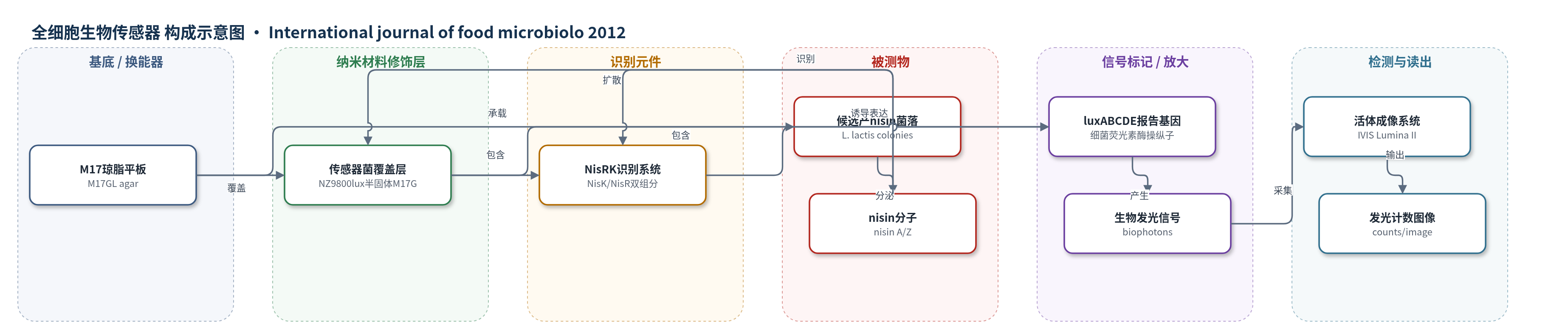
点击图片查看大图 · 依据论文自动绘制
传感器类型
全细胞生物传感器
检测对象
乳链菌肽 nisin(nisin A/Z)及产 nisin 细菌(nisinogenic Lactococcus lactis);样品基质为生牛乳(raw milk)和乳酸乳球菌菌株面板/食品样品。
检测原理
候选产 nisin 菌落在平板上生长并分泌 nisin A/Z。nisin 扩散进入半固体传感器菌覆盖层,与 L. lactis NZ9800lux 细胞膜上的 NisK 激酶结合,触发 NisK 自磷酸化并磷酸化响应调节因子 NisR。磷酸化的 NisR 激活 nisin 控制基因表达系统(NICE)中的 PnisA/PnisF 启动子,诱导 luxABCDE 细菌荧光素酶操纵子表达。荧光素酶利用细胞内源底物催化产生光子,无需外源化学发光底物。nisin 浓度越高,NICE 诱导越强,生物发光计数越高,呈线性剂量响应。由于 NisRK 系统对 nisin 高度特异,其他细菌素通常不诱导发光,因此发光区域可定位产 nisin 菌落。
检测灵敏度
原文未报告LOD、线性范围、灵敏度斜率或相关系数。
效应效果
该方法1 h内出结果,简便低成本。对144个生牛乳菌落筛选,仅3个诱导发光,28个形成抑菌圈;不发光但抑菌的菌落均未检出nisin基因。对91株乳酸乳球菌筛选,鉴定4株产nisin A菌株(SD12、SD14、SL28、SL29),并发现1株携带修饰nisin Z基因但不诱导发光的SL149。11株产生其他细菌素或reuterin的菌株均不诱导发光,特异性良好。生牛乳乳酸链球菌总数3.03×10^3 CFU/ml,产nisin菌1.30×10^2 CFU/ml,占4%以上;共鉴定7株产nisin Z的L. lactis subsp. lactis菌落,分属3个遗传群。作者认为可避免非功能nisin基因假阳性,并直接判断抑制物质。
传感器的构成
- 基底/培养层:M17GL 琼脂平板(M17 broth + 1% glucose + 0.5% lactose + agar),承载候选产 nisin 菌落。
- 传感器菌覆盖层:Lactococcus lactis subsp. cremoris NZ9800lux 全细胞生物传感器菌,接种于半固体 M17G(0.8% agar)中形成覆盖层。
- 识别元件:NisRK 双组分信号转导系统(NisK/NisR),感知胞外 nisin 并启动 NICE 调控。
- 报告基因模块:luxABCDE 细菌荧光素酶操纵子,受 nisin 诱导表达并产生生物发光。
- 维持/选择条件:M17G 培养基含 0.5% 葡萄糖、0.5% 乳糖及 25 μg/ml 氯霉素(Cm),维持传感器菌生长与遗传元件稳定。
- 读出装置:Xenogen IVIS Lumina II 活体成像系统(或 CCD 相机),采集生物发光图像与计数。
中文摘要
本文报道了一种基于生物发光快速筛选产乳链菌肽(nisin)细菌的简便方法。该方法利用 Lactococcus lactis subsp. cremoris NZ9800lux 全细胞生物传感器菌株,将疑似产 nisin 菌落与传感器菌覆盖层共培养,在 1 h 内通过生物发光直接识别产 nisin 菌。方法的功能与特异性经 144 个生牛乳菌落和 91 株乳酸乳球菌面板验证:仅产 nisin 细菌能诱导发光,已知产生其他细菌素的菌株均不诱导。研究还发现一株携带修饰 nisin Z 基因但不诱导发光的乳酸乳球菌,其抑制活性来自低分子量细菌素而非 nisin 变体。生牛乳中产 nisin 菌浓度为 1.3×10^2 CFU/ml,共鉴定出 7 株产 nisin Z 的 L. lactis subsp. lactis 菌落,分属 3 个遗传群。该方法稳健、低成本、操作简便,可直接区分抑制物质,避免传统筛选方法的假阳性。
英文摘要
We present a simple and rapid method for screening nisin producers that directly identifies nisinogenic bacteria by induction of bioluminescence within the Lactococcus lactis NZ9800lux biosensor strain (Immonen and Karp, 2007, Biosensors and Bioelectronics 22, 1982-7). An overlay of putative nisinogenic colonies with the biosensor strain gives identification results within 1h. Functionality and specificity of the method were verified by screening nisin producers among 144 raw milk colonies and a panel of 91 lactococcal strains. Studies performed on strains and colonies that did not induce bioluminescence but inhibited growth of the biosensor demonstrated that only nisinogenic bacteria can cause induction. Bacteria known to produce bacteriocins other than nisin failed to induce bioluminescence, further verifying the specificity of the assay. We discovered a non-inducing but inhibitory lactococcal strain harboring a modified nisin Z gene, and demonstrated that the source of the inhibitory action is not a non-inducing variant of nisin, but a bacteriocin of lower molecular weight. The concentration of nisin producers in a raw milk sample was 1.3 × 10(2)CFU/ml. We identified from raw milk a total of seven nisin Z producing L. lactis subsp. lactis colonies, which were shown by genetic fingerprinting to belong to three different groups. Among the panel of 91 lactococci, four strains were nisin A producers, and one strain harbored the modified nisin Z gene. The method presented here is robust, cost-effective and simple to perform, and avoids the pitfalls of traditional screening methods by directly specifying the identity of the inhibitory substance.