组成图示
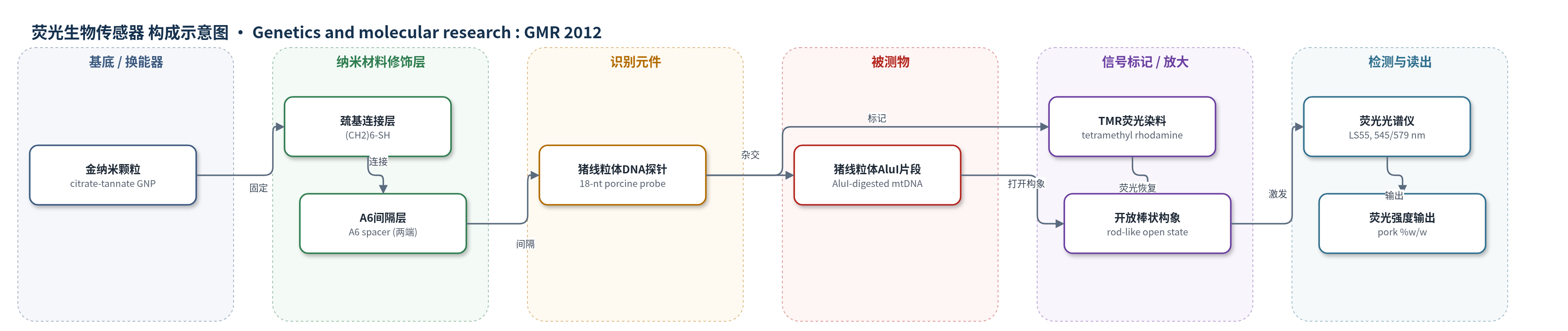
点击图片查看大图 · 依据论文自动绘制
传感器类型
荧光生物传感器
检测对象
猪线粒体DNA(porcine mitochondrial DNA, swine mtDNA);样品基质:2.5 h 高压灭菌猪-牛肉二元混合物、纯猪肉、牛肉、鸡肉、羊肉、山羊肉及清真/犹太肉类产品。
检测原理
样品总 DNA 先经 AluI 限制性内切酶酶切,产生 15–30 nt 的猪线粒体短片段。固定于金纳米颗粒上的 18 nt 猪线粒体探针在无靶标时呈受限拱形/茎环构象,TMR 荧光染料靠近 GNP,发生非辐射能量转移而被猝灭。当猪线粒体靶片段与探针互补杂交后,探针打开为棒状构象,TMR 与 GNP 距离增大,荧光恢复。荧光强度随靶标结合程度和猪肉含量增加而升高,可用标准曲线或 C2=C1I2/I1 公式定量。低离子强度杂交缓冲液(90 mM KCl、10 mM Tris,pH 8.0)增强单碱基错配分辨,提高种属特异性。
检测灵敏度
LOD: 1% 猪肉(在故意污染的 2.5 h 高压灭菌猪-牛肉二元混合物中);检测范围: 1-100% 猪肉 (w/w);线性范围: 3-100% 猪肉 (w/w);R^2 = 0.968;验证集 R^2 = 0.999;RMSEC = 0.011
效应效果
该纳米生物探针在 2.5 h、120°C 高压灭菌的猪-牛肉二元混合物中可检测低至 1% 的猪肉掺假,并对纯牛肉、鸡肉、羊肉和山羊肉无交叉荧光。非互补靶标不引起荧光变化,单碱基错配靶标使完全匹配荧光降低 65–70%,显示高序列特异性。定量方面,3–100% 猪肉范围呈线性(R2=0.968),验证集实际值与回收值高度线性(R2=0.999,RMSEC=0.011)。作者认为该探针可克服 PCR 对严重降解 DNA 的局限,适用于清真和犹太食品中猪肉掺假的快速、稳定检测。
传感器的构成
- 纳米颗粒换能器:3-nm citrate-tannate coated gold nanoparticles (GNP),作为荧光猝灭中心和探针载体
- 表面连接层:alkyl thiol (CH2)6-SH,通过 Au-S 键将寡核苷酸共价固定于 GNP 表面
- 间隔层:A6 spacer,连接 TMR 与识别序列并调节染料与 GNP 距离
- 识别元件:18-nt swine mitochondrial DNA oligo-probe (porcine-probe),特异性杂交猪线粒体 AluI 片段
- 信号标记物:tetramethyl rhodamine (TMR) 荧光染料,位于探针远端,靶标结合后荧光恢复
- 偶联稳定化层:0.1 M NaCl/10 mM PBS (pH 7.4) 老化处理,提高探针-颗粒偶联稳定性与杂交效率
- 杂交/读出介质:90 mM KCl/10 mM Tris (pH 8.0) 杂交缓冲液与 10 mM PBS 重悬液,维持低离子强度并用于荧光测量
中文摘要
本研究以猪(Sus scrofa)线粒体基因组为靶标,通过 AluI 限制性内切酶 in silico 酶切,筛选出 5 个长度 15–30 nt、种间多态性高且种内保守的猪特异性短 DNA 标记,并经 NCBI BLAST 和 ClustalW 比对验证其对 11 种常见肉类动物和鱼类具有特异性。随后将四甲基罗丹明(TMR)标记的 18 nt 猪线粒体 AluI 片段寡核苷酸探针共价连接到 3 nm 柠檬酸-单宁酸包覆金纳米颗粒上,构建猪特异性杂交纳米生物探针。该探针用于检测经 2.5 h 高压灭菌的猪-牛肉二元混合物中的猪肉掺假。结果表明,探针可检测低至 1% 的猪肉,且未观察到跨物种交叉反应,证明该类纳米生物探针可用于清真和犹太食品中猪肉掺假的生物传感器检测。
英文摘要
The pig (Sus scrofa) mitochondrial genome was targeted to design short (15-30 nucleotides) DNA markers that would be suitable for biosensor-based hybridization detection of target DNA. Short DNA markers are reported to survive harsh conditions in which longer ones are degraded into smaller fragments. The whole swine mitochondrial-genome was in silico digested with AluI restriction enzyme. Among 66 AluI fragments, five were selected as potential markers because of their convenient lengths, high degree of interspecies polymorphism and intraspecies conservatism. These were confirmed by NCBI blast analysis and ClustalW alignment analysis with 11 different meat-providing animal and fish species. Finally, we integrated a tetramethyl rhodamine-labeled 18-nucleotide AluI fragment into a 3-nm diameter citrate-tannate coated gold nanoparticle to develop a swine-specific hybrid nanobioprobe for the determination of pork adulteration in 2.5-h autoclaved pork-beef binary mixtures. This hybrid probe detected as low as 1% pork in deliberately contaminated autoclaved pork-beef binary mixtures and no cross-species detection was recorded, demonstrating the feasibility of this type of probe for biosensor-based detection of pork adulteration of halal and kosher foods.