组成图示
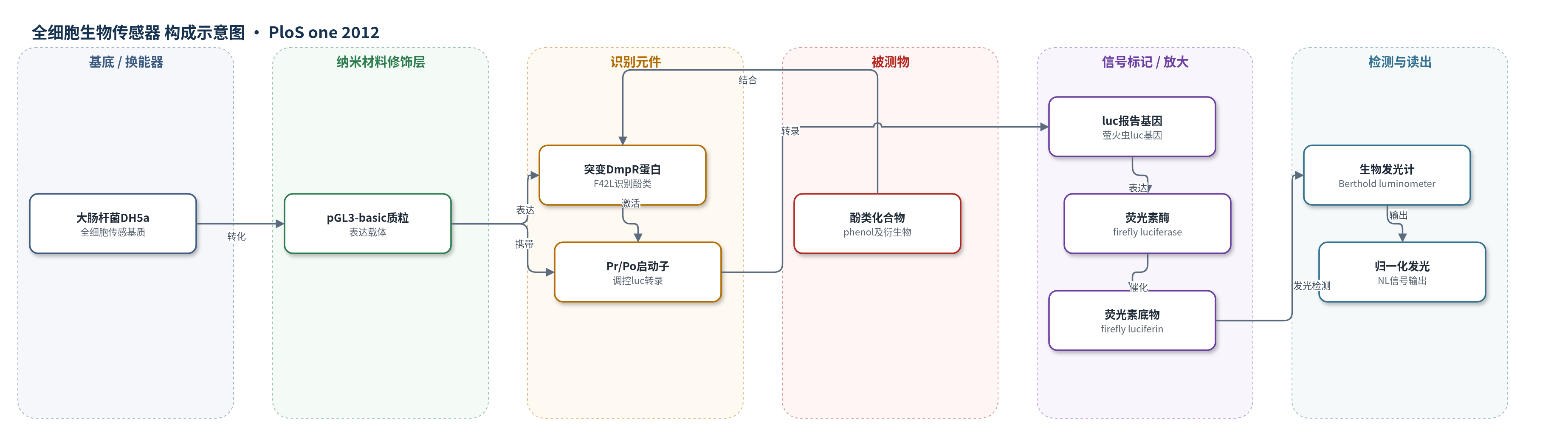
点击图片查看大图 · 依据论文自动绘制
传感器类型
全细胞生物传感器
检测对象
酚(phenol)、2-氯酚(2-chlorophenol)、2,4-二氯酚(2,4-dichlorophenol)、2,4,6-三氯酚(2,4,6-trichlorophenol)、2,4-二甲基酚(2,4-dimethylphenol)、2-硝基酚(2-nitrophenol)、4-硝基酚(4-nitrophenol)、邻甲酚(o-cresol);样品基质:合成水(synthetic water)及 LB 培养基
检测原理
酚类化合物进入 E. coli DH5a 后,与 pRLuc42R 表达的突变 DmpR(F42L)A 域结合。DmpR-酚复合物结合 Pr/Po 操纵子,激活下游萤火虫 luc 基因转录,使细胞表达荧光素酶。加入 firefly luciferin 后,荧光素酶催化其氧化反应并产生生物发光。发光强度经背景与对照校正为归一化发光 NL,在低浓度范围内随酚浓度升高而增加;高浓度时因酚对细胞的毒性或电子传递抑制,响应可能下降。该传感器不依赖电极或纳米材料,信号放大来自基因表达与酶催化发光,因此可快速反映样品中生物可利用酚的浓度。
检测灵敏度
LOD: phenol 0.5 mM (0.047 mg/L);2,4-dimethylphenol 0.1 mM;2-nitrophenol 0.1 mM;2,4,6-trichlorophenol 10 mM;2-chlorophenol 10 mM;2,4-dichlorophenol 100 mM;4-nitrophenol 0.01 mM;o-cresol 1 mM;线性范围: 10 nM–1 mM;R^2 = 0.9913
效应效果
pRLuc42R 对酚、2-氯酚、2,4-二氯酚、2,4,6-三氯酚、2,4-二甲基酚、2-硝基酚、4-硝基酚和邻甲酚阳性,对二甲苯阴性;未检出五氯酚、2,4-二硝基酚和 2-甲基-4,6-二硝基酚。其检出限低于多项已有细菌传感器,如酚 0.5 mM(0.047 mg/L)、4-硝基酚 0.01 mM。RT-PCR 显示 luc 表达较 pRLuc 约 7 倍、较 pRLuc140p143R 约 100 倍。检测约 3 h,较以往 6–7 h 缩短。合成水样可检测总酚类,与化学分析趋势一致;未报告 RSD 与回收率。作者认为其简单、经济、快速,可用于环境酚监测。
传感器的构成
- 宿主细胞:E. coli DH5a,作为全细胞传感基质与基因表达系统
- 表达载体:pGL3-basic 质粒,携带 DmpR/Pr/Po 片段与 luc 基因
- 识别元件:突变 DmpR 蛋白(F42L,pRLuc42R),结合酚类效应物
- 调控元件:Pr/Po 启动子/操纵子,受 DmpR-酚复合物激活转录
- 报告基因:萤火虫 luc 基因,表达荧光素酶
- 信号底物:firefly luciferin,与荧光素酶反应产生生物发光
- 读出装置:Berthold luminometer,测量发光强度
中文摘要
本文报道了一种基于 DmpR 蛋白效应物结合位点突变的全细胞生物发光细菌传感器,用于快速灵敏检测环境中生物可利用酚。作者以 Pseudomonas sp. CF600 的 DmpR 基因及其 Pr/Po 启动子/操纵子为识别调控元件,以萤火虫 luc 基因为报告基因,构建 pRLuc 系列质粒。通过 LIGSITE 预测 DmpR A 域结合位点,并用 GOLD 分子对接筛选关键残基,随后采用突变 PCR 定点突变构建 pRLuc42R、pRLuc140p143R 和 pRLuc113p116R。荧光素酶活性与 RT-PCR 结果显示,仅 pRLuc42R 和 pRLuc113p116R 对酚类效应物呈阳性,其中 pRLuc42R 响应最强。酚最低检出浓度为 0.5 mM(0.047 mg/L),2,4-二甲基酚和 2-硝基酚为 0.1 mM,4-硝基酚为 0.01 mM,邻甲酚为 1 mM;检测时间约 3 h,较以往 6–7 h 缩短。结果表明,基于 DmpR 突变体的重组细菌可作为快速、灵敏的酚类生物传感器。
英文摘要
INTRODUCTION AND RATIONALE: The detection of bioavailable phenol is a very important issue in environmental and human hazard assessment. Despite modest developments recently, there is a stern need for development of novel biosensors with high sensitivity for priority phenol pollutants. DmpR (Dimethyl phenol regulatory protein), an NtrC-like regulatory protein for the phenol degradation of Pseudomonas sp. strain CF600, represents an attractive biosensor regimen. Thus, we sought to design a novel biosensor by modifying the phenol detection capacity of DmpR by using mutagenic PCR.
METHODS: Binding sites of 'A' domain of DmpR were predicted by LIGSITE, and molecular docking was performed by using GOLD to identify the regions where phenol may interact with DmpR. Total five point mutations, one single at position 42 (Phe-to-Leu), two double at 140 (Asp-to-Glu) and 143 (Gln-to-Leu), and two double at L113M (Leu-to- Met) and D116A (Asp-to- Ala) were created in DmpR by site-directed mutagenesis to construct the reporter plasmids pRLuc42R, pRLuc140p143R, and pRLuc113p116R, respectively. Luciferase assays were performed to measure the activity of luc gene in the presence of phenol and its derivatives, while RT-PCR was used to check the expression of luc gene in the presence of phenol.
RESULTS: Only pRLuc42R and pRLuc113p116R showed positive responses to phenolic effectors. The lowest detectable concentration of phenol was 0.5 µM (0.047 mg/L), 0.1 µM for 2, 4-dimethylphenol and 2-nitrophenol, 10 µM for 2, 4, 6-trichlorophenol and 2-chlorophenol, 100 µM for 2, 4-dichlorophenol, 0.01 µM for 4-nitrophenol, and 1 µM for o-cresol. These concentrations were measured by modified luciferase assay within 3 hrs compared to 6-7 hrs in previous studies. Importantly, increased expression of luciferase gene of pRLuc42R was observed by RT-PCR.
CONCLUSIONS: The present study offers an effective strategy to design a quick and sensitive biosensor for phenol by constructing recombinant bacteria having DmpR gene.