组成图示
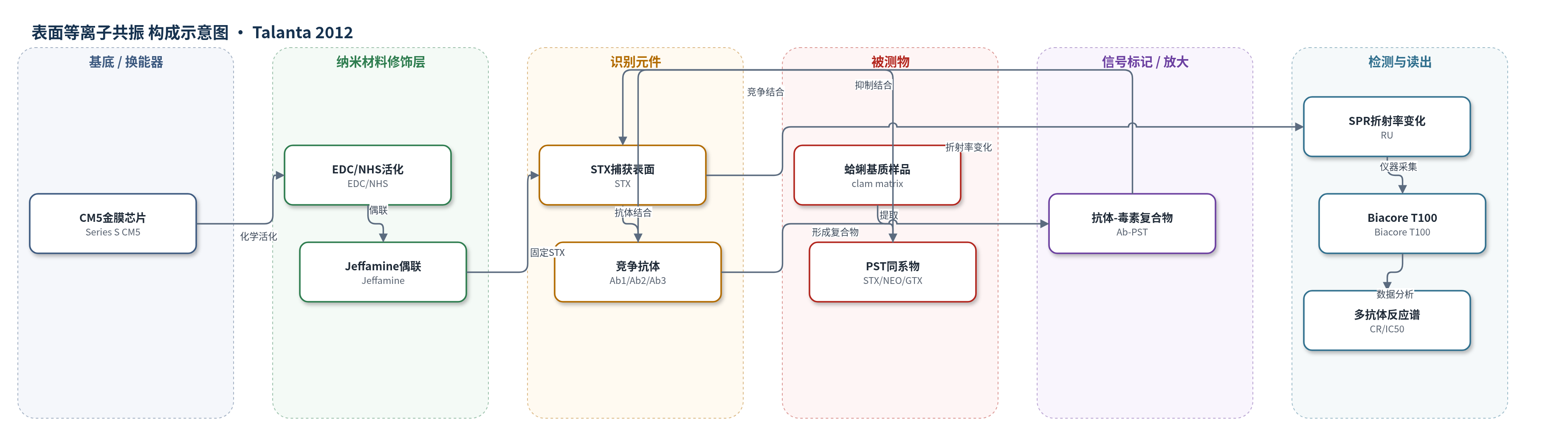
点击图片查看大图 · 依据论文自动绘制
传感器类型
表面等离子共振(SPR)生物传感器
检测对象
麻痹性贝类毒素(paralytic shellfish toxins, PSTs;含STX、NEO、GTX1,4、GTX2,3、dcSTX、dcNEO、dcGTX2,3、B1、C1,2),样品基质为蛤蜊提取物/贝类组织(clam matrix/shellfish tissue)及缓冲液标准。
检测原理
该SPR免疫测定采用竞争法。CM5金膜芯片经EDC/NHS活化后,用Jeffamine偶联saxitoxin(STX),形成固定STX捕获表面。样品中的PST与抗体在进样前预混合,PST占据抗体结合位点;未被PST结合的抗体随后结合芯片表面的STX。PST浓度越高,抗体被竞争抑制越多,芯片表面结合的抗体质量越少,金膜界面折射率变化越小,SPR响应(RU)越低。Biacore T100实时监测折射率变化,1 RU对应10^-6折射率变化。数据经空白归一化后拟合四参数曲线,计算IC20、IC50、IC80和交叉反应性。方法无外源标记、无酶催化放大,依靠多抗体不同反应谱推断毒素组成和毒性。
检测灵敏度
原文称SPR可sub-ppb LOD、<10 min;本文未报告具体LOD、线性范围、灵敏度斜率、R^2;报告动态范围(DR=IC20 to IC80,ng/mL):STX Ab1 2.7–54.3、Ab2 1.4–7.7、Ab3 1.6–6.9;NEO Ab1 530.5–9986.0、Ab2 23.1–793.1、Ab3 17.5–726.4;GTX1,4 Ab1 324.9–16197.1、Ab2 260.9–1955.7、Ab3 79.2–3438.4;GTX2,3 Ab1 3.1–41.4、Ab2 3.0–14.3、Ab3 0.4–24.6;dcSTX Ab1 16.2–290.7、Ab2 2.6–24.7、Ab3 0.8–442.4;dcNEO Ab1 964.5–3724.2、Ab2 100.5–593.0、Ab3 43.2–39711.6;dcGTX2,3 Ab1 4.2–165.9、Ab2 30.7–606.1、Ab3 15.9–5851.5;B1 Ab1 58.1–920.7、Ab2 8.8–40.8、Ab3 5.5–2673.5;C1,2 Ab1 56.1–1716.3、Ab2 4.6–190.7、Ab3 75.1–2091542。
效应效果
SPR测定稳健、重复性良好,但定量响应常与样品毒性不一致。三种抗体交叉反应性不同:Ab1对STX和GTX2,3高反应(>100% CR),对NEO、GTX1,4低反应,可能假阴性;Ab2对STX高反应,对NEO、GTX1,4、dcNEO、dcGTX2,3低反应,对B1/C1,2约15% CR可能假阳性;Ab3对STX/GTX2,3高反应,对多数同系物低反应。在80 µg STX eq./100 g tissue行动水平,混合物均显示抑制;90% STX/10% NEO较准确,80% GTX1,4/20% STX可能假阴性(约>20 µg才触发),77% B1/23% STX可能假阳性(<8 µg即触发)。多抗体策略可提高判断信心,但尚未完全消除假阳性/假阴性,有望减少MBA和LC/MS确证检测。
传感器的构成
- SPR换能基底:Series S CM5金膜芯片,提供表面等离子共振界面并检测折射率变化
- 化学活化层:EDC/NHS将CM5表面活化为琥珀酰亚胺酯,用于共价偶联
- 偶联连接层:Jeffamine连接基团固定于芯片表面,用于连接STX
- 封闭层:ethanolamine封闭未反应位点,降低非特异结合
- 捕获识别层:saxitoxin (STX)经甲醛偶联于芯片表面,作为竞争免疫测定的固定抗原
- 流动相:HBS-EP+缓冲液(10 mM HEPES、150 mM NaCl、3 mM EDTA、0.05% P20),用于样品和抗体输送
- 竞争识别抗体:Ab1(Ridascreen Fast PSP SC)、Ab2(Beacon多克隆抗STX)、Ab3(burro抗STX),与PST结合后竞争结合芯片STX
- 信号读出:无外源标记,SPR实时监测抗体结合引起的折射率变化(RU)
中文摘要
麻痹性贝类毒素(PSTs)是食用受污染海产品时的人类健康风险。PST家族包含20多种同系物,各同系物毒性不同。为在保护消费者的同时减少未污染采捕区的不必要关闭,需要一种可快速分析样品毒性的方法。虽然已有多种PST免疫测定方法,但突出挑战在于将定量响应与样品毒性相关联,因为尚无单一抗体能以与毒性相关的方式识别所有PST同系物。为此,本研究提出组合多种具有不同反应性的抗体,建立筛查测定。作者利用表面等离子共振(SPR)生物传感器评估三种现有抗体对9种常见PST的反应谱。结果表明,检测R1羟基化PST仍存在困难,但多抗体策略可能提高判断总体毒性和毒素谱的信心。多联方法不仅可改进SPR生物传感器测定,也可应用于侧流免疫层析平台;文中还展示了包含三种抗体的理论装置。这些改进测定有望减少动物生物测定和LC/MS等确证分析的使用,从而提升食品安全并促进贝类资源经济利用。
英文摘要
Paralytic shellfish toxins (PSTs) are a risk to humans upon consumption of contaminated seafood. The PST family is comprised of more than twenty congeners, with each form having a different potency. In order to adequately protect consumers yet reduce unnecessary closures of non-contaminated harvesting areas, a rapid method that allows for analysis of sample toxicity is needed. While a number of PST immunoassays exist, the outstanding challenge is linking quantitative response to sample toxicity, as no single antibody reacts to the PST congeners in a manner that correlates with potency. A novel approach, then, is to combine multiple antibodies of varying reactivity to create a screening assay. This research details our investigation of three currently available antibodies for their reactivity profiles determined using a surface plasmon resonance biosensor assay. While our study shows challenges with detection of the R1-hydroxylated PSTs, results indicate that using multiple antibodies may provide more confidence in determining overall toxicity and the toxin profile. A multiplexed approach would not only improve biosensor assays but could also be applied to lateral flow immuno-chromatographic platforms, and such a theoretical device incorporating the three antibodies is presented. These improved assays could reduce the number of animal bioassays and confirmatory analyses (e.g., LC/MS), thereby improving food safety and economic use of shellfish resources.