组成图示
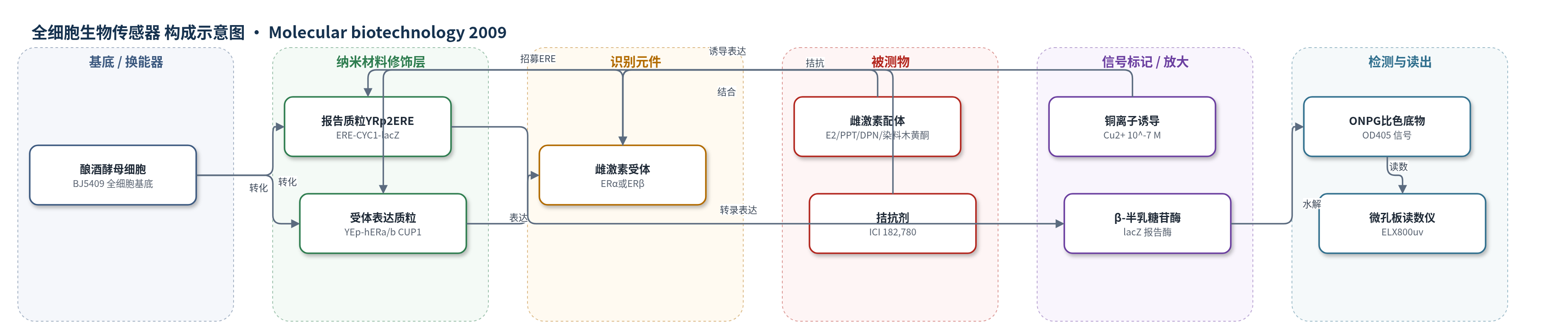
点击图片查看大图 · 依据论文自动绘制
传感器类型
全细胞生物传感器
检测对象
雌激素受体配体(estrogen receptor ligands):17β-雌二醇(17β-estradiol, E2)、PPT、DPN、染料木黄酮(genistein)、ICI 182,780;样品基质为化学溶液/酵母培养基(DMSO 储备液)
检测原理
铜离子通过 CUP1 启动子剂量依赖诱导酿酒酵母中 ERα 或 ERβ 表达。待测雌激素类配体进入细胞后与 ER 结合,形成配体-ER 复合物并二聚化,随后被招募至报告质粒 YRp2ERE 上游的两个 ERE 元件,启动 CYC1-lacZ 转录,使 β-半乳糖苷酶表达量随配体激动活性增加。裂解酵母后,β-半乳糖苷酶水解 ONPG 产生 OD405 比色信号,经 OD600 归一化后反映配体浓度;信号-浓度关系用 Sigmoidal/Boltzmann 模型拟合。ICI 182,780 可竞争性抑制 ER 转录激活,ChIP 证实 ER 在雌激素处理后结合 ERE,说明信号由 ER 介导。
检测灵敏度
LOD: 4.7 pM (1.3 ng/l) for ERa;0.12 nM (33.5 ng/l) for ERb;EC50: 0.18 ± 0.01 nM (BRYa)、0.49 ± 0.05 nM (BRYb);IC50: 0.93 ± 0.06 μM (BRYa)、0.28 ± 0.02 μM (BRYb);sigmoidal slope dx: 0.4 ± 0.02 (BRYa)、0.29 ± 0.03 (BRYb)
效应效果
系统可重复且灵敏:三天重复测定,Sigmoidal 参数标准差小(ERα A1 22.8±0.5、A2 203.6±2.0、dx 0.4±0.02;ERβ A1 26.1±0.7、A2 139.9±1.5、dx 0.29±0.03)。选择性:PPT 相对效力 β:α 0.67、效率 β:α 0.36,偏 ERα;DPN 效力 β:α 21.57,偏 ERβ;染料木黄酮效力 β:α 2710.54、效率 β:α 2.59,强偏 ERβ。ICI 182,780 剂量依赖抑制,ChIP 证实 ERE 占据。作者称较 Jungbauer 酵母 ERα 系统灵敏度约高25倍,2天完成,适合高通量筛选。
传感器的构成
- 细胞基底/全细胞换能器:酿酒酵母 Saccharomyces cerevisiae BJ5409(MATa, leu2Δ, his3Δ200, urdx-52, trp1, gal),作为全细胞传感平台。
- 报告基因质粒:YRp2ERE,含 URA3、CYC1 最小启动子、lacZ β-半乳糖苷酶报告基因及上游两个 ERE 拷贝,将 ER 激活转化为可测酶活。
- 受体表达质粒:YEp-hERa 或 YEp-hERb,含 TRP1、Apr 和由 CUP1 铜诱导金属硫蛋白启动子控制的人 ERα/ERβ 基因,用于表达识别元件。
- 识别元件:人雌激素受体 ERα 或 ERβ,由 CUP1 启动子诱导表达,结合雌激素类配体。
- 诱导/调控剂:铜离子(Cu2+,最适 10^-7 M),通过 CUP1 启动子剂量依赖诱导 ER 表达。
- 信号读出底物:ONPG(邻硝基苯基-β-D-半乳糖苷),被 β-半乳糖苷酶水解产生 OD405 比色信号。
- 裂解/反应体系与仪器:lyticase、Z-buffer、SDS 用于裂解酵母并释放酶活;Universal Microplate Reader ELX800uv 读取 OD600 与 OD405。
中文摘要
由于雌激素受体α(ERα)和β(ERβ)被认为介导不同生物效应,设计或筛选亚型选择性ER配体备受关注。本文构建了双组分重组酵母系统(BRYS),用于筛选和评估亚型选择性ER配体。采用均匀设计和免疫印迹确定通过铜诱导金属硫蛋白启动子(CUP1)控制ER表达的最适铜离子剂量。测试了天然雌激素17β-雌二醇、特异性ER激动剂PPT和DPN以及植物雌激素染料木黄酮,以验证该系统。这些化学物质被鉴定和表征时,激动活性之间出现明显且符合预期的区分。此外,使用拮抗剂ICI 182,780和染色质免疫沉淀(ChIP)确认激动效应通过ER介导。比较研究显示该系统可重复且灵敏。ERα最低可检测雌激素浓度为4.7 pM(1.3 ng/l),ERβ为0.12 nM(33.5 ng/l)。结果表明,体外筛选亚型选择性ER配体可在简单酵母系统中进行,快速、灵敏、可靠且定量。
英文摘要
Since the estrogen receptor alpha (ERalpha) and beta (ERbeta) are thought to mediate different biological effects, there is intense interest in designing or screening subtype-selective ER ligands. Here, we constructed a biosensor identified as bipartite recombinant yeast system (BRYS) to screen and evaluate subtype-selective ER ligands. Uniform design and immunoblotting was used to determine an optimal dose of copper which control the expression of ERs through a copper inducible metallothionine promoter (CUP1). Some chemicals including natural estrogen (17beta-estradiol), specific estrogen receptor agonist (PPT and DPN), and phytoestrogens (genistein) were tested to validate this system. There was obvious and anticipative discrimination between the agonistic activities when these chemicals were identified and characterized. Furthermore, antagonist (ICI 182,780), which could antagonize the transactivation of estrogen, and chromatin immunoprecipitation (ChIP) were used to confirm that the agonistic effects were mediated through ERs. Comparative studies showed that this system was reproducible and sensitive. 4.7 pM (1.3 ng/l) estrogen was the lowest concentration that could be detected to ERalpha and 0.12 nM (33.5 ng/l) for ERbeta. The results from our study showed that in vitro screening for subtype-selective ER ligands could be conducted in a simple yeast system that is rapid, sensitive, reliable, and quantitative.