组成图示
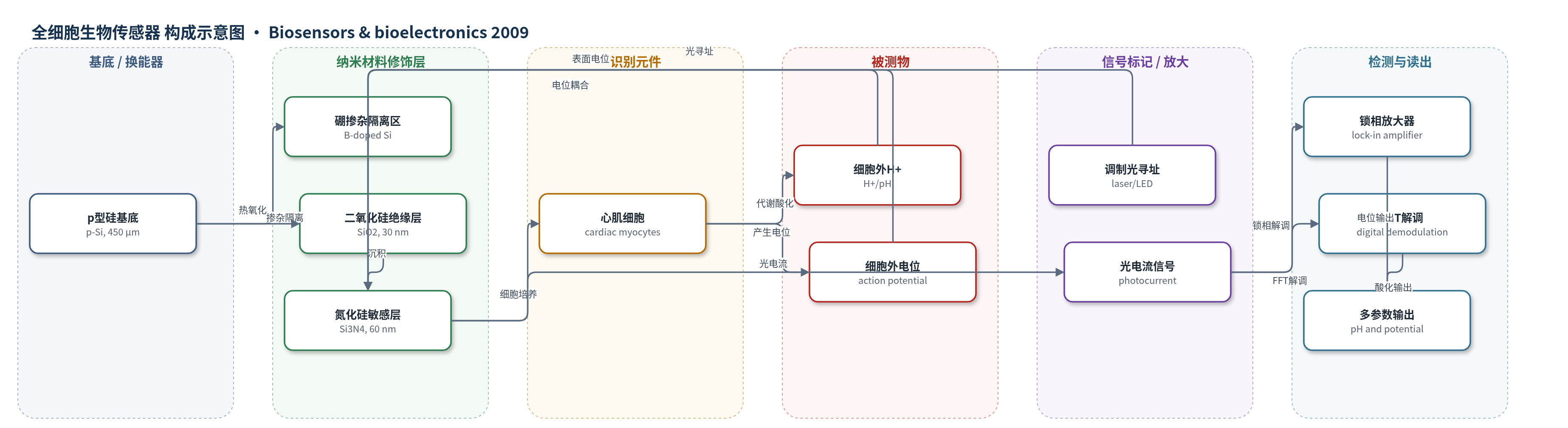
点击图片查看大图 · 依据论文自动绘制
传感器类型
全细胞生物传感器
检测对象
细胞酸化(cell acidification,细胞外H+/pH)、细胞外电位(extracellular potential,心肌细胞动作电位);样品基质:心肌细胞培养液/电解质溶液
检测原理
LAPS采用电解质-绝缘体-半导体(EIS)结构,Si3N4/SiO2表面与溶液界面存在H+位点结合。细胞代谢使局部H+浓度升高时,敏感层表面电位改变,并耦合到固定偏置电压,使调制光诱导的光电流发生偏移;心肌细胞贴附在表面时,其动作电位同样改变局部表面电位,从而调制光电流。芯片上不同测试区用不同频率的调制光寻址,总光电流经I-V转换后,锁相放大器提取10 kHz激光对应的细胞外电位信号,FFT提取四个LED频率对应的酸化信号,实现并行检测。pH变化与光电流变化近似线性,1%光电流变化约对应0.0325 pH单位。
检测灵敏度
灵敏度斜率: 53.9 mV/pH;线性范围: pH 4–9;R^2 = 0.9998;1% 光电流变化对应 0.0325 pH 单位
效应效果
该传感器通过硼掺杂隔离和缩小有效面积降低噪声:200 μm×200 μm小井噪声为2.166±0.384 nA,低于3 mm×3 mm的3.510±0.829 nA;阵列噪声低于同面积单LAPS的6.205±1.021 nA。酸化检测pH 4–9线性良好,R2=0.9998;停流酸化下降、复流恢复,乙酰胆碱抑制后停止。细胞外电位基线噪声约100 μVp-p,肾上腺素10 μg/mL后出现约400 μV尖峰,乙酰胆碱10 μg/mL后回落;A、D1、D2型幅度约0.25、0.12、0.5 mV。相比FET/MEA,LAPS阵列仅需一根引线并可自由选点,适合多参数监测和药物筛选。
传感器的构成
- 基底/换能器:p型硅晶圆(p-Si,450 μm,<100>),背面蒸镀铝(Al,200 nm)欧姆接触,构成EIS半导体换能器。
- 隔离掺杂层:硼(B)重掺杂硅区,隔离相邻测试区耗尽层,降低串扰和噪声。
- 绝缘层:热生长二氧化硅(SiO2,测试区30 nm,掺杂区数百纳米),形成EIS绝缘层并参与井状结构。
- 敏感层:PECVD沉积氮化硅(Si3N4,60 nm),作为H+敏感表面,形成表面电位。
- 微测试区:200 μm×200 μm小井用于细胞外电位,3 mm×3 mm大井用于细胞酸化,提供空间分辨检测。
- 细胞附着层:多聚-L-鸟氨酸(poly-l-ornithine,100 μg/mL)和层粘连蛋白(laminin,8 μg/mL),促进心肌细胞贴附。
- 识别/信号源:心肌细胞(cardiac myocytes),培养于测试区,产生细胞外电位并代谢酸化培养液。
- 光寻址层:690 nm激光(10 kHz,0.2 mW)和四个625 nm LED(不同频率,50 mW),用于选择测试区并产生光电流。
中文摘要
本文讨论了一种新型多功能集成细胞基生物传感器的设计,用于同时检测细胞酸化与细胞外电位。该传感器采用心肌细胞等活细胞作为光寻址电位传感器(LAPS)阵列的信号源,使同一LAPS阵列能够并行监测细胞酸化与细胞外电位。在LAPS阵列制备中,部分硅基底被重掺硼以形成相互独立的测试区。检测系统由锁相放大器和基于快速傅里叶变换(FFT)的数字解调方法构成,可分离不同频率调制光对应的信号。该LAPS阵列对H+表现出53.9 mV/pH的良好灵敏度和良好线性;用于细胞外电位检测的测试区被缩小至200 μm×200 μm,以获得更好的灵敏度。实验结果表明,该LAPS阵列能够以良好灵敏度监测细胞酸化及细胞外电位。这种新型集成生物传感器可用于多参数细胞外监测,并可能成为药物筛选平台。
英文摘要
The paper discussed a novel design of multifunctional cell-based biosensors for simultaneously detecting cell acidification and extracellular potential. Employing living cells such as cardiac myocytes as a source for the light addressable potentiometric sensor (LAPS) array, this cell-based biosensor was able to monitor both the acidification and extracellular potential in parallel. For LAPS array fabrication, part of the silicon base was heavily doped with boron to form separate testing areas. Detecting system was built involving lock-in amplifier and digital demodulation with FFT methods. This LAPS array showed a good sensitivity of 53.9 mV/pH to H(+) with good linearity. Each testing area for extracellular potential detection was decreased to 200 microm x 200 microm in size to obtain a better sensitivity. Experiment results showed that this LAPS array could monitor the acidification of cells as well as the extracellular potential with good sensitivity. This novel integrated biosensor will be useful for multi-parameter extracellular monitoring and can possibly be a platform for drug screening.