组成图示
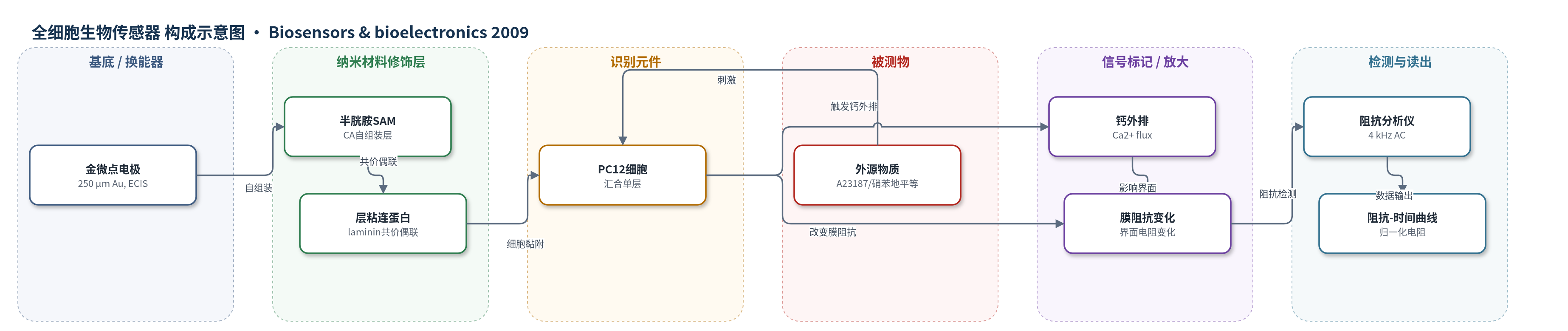
点击图片查看大图 · 依据论文自动绘制
传感器类型
全细胞生物传感器
检测对象
钙离子载体A23187(calcimycin/A23187)、硝苯地平(nifedipine)、D-甘露醇(d-mannitol)、卡巴胆碱(carbachol)、神经生长因子(NGF)、地塞米松(dexamethasone)、毛喉素(forskolin);样品基质:无血清细胞培养基/细胞培养液
检测原理
该传感器以汇合PC12细胞作为全细胞识别元件,外源物质与细胞膜受体、离子通道或膜脂相互作用,触发胞内Ca2+升高、钙外排、离子流改变或细胞形态/膜完整性变化。这些生理事件改变细胞-电极界面的介电与导电特性,使4 kHz交流阻抗的实部电阻发生可测变化。阻抗分析仪以50 mV p-t-p正弦激励连续监测归一化电阻,信号随刺激物类型和浓度变化:如甘露醇100、200、300 mM引起不同幅度和恢复时间的阻抗峰,A23187引起持续阻抗升高,硝苯地平引起阻抗下降。系统无外源标记或酶放大,主要依赖细胞生理响应和长时间阻抗监测实现检测。
检测灵敏度
未报告LOD、线性范围、灵敏度斜率或相关系数。
效应效果
该传感器在37 ℃下可连续监测约9–24 h,界面稳定。A23187处理后5 min出现阻抗升高,6.17 h达平台,最大归一化阻抗1.04±0.07;硝苯地平1.68 h降至0.745±0.02;卡巴胆碱最大1.01±0.07。甘露醇呈浓度依赖:100 mM 17.3 h达0.926±0.02,20 h恢复;200 mM 6.16 h达0.900±0.04,10 h恢复;300 mM 10.1 h达0.844±0.01且未恢复。NGF 2.08 h降至0.913±0.0,地塞米松4.82 h降至0.740±0.04,毛喉素6.3 h降至0.718±0.02。设置空白、阴性和阳性对照,并在无细胞裸电极上验证外源物不直接改变电极阻抗。作者认为该模型可用于受体介导响应、胆碱能刺激和毒性/药物筛选。
传感器的构成
- 基底/换能器电极:8孔细胞培养生物芯片ECIS 8W1E,含250 μm金微点工作电极与大面积对电极,用于AC阻抗换能
- 自组装修饰层:半胱胺(CA)SAM,2 mM水溶液吸附形成有序单分子层,提供氨基用于蛋白偶联
- 细胞附着识别层:层粘连蛋白(laminin),经EDC/NHS异双功能偶联共价固定于CA SAM,促进PC12细胞黏附
- 全细胞识别元件:PC 12细胞(CRL-1721),培养至汇合,作为响应外源物质的生物传感元件
- 样品基质:RPMI 1640培养基及无血清培养基,维持细胞存活并提供阻抗测量环境
- 信号读出装置:Model 1260阻抗/增益-相位分析仪与HP 34970A数据采集/开关单元,4 kHz、50 mV p-t-p正弦激励下监测实部阻抗
中文摘要
本研究报道了一种基于PC 12细胞的全细胞阻抗生物传感器,用于监测外源物质对细胞电生理行为的影响。PC 12细胞被培养至汇合并附着于8孔细胞培养生物芯片中的250 μm金微点电极上;通过半胱胺(CA)自组装单分子层共价衍生层粘连蛋白(laminin),实现细胞与金微电极的紧密附着。采用交流阻抗谱监测细胞在钙离子载体A23187(calcimycin)、硝苯地平(nifedipine)、D-甘露醇(d-mannitol)和卡巴胆碱(carbachol)作用下的阻抗响应,其中卡巴胆碱可诱导毒蕈碱受体依赖的胞质游离Ca2+升高。A23187与硝苯地平实验用于阐明受体触发事件及非线粒体钙库释放之间的关系。此外,研究还考察了神经生长因子(NGF)、地塞米松(dexamethasone)和毛喉素(forskolin)引起的表型改变及离子流调节。结果表明,胞质Ca2+外排等电生理行为变化可通过阻抗谱检测,支持将阻抗波动归因于离子流变化。
英文摘要
The effect of exogenous agents on the complex impedance of PC 12 cells that were cultured to confluency on 250-mum gold microdot electrodes fabricated within 8-well cell culture biochips was studied. Surface attachment of PC 12 cells to gold microelectrodes was accomplished using cysteamine SAMs covalently derivatized with laminin. The impedimetric response of PC 12 cells that undergo calcium exocytosis in the presence of calcimycin, nifedipine, mannitol and carbachol were identified. Treatment with carbachol induces muscarinic receptor-dependent rises in free cytosolic Ca(2+). Experiments with calcimycin and nifedipine were carried out to clarify the relationship between these two receptor-triggered events. In particular, it is believed to mediate intracellularly the release of Ca(2+) from non-mitochondrial stores. We also examined cellular impedance responsiveness of PC 12 cells in response to phenotypic alteration especially with regard to modulation of ion fluxes using nerve growth factor (NGF), dexamethasone and forskolin. Our results demonstrate that a change in electrophysiological behavior, such as exocytosis of cytosolic Ca(2+) is detectable using impedance spectroscopy, and therefore support the results of impedance fluctuation to be attributed to ion-fluxes.