组成图示
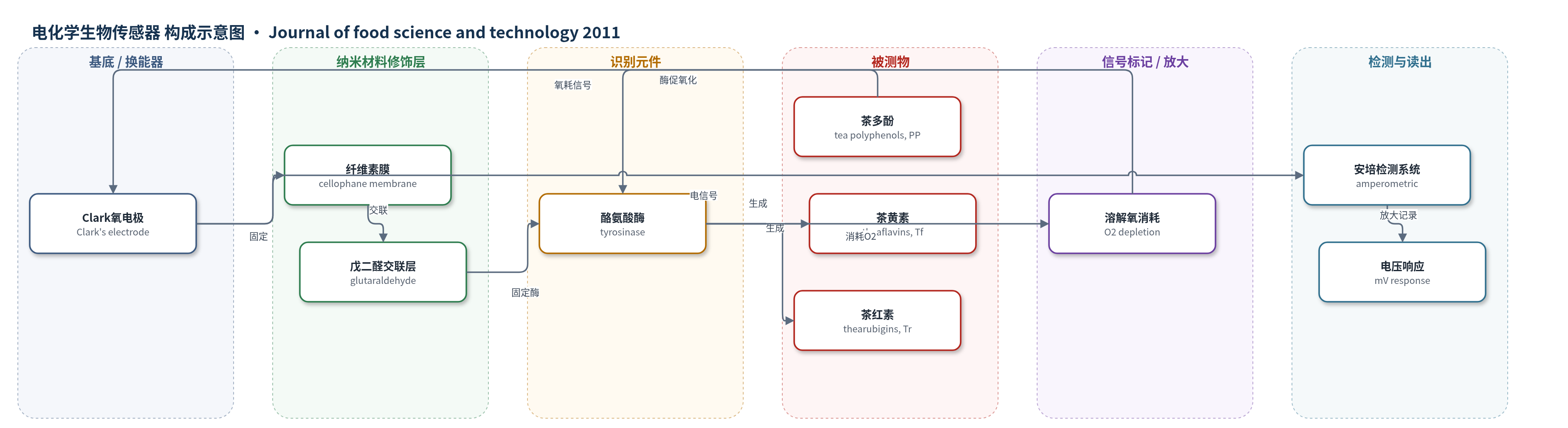
点击图片查看大图 · 依据论文自动绘制
传感器类型
电化学生物传感器
检测对象
茶多酚(tea polyphenols, PP;含茶黄素 theaflavins, Tf 与茶红素 thearubigins, Tr);样品基质:市售红茶浸出液(black tea infusions)
检测原理
该传感器以固定化酪氨酸酶为催化识别元件,以Clark氧电极为换能器。茶浸出液中的茶多酚(PP,主要为儿茶酚类)进入反应池后,在酪氨酸酶催化下被氧化为邻醌,并进一步聚合生成茶黄素(Tf)和茶红素(Tr)。该酶促反应同时消耗溶解氧,使电极附近氧浓度下降;Clark电极将氧耗变化转换为电化学电压信号。信号经安培检测系统放大和记录,电压响应与样品中PP浓度呈正相关,因此可间接反映Tf/Tr含量及红茶品质。方法未使用额外化学放大,主要依靠酶催化和氧电极检测。
检测灵敏度
—
效应效果
研究对8个市售红茶品牌(A–H)进行对比,生物传感器响应与分光光度法、CIE颜色评价和感官评价总体一致。样品A茶黄素含量较高(约0.4%),生物传感器响应也较高;样品G响应较低,其偏红色被认为可能来自人工色素,而人工色素不引起酪氨酸酶响应,显示一定抗干扰性。颜色PCA中PC1和PC2分别解释65.8%和22.9%方差,合计超过88%;感官PCA中PC1和PC2分别解释41.2%和18%方差,合计约60%。数据为3次独立重复均值±标准差。作者认为该方法可简化红茶品质与市场价格评价。
传感器的构成
- 换能器电极:Clark氧电极(Clark's electrode),检测酶促反应中溶解氧消耗并输出电化学电压信号
- 酶固定化载体:纤维素膜(cellophane membrane),承载并固定酪氨酸酶与溶菌酶
- 识别/催化元件:酪氨酸酶(tyrosinase,来自Agaricus bisporus),催化茶多酚氧化为邻醌并进一步聚合
- 交联稳定剂:戊二醛(glutaraldehyde),交联固定酪氨酸酶以稳定酶膜
- 辅助稳定剂:溶菌酶(lysozyme),与酶共固定以增强操作稳定性
- 反应介质:0.1 M磷酸盐缓冲液(pH 6.8),维持酶活性并作为样品反应介质
- 信号读出系统:安培检测系统(amperometric detection system),放大并记录毫伏电压响应
中文摘要
本研究旨在建立一种用于茶叶(Camellia sinensis)质量评价的高效方法,采用基于酪氨酸酶(tyrosinase)的生物传感器检测茶多酚(polyphenols, PP)。酪氨酸酶可催化茶多酚氧化聚合生成茶黄素(theaflavins, Tf)和茶红素(thearubigins, Tr),二者决定茶汤颜色与涩味,是茶叶品质的重要指标。不同茶浸出液在生物传感器上的响应差异可反映Tf和Tr含量的不同。研究对8个市售红茶品牌(A–H)进行质量属性比较,并将生物传感器结果与分光光度法、高效液相色谱(HPLC)、CIE颜色系统和感官评价进行对比。结果显示,生物传感器、感官评价和分光光度法之间具有较好相关性。样品A的Tf含量较高,生物传感器响应也较高;样品G响应较低。作者认为,生物传感器有望成为未来评价茶叶市场价值的基础工具。
英文摘要
Attempts were made to evolve an efficient technique for quality assessment of tea (Camellia sinensis) using a tyrosinase based biosensor to detect polyphenols (PP). Tyrosinase catalyzes the polymerization of PP to form theaflavins (Tf) and thearubigins (Tr) contributing to the colour and astringency of tea, which determine tea quality. Variation in biosensor response of tea infusions gave an indication of differential amount of Tf and Tr. A comparative study of quality attributes of 8 varieties of commercially available brands of tea (A-H) was done using biosensor and results were compared with conventional techniques such as spectrophotometry, high performance liquid chromatography (HPLC), Commission Internationale de I'Eclairage (CIE) system and sensory evaluation. Considerable correlation was observed among the biosensor, sensory and spectrophotometric evaluation of tea samples. Sample A showed high Tf content and also showed a relative high biosensor response whereas sample G showed relatively poor response. Application of biosensors would serve as a basis for the evaluation of market value of tea in the near future.