组成图示
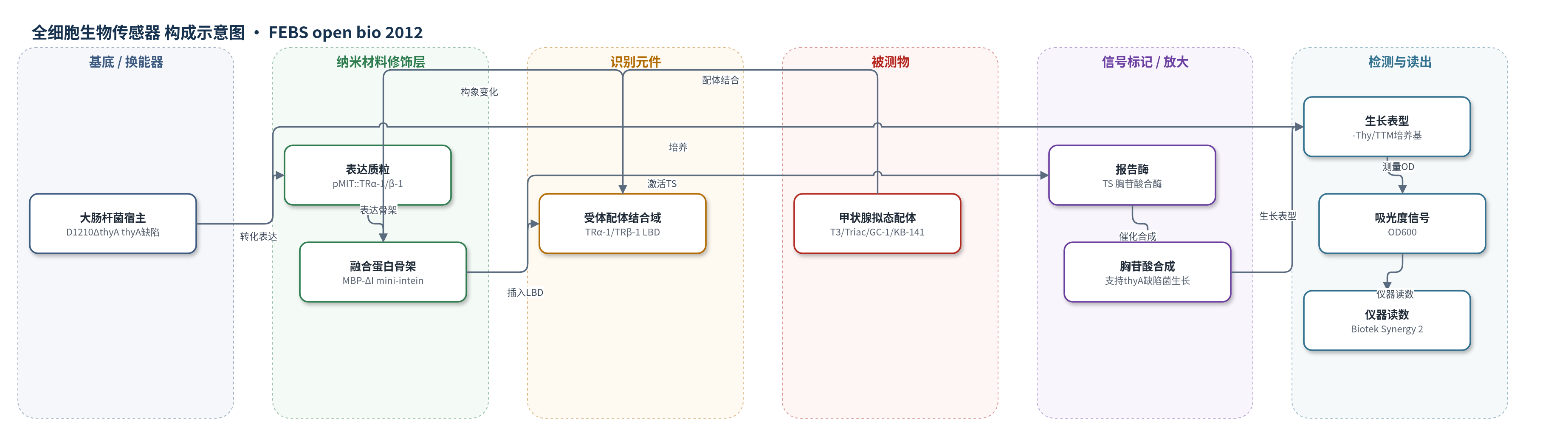
点击图片查看大图 · 依据论文自动绘制
传感器类型
全细胞生物传感器
检测对象
三碘甲状腺原氨酸(T3)、三碘甲状腺乙酸(Triac)、GC-1、KB-141、17-β-雌二醇(E2,阴性对照);样品基质:DMSO 溶液加入 -Thy/TTM 定义培养基中的大肠杆菌培养体系
检测原理
该传感器将人甲状腺激素受体α-1或β-1配体结合域(LBD)插入MBP-ΔI mini-intein-TS融合蛋白的mini-intein区。未结合配体时,TS二聚化受空间位阻抑制,thyA缺陷大肠杆菌在无胸腺素培养基(-Thy)中生长受限。配体结合LBD后,诱导LBD第12螺旋重定位,并通过mini-intein传递构象变化,剂量依赖地解除TS抑制、恢复胸苷酸合成活性。TS活性使细菌在-Thy培养基中增殖,OD600随配体浓度升高而增加;在含胸腺素和甲氧苄啶的TTM培养基中则出现镜像抑制表型,用于排除一般毒性或营养效应。通过系列稀释拟合剂量-响应曲线获得EC50,并计算TRα/TRβ选择性比值。
检测灵敏度
检测限(原文称 detection limits): T3、KB-141、GC-1 约 100 nM;Triac 约 10 nM
效应效果
该细菌生物传感器与哺乳动物细胞报告基因检测定性一致:T3对TRα-1和TRβ-1的EC50分别为0.52 μM和0.58 μM,无明显选择性;Triac、GC-1和KB-141均显示TRβ选择性,选择性比值分别为4.43、4.04和4.66。E2对TRα-1无显著作用,对TRβ-1仅高浓度弱激动。统计质量良好,Z′因子0.66–0.92,TRα信噪比>66、TRβ>16,信背比>3。实验每板三重复并跨三块板计算;pH 6.9–7.1可致OD变化达25%,板边效应低生长约10%、高生长约4%。作者强调其非放射性、简单、经济(每孔<0.10美元),适合高通量初筛。
传感器的构成
- 宿主细胞:大肠杆菌 D1210ΔthyA(thyA 缺陷株,作为生长换能基质)
- 表达质粒:pMIT::TRα-1 或 pMIT::TRβ-1(携带 Ptac* 启动子,驱动融合蛋白表达)
- 识别元件:人甲状腺激素受体 α-1 或 β-1 配体结合域(TRα-1 LBD / TRβ-1 LBD)
- 变构连接骨架:麦芽糖结合蛋白(MBP)-Mtu RecA mini-intein(N-Mtu/C-Mtu)
- 报告酶:胸苷酸合酶(TS,T4 thymidylate synthase)
- 读出介质:无胸腺素定义培养基(-Thy medium)或胸腺素+甲氧苄啶培养基(TTM medium)
- 检测仪器:96 孔板与 Biotek Synergy 2 分光光度计(OD600)
中文摘要
亚型选择性甲状腺拟态物有望用于预防或治疗心脏病、高LDL胆固醇和肥胖,但现有方法有限,难以检测甲状腺激素受体(TR)活性化合物的激动行为。本文报道并验证了一种新设计的TRα-1细菌生物传感器,通过工程化大肠杆菌在简单定义培养基中的生长表型指示甲状腺活性化合物的存在。该传感器利用工程化变构融合蛋白,将激素受体配体结合域(LBD)的构象与胸苷酸合酶(TS)报告酶活性偶联,使表达菌产生激素依赖的生长表型。该传感器可与已发表的TRβ-1细菌生物传感器联用,用于检测GC-1和KB-141等潜在亚型选择性治疗化合物。作者测定了T3、Triac、GC-1和KB-141的半数有效浓度(EC50)及在各传感器菌株中的相对效力,结果与哺乳动物细胞报告基因检测一致,证实该体系可用于识别TR亚型选择性药物。该生物传感器具有高通量、受体特异和经济(实验室规模每孔低于0.10美元)等优势。
英文摘要
Subtype-selective thyromimetics have potential as new pharmaceuticals for the prevention or treatment of heart disease, high LDL cholesterol and obesity, but there are only a few methods that can detect agonistic behavior of TR-active compounds. Among these are the rat pituitary GH3 cell assay and transcriptional activation assays in engineered yeast and mammalian cells. We report the construction and validation of a newly designed TRα-1 bacterial biosensor, which indicates the presence of thyroid active compounds through their impacts on the growth of an engineered Escherichia coli strain in a simple defined medium. This biosensor couples the configuration of a hormone receptor ligand-binding domain to the activity of a thymidylate synthase reporter enzyme through an engineered allosteric fusion protein. The result is a hormone-dependent growth phenotype in the expressing E. coli cells. This sensor can be combined with our previously published TRβ-1 biosensor to detect potentially therapeutic subtype-selective compounds such as GC-1 and KB-141. To demonstrate this capability, we determined the half-maximal effective concentration (EC50) for the compounds T3, Triac, GC-1 and KB-141 using our biosensors, and determined their relative potency in each biosensor strain. Our results are similar to those reported by mammalian cell reporter gene assays, confirming the utility of our assay in identifying TR subtype-selective therapeutics. This biosensor thus provides a high-throughput, receptor-specific, and economical method (less than US$ 0.10 per well at laboratory scale) for identifying important therapeutics against these targets.