组成图示
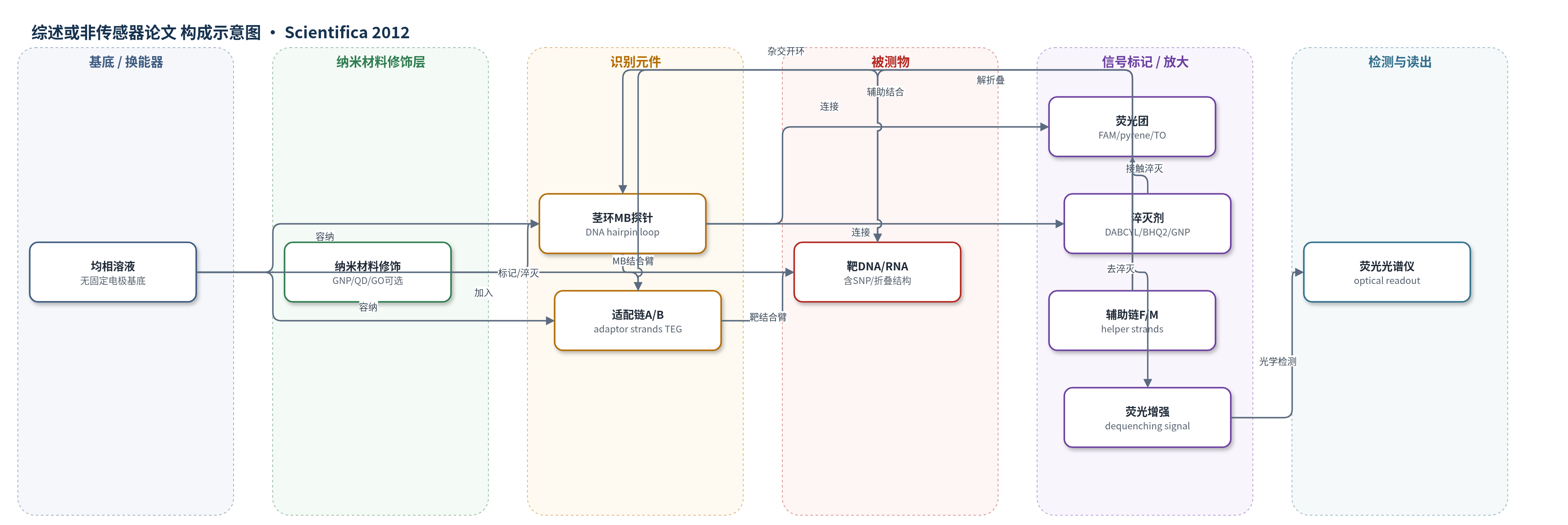
点击图片查看大图 · 依据论文自动绘制
传感器类型
综述或非传感器论文
检测对象
DNA、RNA、microRNA、mRNA、SNP/点突变核酸、折叠RNA/DNA;样品基质:缓冲液、活细胞/细胞裂解液、血清、体外转录体系、细菌/病毒样品
检测原理
经典MB探针为茎环DNA,loop与靶DNA/RNA互补,stem两端连接荧光团和淬灭剂。无靶时茎环闭合,荧光团与淬灭剂近距离接触,发生接触淬灭,背景低;靶杂交后茎环打开,荧光团远离淬灭剂,荧光增强,信号随靶浓度升高而增加,且结合可逆。茎环构象约束使错配靶难以稳定杂交,从而提高SNP选择性。X传感器/DX tile通过适配链和TEG形成四路交叉,增加构象约束并降低未结合态自由能;helper strands可解开折叠核酸。稀土时间分辨、激基复合物、GNP/QD/GO等策略进一步提高信噪比。
检测灵敏度
LOD: 1 pM;LOD: 0.5 nM;LOD: 0.3 nM;LOD: 40 pM;LOD: 167 nM;LOD: 0.17 nM;线性范围: 1–100 nM
效应效果
综述总结MB探针具有低背景、可逆、免洗即时检测优势。SNP选择性高:DMB判别因子最高60;X传感器在室温下可于100倍单碱基错配过量中识别匹配靶,杂交约15 min;三茎探针在20–60°C保持选择性但信号饱和需3 h;折叠核酸检测可达亚纳摩尔,室温解开Tm>80°C茎环DNA。信噪比从8到570不等,FIT探针450、稀土探针>400、GNP约100;LOD最低1 pM。成本$400–850/探针,DX tile多重检测可省约5倍,总省23–34倍。适用于rtPCR、活细胞RNA/microRNA成像、血清标志物检测。
传感器的构成
- 识别元件:茎环DNA分子信标(MB)探针,loop 15–20 nt与靶DNA/RNA互补,stem 4–7 bp维持折叠与选择性
- 信号标记物:荧光团(FAM、pyrene、TO、稀土发光配合物等)与淬灭剂(DABCYL、BHQ2、金纳米颗粒GNP、香豆素等)位于发夹两端或茎内
- 换能/读出:荧光光谱或荧光显微镜,检测靶结合后荧光团-淬灭剂分离引起的荧光增强
- 适配链:A/B适配DNA链(adaptor strands),含MB结合臂与靶结合臂,经三乙二醇(TEG)连接,形成X/DX四路交叉
- 辅助链:F/M helper strands或assistant probe,用于解折叠靶核酸并辅助SNP识别
- 纳米材料:金纳米颗粒(GNP)、量子点(QD)、氧化石墨烯(GO)等作为淬灭剂或荧光标记
中文摘要
分子信标(MB)探针是两端分别标记荧光团和淬灭剂的短合成DNA,折叠为茎环结构。自Tyagi和Kramer首次报道以来,MB已成为核酸分析中广泛接受的工具,并推动分子传感领域一系列相关发展。MB探针的突出成功源于其能在杂交后立即检测特定DNA或RNA序列,无需洗去未结合探针,即“即时”检测格式。发夹结构既降低荧光背景,又提高选择性。此外,信号以可逆方式产生;若移除分析物,信号回落至背景。本文强调MB探针的优势,并讨论解决MB探针设计挑战的方法。基于MB的多种检测变体可应对茎区侵入、改善单核苷酸多态性(SNP)基因分型和信噪比,并解决折叠RNA与DNA检测难题。
英文摘要
Molecular beacon (MB) probes are fluorophore- and quencher-labeled short synthetic DNAs folded in a stem-loop shape. Since the first report by Tyagi and Kramer, it has become a widely accepted tool for nucleic acid analysis and triggered a cascade of related developments in the field of molecular sensing. The unprecedented success of MB probes stems from their ability to detect specific DNA or RNA sequences immediately after hybridization with no need to wash out the unbound probe (instantaneous format). Importantly, the hairpin structure of the probe is responsible for both the low fluorescent background and improved selectivity. Furthermore, the signal is generated in a reversible manner; thus, if the analyte is removed, the signal is reduced to the background. This paper highlights the advantages of MB probes and discusses the approaches that address the challenges in MB probe design. Variations of MB-based assays tackle the problem of stem invasion, improve SNP genotyping and signal-to-noise ratio, as well as address the challenges of detecting folded RNA and DNA.