组成图示
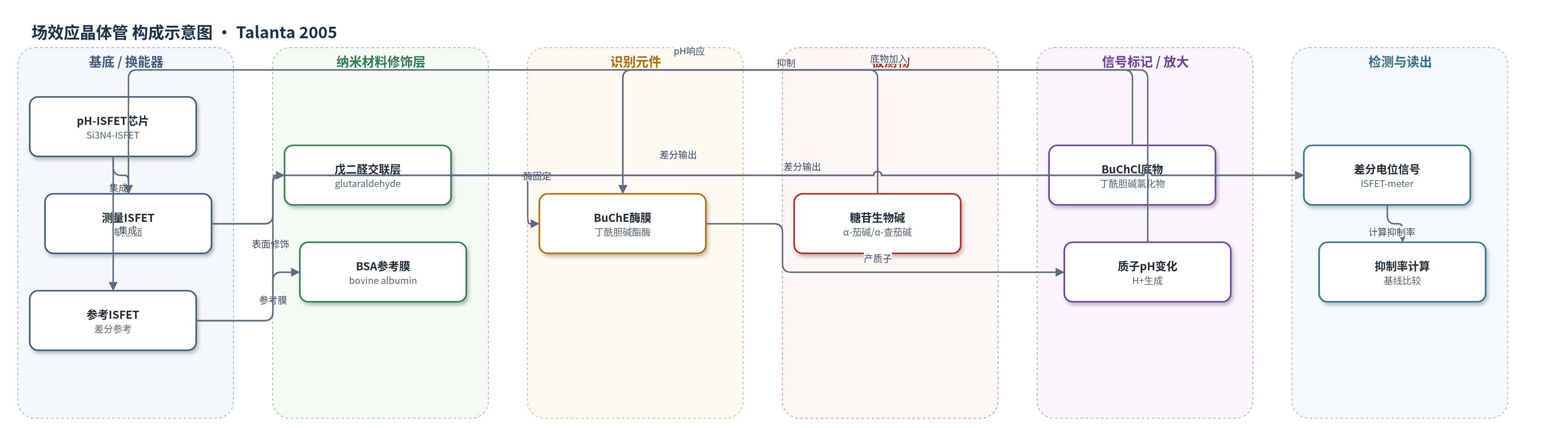
点击图片查看大图 · 依据论文自动绘制
传感器类型
场效应晶体管(FET)生物传感器
检测对象
总糖苷生物碱(potato glycoalkaloids,主要为 α-茄碱 α-solanine 和 α-查茄碱 α-chaconine);样品基质:马铃薯汁、马铃薯块茎组织或植物材料悬浮液
检测原理
传感器以 BuChE 为识别元件,糖苷生物碱作为可逆抑制剂与 BuChE 作用,降低其催化活性。测量时先加入丁酰胆碱氯化物(BuChCl),BuChE 催化其水解并释放质子,使酶膜附近 pH 下降;pH-ISFET 的 Si3N4 敏感膜对 H+ 电位响应(约 40 mV/pH),将 pH 变化转换为差分电位信号。样品中糖苷生物碱浓度越高,BuChE 被抑制程度越大,底物水解产质子速率越低,稳态电位变化越小。通过比较加入样品前后的酶响应,计算抑制率,并按 α-查茄碱/α-茄碱 1:1 标准曲线换算总糖苷生物碱浓度。检测后缓冲液洗涤即可再生。
检测灵敏度
LOD: α-查茄碱 0.2 μM;α-茄碱 0.5 μM;检测范围: 0.2–100 μM(依生物碱类型);总糖苷生物碱准线性范围: 1/1 混合物低于 2 μg/ml,2 μg/ml 时抑制率 48%
效应效果
该传感器可直接用于未经前处理的马铃薯汁或植物材料悬浮液,与标准前处理 HPLC 法测定不同品种总糖苷生物碱含量呈良好相关;差异部分源于 HPLC 提取不完全定量。重现性良好,Producent Rubempré 品种 20 次测定 RSD 约 3%。操作漂移约 1%/天,4 ℃、5 mM 磷酸盐缓冲液(pH 7.2)中储存稳定超过 3 个月。糖苷生物碱抑制可逆,缓冲液洗涤 10 min 可恢复基线;若与农药共存,可通过洗涤前后不可逆抑制区分。方法成本低、操作简便、分析时间短,适合大量品种快速筛查。还可显示皮层含量高于果肉(Agata 皮 234 mg/kg、肉 105 mg/kg),芽眼附近皮层可高于无芽眼皮层 2 倍以上,去皮可去除 60–96% 糖苷生物碱。
传感器的构成
- 基底/换能器:Si3N4-ISFET 芯片,含测量与参考两个 pH-ISFET,将界面 pH 变化转换为差分电位信号
- 识别元件:丁酰胆碱酯酶(BuChE,EC 3.1.1.8,马血清来源),催化底物水解并受糖苷生物碱可逆抑制
- 交联固定层:戊二醛(glutaraldehyde)蒸气与牛血清白蛋白(BSA,bovine albumin)交联,将 BuChE 固定于 ISFET 敏感面
- 成膜助剂:甘油(glycerol)与 20 mM 磷酸盐缓冲液(pH 7.2)组成酶膜,辅助成膜并维持酶活性
- 底物/信号源:丁酰胆碱氯化物(BuChCl),酶催化水解产生质子,引起局部 pH 变化
- 参考通道:参考 ISFET 上固定牛血清白蛋白/甘油膜,与测量 ISFET 差分输出以抑制基线漂移
- 工作介质:5 mM 磷酸盐缓冲液(pH 7.2),作为测量介质和再生洗涤液
中文摘要
本文报道了一种基于 pH 敏感离子敏感场效应晶体管(pH-ISFET)的酶生物传感器,用于直接测定真实马铃薯样品中总糖苷生物碱含量,无需任何样品前处理。该传感器以丁酰胆碱酯酶(BuChE)为识别元件,利用糖苷生物碱对 BuChE 的抑制作用,通过酶催化丁酰胆碱底物产生质子引起界面 pH 变化,由 pH-ISFET 电位法读出。对来自不同实验品种的马铃薯样品,生物传感器测得的总糖苷生物碱浓度与采用标准复杂前处理的高性能液相色谱(HPLC)法结果呈良好相关。检测可重复,相对标准偏差约 3%。利用该传感器还研究了总糖苷生物碱含量在马铃薯块茎不同部位、不同大小及不同种植区域中的分布差异。该方法成本低、操作简便、分析时间短,可直接用于马铃薯汁甚至马铃薯或植物材料悬浮液,适用于多种马铃薯品种总糖苷生物碱含量的快速筛查。传感器操作与储存稳定性良好,漂移低于 1%/天,响应可稳定保持 3 个月以上。
英文摘要
The applicability of an enzyme biosensor based on pH-ISFETs for direct determination of total glycoalkaloids content in real potato samples, without any pre-treatment, is shown. The results of determination of the total glycoalkaloids concentrations in potato samples from different experimental varieties obtained by the biosensor are well correlated with the analogous data obtained by the HPLC method with standard complex sample pre-treatment procedure. The detection of total glycoalkaloids content by biosensors is reproducible, the relative standard deviation was around 3%. The dependence of total glycoalkaloids content on various parts of the potato tuber and their size, different growing area has been shown using the biosensor developed. The method based on biosensors is cheap, easy to operate and requires a shorter analysis time than the one needed using traditional methods for glycoalkaloids determination. The biosensor can operate directly on potato juice, or even directly on a suspension of potato or plant material. It can provide a way to save time and costs, with a possibility of taking rapid assessment of total glycoalkaloids content in a wide variety of potato cultivars. Furthermore the operational and storage stability of this biosensor are quite good with a drift lower than 1% per day and response being stable for more than 3 months.