组成图示
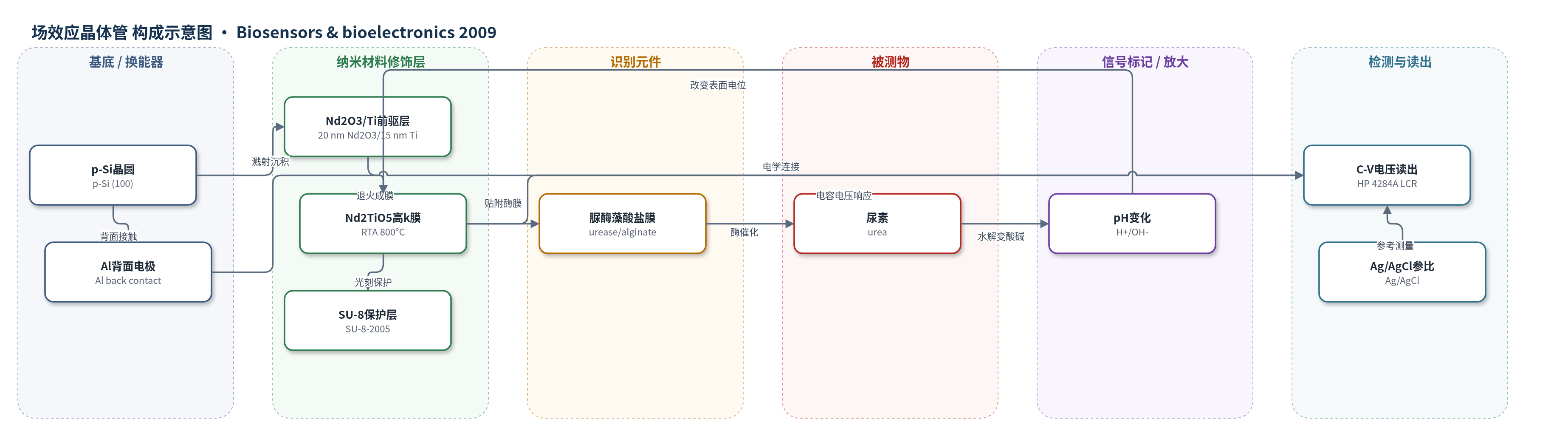
点击图片查看大图 · 依据论文自动绘制
传感器类型
场效应晶体管(FET)生物传感器
检测对象
pH(H+浓度,标准缓冲液)、尿素(urea,PBS标准溶液/拟用于血清)
检测原理
该器件以Nd2TiO5高k绝缘膜作为pH敏感界面。溶液中的H+或OH-与膜表面羟基发生质子化/去质子化,改变表面电荷与表面电位,使EIS电容的平带电压发生移动,通过C–V曲线参考电压读出。800°C退火形成较薄低k界面层并提高表面粗糙度,增加表面位点密度,从而提高灵敏度。尿素检测时,藻酸盐膜中脲酶催化尿素水解:NH2CONH2+3H2O→2NH4+ + OH- + HCO3-,局部pH随尿素浓度升高而改变,再由EIS将pH变化转换为电压响应,实现间接定量。
检测灵敏度
pH灵敏度: 57.2 mV/pH;pH范围: 2–12;尿素线性范围: 3–40 mM;尿素灵敏度: 9.52 mV/mM;R^2 = 0.99
效应效果
800°C退火器件在pH 2–12范围内表现出最优性能:pH灵敏度57.2 mV/pH,滞后电压2.33 mV,漂移率1.80 mV/h;pH检测RSD为2.19%(n=6),滞后评估RSD约4.05%–4.11%,满足一般传感器件要求。尿素传感器在3–40 mM范围内线性良好(R2=0.99),灵敏度9.52 mV/mM,覆盖血清尿素常规临床检测范围。藻酸盐酶膜可物理贴附并更换,有利于一次性或可更换式尿素生物传感器应用。
传感器的构成
- 基底/换能器:p型(100) Si晶圆(5–10 Ω cm),作为EIS电容的半导体基底与换能器。
- 背面电极:约4000 Å Al薄膜,作为Si背面接触电极。
- 前驱绝缘层:约20 nm Nd2O3反应溅射层,提供稀土氧化物组分。
- 前驱金属层:约15 nm Ti溅射层,与Nd2O3经RTA反应形成Nd2TiO5。
- 高k传感膜:Nd2TiO5薄膜(600–900°C RTA 30 s),作为pH敏感绝缘层。
- 保护/定义层:SU-8-2005光敏环氧,光刻定义传感膜区域并起抗酸保护。
- 酶识别层:脲酶(urease,Jack Beans)包埋于藻酸盐(alginate)水凝胶薄膜(约1 mm),固定识别元件并催化尿素水解。
- 封装/引线:PCB铜线、银胶(silver gel)与环氧封装,形成导电连接与器件封装。
中文摘要
为提高pH检测灵敏度,本文提出在硅基底上通过反应溅射和沉积后退火制备Nd2TiO5薄膜的电解质–绝缘体–半导体(EIS)器件。采用X射线衍射、X射线光电子能谱和原子力显微镜研究600、700、800和900°C退火对Nd2TiO5薄膜结构特性的影响,并将结构性质与pH传感性能关联。在酶场效应晶体管尿素生物传感中,将固定脲酶的藻酸盐薄膜贴附于Nd2TiO5传感膜上,构建混合结构。800°C退火EIS器件表现出57.2 mV/pH的pH检测灵敏度、2.33 mV的滞后电压和1.80 mV/h的漂移率,优于其他退火温度,归因于氧化物/硅界面形成更薄低k界面层及更高表面粗糙度。尿素传感器在3–40 mM范围内线性良好(R2=0.99),灵敏度为9.52 mV/mM,可满足血液尿素常规临床检测需求。
英文摘要
For high sensitive pH sensing, an electrolyte-insulator-semiconductor (EIS) device with Nd(2)TiO(5) thin layers fabricated on Si substrates by means of reactive sputtering and the subsequent post-deposition annealing (PDA) treatment was proposed. In this work, the effect of thermal annealing (600, 700, 800, and 900 degrees C) on the structural characteristics of Nd(2)TiO(5) thin layer was investigated by X-ray diffraction, X-ray photoelectron spectroscopy, and atomic force microscopy. The observed structural properties were then correlated with the resulting pH sensing performances. For enzymatic field-effect-transistors-based urea biosensing, a hybrid configuration of the proposed Nd(2)TiO(5) thin layer with urease-immobilized alginate film attached was established. Within the experimental conditions investigated, the EIS device with the Nd(2)TiO(5) thin layer annealed at 800 degrees C exhibited a higher pH detection sensitivity of 57.2 mV/pH, a lower hysteresis voltage of 2.33 mV, and a lower drift rate of 1.80 mV/h compared to those at other annealing temperatures. These results are attributed to the formation of a thinner low-k interfacial layer at the oxide/Si interface and the higher surface roughness occurred at this annealing temperature. Furthermore, the presented urea biosensor was also proved to be able to detect urea with good linearity (R(2)=0.99) and reasonable sensitivity of 9.52 mV/mM in the urea concentration range of 3-40 mM. As a whole, the present work has provided some fundamental data for the use of Nd(2)TiO(5) thin layer for EIS-based pH detection and the extended application for biosensing.