组成图示
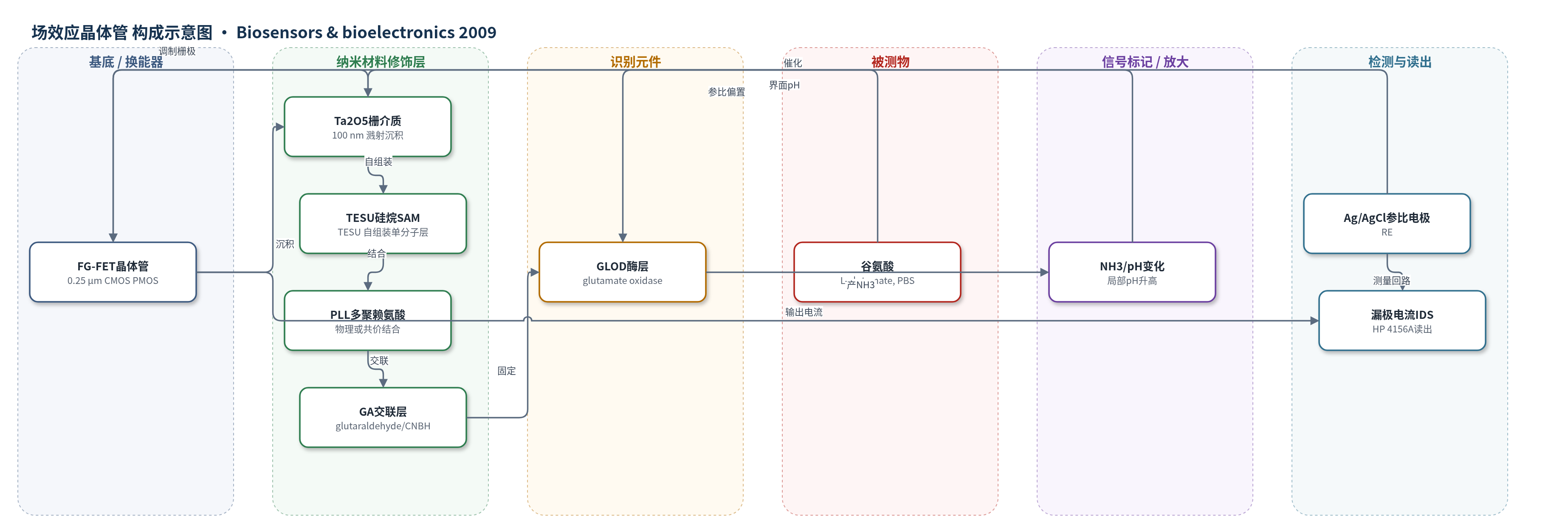
点击图片查看大图 · 依据论文自动绘制
传感器类型
场效应晶体管(FET)生物传感器
检测对象
L-谷氨酸(L-glutamate, Glu);样品基质:PBS缓冲液(150 mM,pH 7),面向体外神经元释放检测
检测原理
谷氨酸氧化酶(GLOD)作为识别与催化元件,选择性催化L-谷氨酸氧化,生成α-酮戊二酸、H2O2和NH3/NH4+。反应在Ta2O5传感界面附近产生局部pH升高,使Ta2O5表面羟基发生去质子化,改变表面电荷与浮栅FET的等效栅极电位。对于p沟道FG-FET,去质子化导致漏极电流IDS增大。谷氨酸浓度越高,单位时间内产生的NH3越多,局部pH变化越大,IDS变化越大。信号通过Ag/AgCl参比电极和参数分析仪在恒压偏置下读出,酶催化与FET跨导共同实现放大。
检测灵敏度
LOD: 10−7 M;动态范围: 100 nM–500 μM;pH灵敏度: ΔIDS/ΔpH = 55.4 ± 8.14 μA;gm ≈ 1.2 mS (pH 7)
效应效果
该传感器对谷氨酸具有选择性,100 μM天冬氨酸未引起显著电流响应;文献中GLOD对谷氨酸与天冬氨酸的相对活性分别为100%和0.6%。酶负载为571.7±69.5 ng/cm2,比色法推算活性酶约525 ng/cm2,约91.8±12%保持活性。表面化学在4°C Tris缓冲液中至少稳定一个月,TESU层在约50天后仍优于无TESU表面;干燥储存10天后酶活性降至最低,Tris储存优于PBS。基线漂移较慢,短时间检测中可忽略,响应在溶液切换后数秒内出现。作者认为该ENFET可用于体外谷氨酸检测,并通过更换酶系统扩展至其他神经递质。
传感器的构成
- CMOS浮栅晶体管:0.25 μm p沟道FG-FET(PMOS,W/L=100,传感区10 μm),作为电荷敏感换能器并输出漏极电流
- 栅介质层:100 nm Ta2O5(五氧化二钽)DC反应溅射沉积,提供pH敏感表面位点并锚定表面化学
- 硅烷自组装层:2% TESU(11-triethoxysilylundecanal)SAM,形成有序界面以提高酶固定效率与稳定性
- 多聚赖氨酸层:PLL(poly-l-lysine)直接吸附或经CNBH共价结合至TESU,作为酶结合与交联层
- 交联醛化层:GA(glutaraldehyde)与CNBH处理,将PLL游离氨基转化为醛基以实现GLOD共价固定
- 识别催化层:GLOD(glutamate oxidase)固定于表面,催化谷氨酸氧化并产生NH3与H2O2
- 参考电极:Ag/AgCl RE,与FG-FET构成四端测量结构并提供稳定电位参考
- 封装保护层:Epotek H54环氧树脂保护电连接,防止液体暴露
中文摘要
神经递质释放是大脑化学信使的关键,快速、灵敏且原位检测单细胞神经递质释放对研究生理或病理条件下的突触传递至关重要。由于突触传递中释放的分子数量有限且释放后扩散与再摄取迅速,谷氨酸等神经递质检测仍具挑战。微电子生物传感器的发展使多种分析物的高灵敏、高选择性快速检测成为可能,其中酶修饰场效应晶体管(ENFET)因响应快、尺寸小且可在同一芯片集成大量传感器而具有吸引力。本文报道了一种涂覆谷氨酸氧化酶(GLOD)层的浮栅场效应晶体管(FG-FET)传感器。通过优化表面化学实现最大酶负载和长期稳定性,并用石英晶体微天平(QCM)和比色法表征。多聚-L-赖氨酸(PLL)结合戊二醛(GA)的表面酶负载最高,且在4°C Tris缓冲液中至少稳定一个月。GLOD修饰FET的谷氨酸检测限为10^-7 M,且仅对谷氨酸选择性响应。该传感器是体外检测谷氨酸的有前景工具,并可扩展至其他神经递质。
英文摘要
Neurotransmitter release is the key factor of chemical messaging in the brain. Fast, sensitive and in situ detection of single cell neurotransmitter release is essential for the investigation of synaptic transmission under physiological or pathophysiological conditions. Although various techniques have been developed for detecting neurotransmitter release both in vitro and in vivo, the sensing of such events still remains challenging. First of all, the amount of neurotransmitter released during synaptic transmission is unknown because of the limited number of molecules released and the fast diffusion and reuptake of these molecules after release. On the other hand, advances in microelectronic biosensor devices have made possible the fast detection of various analytes with high sensitivity and selectivity. Specifically, enzyme-modified field-effect (ENFET) devices are attractive for such applications due to their fast response, small dimensions and the possibility to integrate a large number of sensors on the same chip. In this paper, we present a floating-gate FET device coated with glutamate oxidase (GLOD) layer. The surface chemistry was optimized for maximal enzyme loading and long-term stability, and characterized by quartz crystal microbalance and colorimetric assays. Enzyme loading was largest on poly-L-lysin-based surfaces combined with glutaraldehyde. The surface chemistry showed excellent stability for at least one month in Tris buffers stored at 4 degrees C. A glutamate detection limit of 10(-7) M has been obtained with the GLOD-coated FET and our sensor proved to be selective to glutamate only. We show that this biosensor is a promising tool for the in vitro detection of glutamate and can be extended to other neurotransmitters.