组成图示
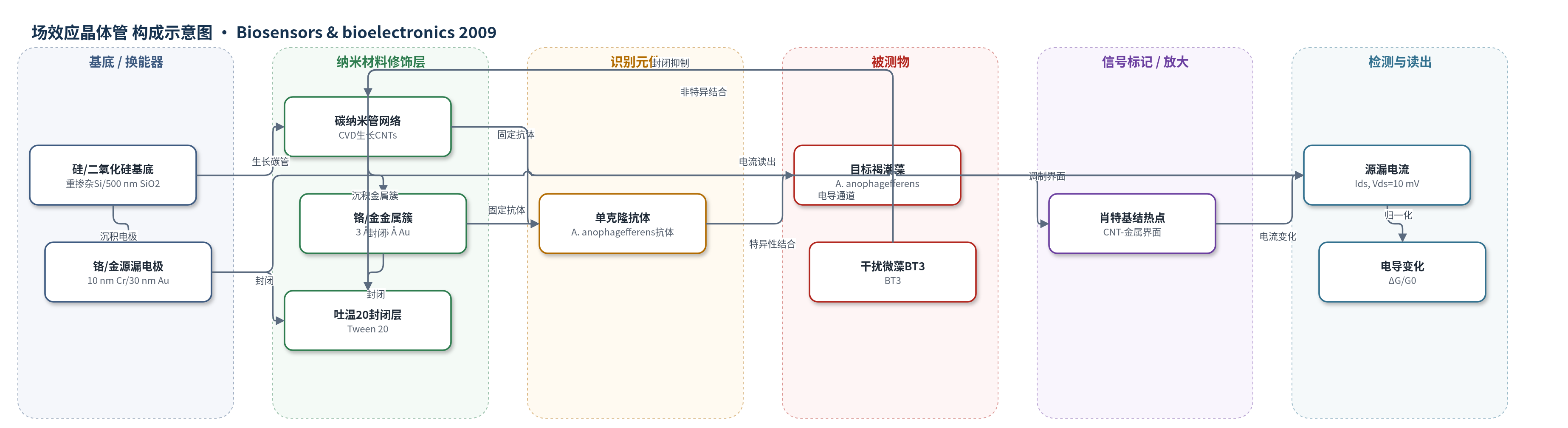
点击图片查看大图 · 依据论文自动绘制
传感器类型
场效应晶体管(FET)生物传感器
检测对象
Aureococcus anophagefferens(A. anophagefferens,褐潮藻)、BT3(干扰微藻)、链霉亲和素(streptavidin, SA);样品基质:PBS缓冲液(pH 7.4, 0.14 M NaCl)中的藻细胞悬液/蛋白溶液
检测原理
该传感器为无标记碳纳米管场效应/电导型生物传感器。重掺杂Si/SiO2基底上的CNT网络作为导电通道,Cr/Au源漏电极施加10 mV源漏电压,Pt线接地。电子束蒸发的Cr/Au金属簇在CNT表面形成大量金属-CNT肖特基结热点,使蛋白或细胞吸附对界面势垒和载流子输运的调制更显著,从而将链霉亲和素灵敏度提高2000倍。目标A. anophagefferens与固定MAb特异性结合后,抗体-细胞复合物及细胞膜生物分子覆盖/扰动肖特基结,引起源漏电导下降;浓度越高,电导下降越明显。Tween 20封闭非特异位点,抑制BT3结合,提高选择性。
检测灵敏度
LOD: 10 pM;LOD: 低于10^4 cells/ml;检测范围: 至10^6 cells/ml;灵敏度增强: 2000-folds
效应效果
金属簇修饰使链霉亲和素灵敏度提高2000倍:10 pM约1%电导下降,100 pM约3%;未修饰器件2 nM无响应,20 nM约4%。MAb功能化后,10^4 cells/ml A. anophagefferens响应约2%,无MAb仅约0.5%。MAb+Tween 20下,8×10^5 cells/ml BT3几乎无响应,随后A. anophagefferens降约2%,选择性良好。至少3个器件行为一致,电阻均值31.20 kΩ、标准差8.32 kΩ,56%在20–60 kΩ,良率100%。相比免疫荧光/ELISA,分析约10 min,紧凑、低成本、无标记、实时,检测范围至10^6 cells/ml。
传感器的构成
- 基底/绝缘层:重掺杂Si晶圆/500 nm SiO2 (Si/SiO2),提供机械支撑与绝缘
- 换能通道:碳纳米管网络 (CNTs),Fe纳米颗粒催化CVD生长,作为导电通道
- 源漏电极:10 nm Cr/30 nm Au,经Cu阴影掩模沉积,形成源漏接触
- 通道保护/刻蚀掩模:聚甲基丙烯酸甲酯 (PMMA),覆盖通道区并辅助氧等离子刻蚀去除多余CNT
- 金属簇修饰层:3 Å Cr/5 Å Au金属簇,电子束蒸发沉积,形成CNT-金属肖特基结热点以提高灵敏度
- 识别元件:A. anophagefferens单克隆抗体 (MAb),经疏水作用固定,特异性捕获目标藻细胞
- 封闭剂:Tween 20,封闭暴露CNT、金属簇和金属接触,抑制BT3非特异结合
- 测量介质/参考电极:PBS (pH 7.4, 0.14 M NaCl) 与Pt线,提供溶液环境并接地
中文摘要
本文报道了一种用于藻细胞快速无标记检测的金属簇修饰碳纳米管生物传感器。器件在完整4英寸晶圆上制备:先在重掺杂Si/SiO2基底上通过化学气相沉积生长碳纳米管网络,再用阴影掩模沉积Cr/Au源漏电极;随后电子束蒸发3 Å Cr和5 Å Au形成金属簇。金属簇与碳纳米管形成肖特基结,激活碳纳米管通道,使链霉亲和素检测灵敏度提高2000倍,最低可检测10 pM。利用该传感器对两种褐潮相关藻Aureococcus anophagefferens和BT3进行实时电导检测。以A. anophagefferens单克隆抗体功能化后,可在10^4 cells/ml浓度下检测到目标藻,基于信噪比预计灵敏度可低于10^4 cells/ml。进一步用Tween 20封闭可抑制BT3非特异结合,实现A. anophagefferens的无标记、选择性检测。该纳米生物传感器有望用于环境监测和疾病诊断。
英文摘要
In this paper, the use of carbon nanotube biosensors toward alga cell detection was examined. The biosensor devices were fabricated on complete 4 in. wafers by first growing carbon nanotubes (CNTs) and then depositing metal electrodes using a shadow mask. In addition, we decorated the biosensors with metal-clusters resulted in enhancing the sensitivity by 2000-folds and has enabled the detection of streptavidin down to 10 pM concentration. This sensitivity enhancement was attributed to activation of CNT channels due to formation of Schottky junctions between CNTs and metal-clusters. Real-time cell detection has been successfully carried out using the CNT biosensors for two kinds of alga related to brown tides: Aureococcus anophagefferens and BT3. Functionalization of the CNT biosensors with the monoclonal antibody for A. anophagefferens has led to detection at a concentration of 10(4) cells/ml, with sensitivity lower than 10(4) cells/ml projected based on the signal-to-noise ratio of the sensors. Further functionalization with tween 20 led to suppression of non-specific binding of BT3 and enabled label-free and selective detection of A. anophagefferens. These nanobiosensors may find potential applications for environmental monitoring and disease diagnosis.